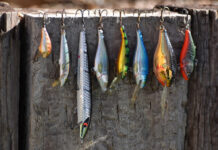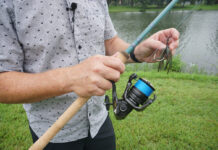
Buzzbaits, topwater poppers and slash baits are called reaction baits. Cast them out, reel them in and the lure does the work. But there’s another class. Finesse fishing lures require slow-retrieve, light touch and precise presentation. When the fish have lockjaw, pros bust out their finesse skills. Whether targeting freshwater bass, saltwater bass, redfish, sea trout or walleye, mastering the slow approach can result in fast action.
Smallmouth Bass
 War Eagle Finesse Spinnerbait

$7.79 | wareaglelures.com
To find big smallmouth in dirty water, Hobie pro Jody Queen rolls a spinnerbait over rocks and logs. “Especially in muddy water,” he adds. Queen picks a 5/16-ounce War Eagle Finesse Spinnerbait with gold Hildebrandt Colorado blade and a dark brown pumpkin or green pumpkin skirt. “Drag it over logs and rocks then let it drop to the bottom,” he explains. The spinner blades and skirt keep the lure from snagging. He says, “Use a slow, bottom-bouncing retrieve.”
Largemouth Bass

Yamamoto Senko
$7.89 | baits.com
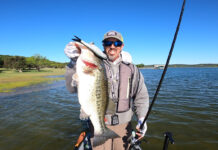
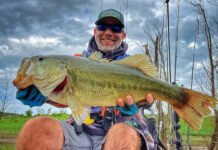
Wherever Chad Hoover casts his bait, the globe-trotting angler relies on a Yamamoto Senko. “It’s the ultimate do-nothing lure,” Hoover laughs. And in our rankings of the best bass fishing lures, it was crowned the top soft-plastic stick bait. A Senko can be rigged weedless, weightless, wacky, Texas rig or Carolina rig. Imitating a worm helplessly falling through the water, the Senko looks like an easy meal to largemouth bass. The tactic is especially effective when it is cast to overhanging banks and under cover. Gary Yamamoto Custom Baits are hand inspected and built of the best materials. “The Senko flat-out catches fish,” Hoover says.
Speckled Trout

MirrOlure MirrOdine
$8.67 | shopmirrolure.com
From the Gulf Coast to the mid Atlantic, speckled trout anglers take slow baits to the next level.
MirrOlure’s line of MirrOdine twitch baits take a light hand and steely patience to entice gator trout. Cast out the lure and let it sink for 10 to 15 seconds. Then slash the rod tip one or two times before letting the lure pause up to 20 seconds. Timing the sink and the pause are part of the touch. But the real fun is hooking a light-biting trout on a finesse lure. At the slightest tap, come tight on the line and set the hook, trout don’t chew on their food for long.
Striped Bass

Hogy HDUV
$12.95 | hogylures.com
When Eric Harrison knows big striped bass are in the area, but he can’t get a bite, he switches to a super slow presentation with a light lure. One of his favorites is a nine-inch Hogy HDUV tail on a ½-ounce jighead. HD stands for heavy duty. Hogy uses super strong yet subtly soft plastic. The UV means the lure is infused with ultraviolet pigments that are more visible at night. Harrison says, “I slowly drag it on the bottom, careful not to get it caught in the rocks.” The light jig helps the lure avoid snags. Between slow turns of the reel handle, Harrison pauses for three seconds. “It’s hard to work the lure so slow,” he jokes.
Walleye

Rapala Jigging Rap
$6.39 | rapala.com
When walleye hold tight to the bottom, Al Linder, host of Angling Edge television series, gives them something different. “You gotta try this,” he says in a video about Rapala’s Jigging Rap. Usually an ice-fishing lure, Linder says the Jigging Rap is great for deep water jigging summer walleye. “Anytime I’m marking fish below 18 feet, I can use the Jigging Rap,” Linder says. The unique lure features a hook at the front and one on the rear with a treble dangling from the middle. Linder works the lure by slowly moving ahead and jerking the lure off the bottom. “The jig works best in sandy or soft bottom,” Linder points out, rocks and other structure will cause it to snag.
Spotted Bay Bass

A Band of Anglers Hyperlastics Dartspin
$7.50 | abandofanglers.com
World-traveling adventure angler Jim Sammons needs one bait he can use anywhere. “Lately, I’ve been using Band of Anglers Hyperlastics Dartspin,” he says. Designed by legendary lure guru, Patrick Sabile, the Dartspin is a rubber jig with a willow blade attached to the tail. “Use it weightless, with a jighead or weighted worm hook” Sammons suggests. He’s caught everything from bass to tuna, “my friend even caught a marlin on one recently,” he says. Molded out of SofTough material free of PVC, Phthalates or plastisol, the biodegradable Dartspin floats and will suspend horizontally. Sammons says, “The blade begins spinning at a slow speed so it works great on the sink, slow retrieve and stop and go.”
[ Browse the widest selection of boats and gear in the Kayak Angler Buyer’s Guide ]

This article was first published in the Early Summer 2020 issue of Kayak Angler Magazine. Subscribe to Kayak Angler Magazine’s print and digital editions, or browse the archives.
Pros bust out their finesse fishing lures when the fish have lockjaw. | Feature photo: Ric Burnley