
Everyone has been at the end of a long fishing trip, stuck miles from home, facing an opposing current and headwind. Most of us grin and bear it, wishing we had a small motor to help with the work. When Houman Nikmanesh and Damon Borich were caught in a kayak offshore, they didn’t just dream of an easy way home, these innovators developed compact jet motors to do the job.
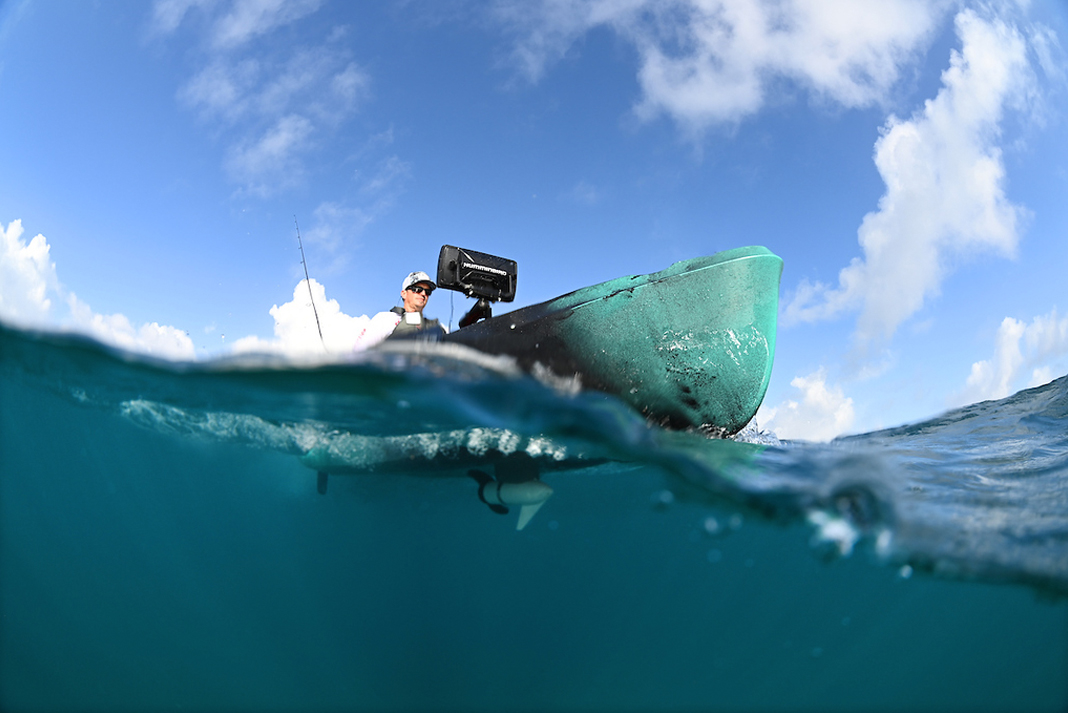
Need for Speed? Attach a Jet Engine to Your Kayak
Meet the Jetsons
Houman Nikmanesh was in a kayak five miles off the coast of San Diego when he dreamed up the Bixpy motor. “I had no experience in kayak propulsion,” Nikmanesh laughs, but he is a high-level tinkerer with a degree in shade tree engineering.
Working with a team of engineers, Nikmanesh developed the Bixpy motor, a compact impeller that attaches to almost any paddlecraft in minutes. “Our ignorance helped us turn over rocks others with more experience ignored,” Nikmanesh says.
The key to the system is the impeller. An impeller forces water through a tunnel to get more power out of smaller blades. Think of a jet engine compared to a prop plane.

Down in the Lone Star State, Damon Borich, the owner of Texas Power Paddle, has a similar story. He and his wife got stuck off the Gulf Coast when a headwind kicked up. “I thought, there has to be a better way.”
Borich has a background in robotics, automation and electronic instrumentation with a fascination for electric motors. His experience led to the invention of Texas Power Paddle, a small impeller that retracts into the kayak hull. “We focused on making the motor light and unobtrusive so I still get the experience of kayaking.”

Who Needs It?
Captain Matt Murphy, at No Wake Coastal Guide Service, uses Texas Power Paddle to assist paddling or pedaling and provide hands-free control while fishing. “The motor helps my clients go farther and fish harder,” he explains.
Not to say a motorized impeller isn’t for serious fishing. Tournament angler Jonathan Pingilley appreciates the low-profile design and efficiency of the motor, using it to zoom to the fishing spot and hold his kayak in position while he’s casting. “I can reach unpressured spots before the rest of the crowd and focus on fishing instead of maneuvering the kayak,” he says.
Both pros say their small motors are perfect for anglers who want the confidence of a motor without losing the pedaling or paddling experience. Murphy says, “I can’t even tell the motor is there.”
The Best Part
Installation is one of the big advantages of an auxiliary motor. Not only are the motors and batteries smaller, but there are more options for attaching the motor to the kayak.
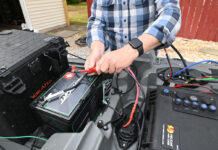
An impeller is about the size and shape of a football. The battery pack comes in a watertight suitcase and weighs less than 10 pounds. The battery connects to the motor with a single wire and a handheld remote controls speed, forward and reverse.
The most common installation is simply attaching the motor to the kayak’s existing rudder. Matt Murphy says, “All you need is a Phillips screwdriver.”
Jonathan Pingilley connects the motor to the through-hull pod on his Feelfree Moken 10 V2. “I can quickly remove the motor and move it to another kayak,” Pingilley adds. This setup also allows him to steer with the Moken’s large rudder. Going from motoring to paddling only takes a few seconds.
To install the motor on a standup paddleboard, use an adapter to connect the motor to the fin box and use the paddle as a rudder. For an inflatable kayak, glue a mount to the bottom of the boat. Another option is attaching the motor to a tiller. With dozens of adapters and mounting bases, there’s a way to attach an auxiliary motor to any paddlecraft.
Texas Power Paddle offers a mounting option allowing the motor to retract into the kayak hull. Matt Murphy points out, “I get the most out of the motor and still maintain the kayak’s paddling or pedaling performance.” His clients can paddle or pedal until they are tired, then hit a button and motor home.
Where Ya’ Going?
Matt Murphy sums up the best use for a small motor: “An auxiliary motor is there when you need it and not there when you don’t,”
On its own, at full speed, Murphy says the auxiliary motor pushes three or four miles per hour but the battery may only last a few hours. To fish all day, Murphy says the best practice is running the motor at half-speed.

For Jonathan Pingilley, the auxiliary motor is an important part of his tournament strategy. “I can use the motor to hold my kayak while I fish a bank,” he says. Using the motor to maneuver his boat allows him to concentrate on fishing and let the motor do the work. “I’m not wasting time and energy,” he explains.
Both anglers point to shallow-water performance as the big draw. Matt Murphy says, “I fish super shallow for redfish.” Not only does the auxiliary motor draft less water, but he can fold it out of the way.
For tournament angler Jonathan Pingilley, the small, unobtrusive motor puts him ahead of the competition. “The Bixpy motor immerses me in my surroundings, I can focus on my electronics and reach unpressured spots before anyone else.”
Both anglers agree, the price of a jet motor makes it very enticing. Pingilley says, “When I started tournament fishing, I didn’t have a lot of money and Bixpy caught my eye.” At about $1,300 for the base-level motor, battery and controls, the jet impeller is less expensive than a trolling motor or electric outboard. “Now I value the motor for its versatility,” Pingilley says.
View the Latest from Texas Power Paddle and Bixpy at ICAST 2023:

Versatile, compact power. | Feature photo: Courtesy Bixpy



What about the PAC-Motor?
The ones you reviewed seem more enclosed propeller (impeller) systems than jet-driven.
I mean… sure, why not?!