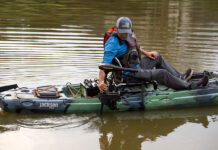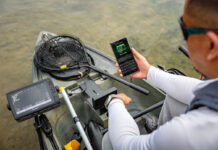
Installing an electric outboard on the stern of my Bonafide PWR129 required a screwdriver and four screws. To add a trolling motor to the bow, I spent 15 minutes turning a half dozen bolts. Attaching the fish finder display and transducer required drilling two holes. Mounting my motors and electronics was easy, but connecting to the power source was complicated. To ease the process, and avoid a fire, I reached out to kayak fishing guide Chuck Earls, tournament angler Steven Johnson and rigging guru Chad Hoover for expert advice and safety control.
How to Connect Electronics, Lights and Motors to Batteries
Cable Guy
Modern fishing kayaks have space for motors, huge hatches, ample storage for batteries and removable panels to assist running wires below deck.
After I installed the main components above deck, I set out to connect my accessories to the batteries. Chuck Earls recommends heavier gauge wire than provided by manufacturers. “Most trolling motors use eight gauge wire, but I use six gauge marine-grade, tinned wire to prevent the wire from heating up and melting.”
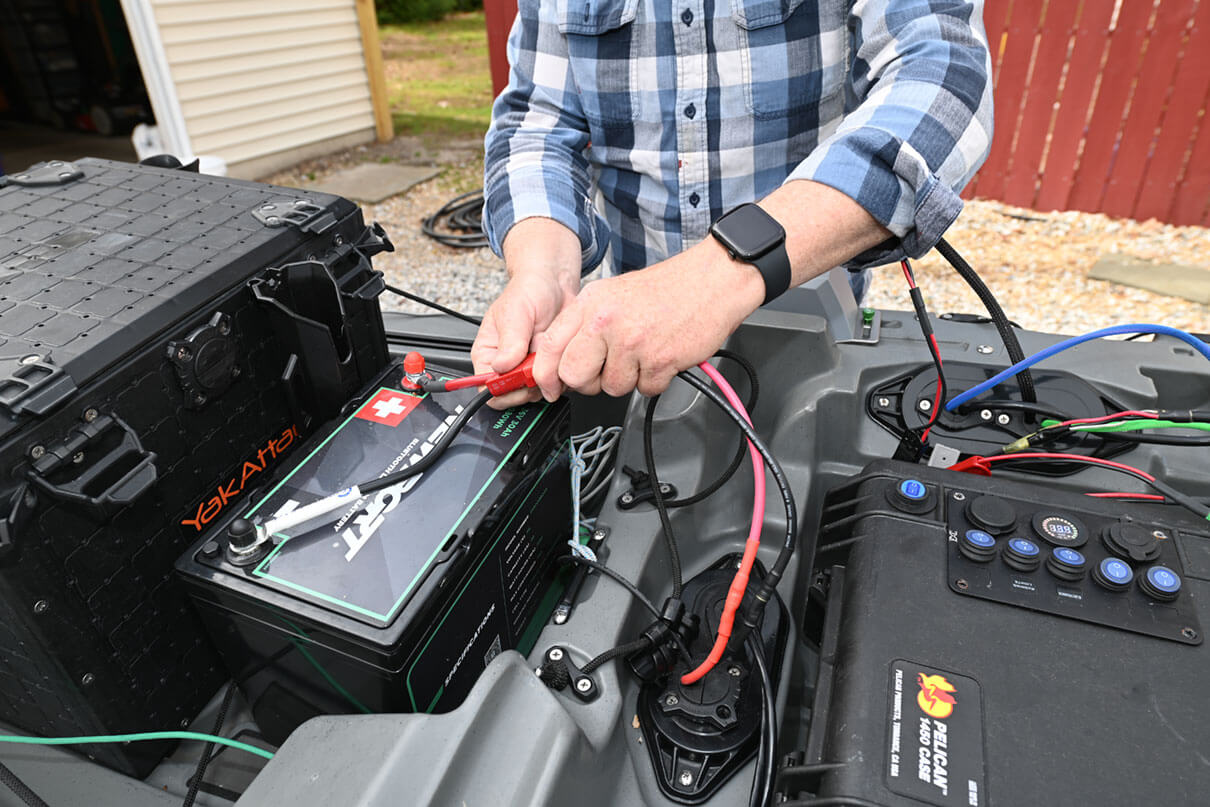
Running wires through the hull requires YakAttack GridLoc through-hull ports. The ports have rubber flappers filling the gap around the wire. The system is water resistant but Earls applies super glue to the joints to further prevent water from entering the hull. “Then I seal the back of the cover with silicone,” he adds.
To route wires through the hull, Earls uses zip ties with mounting holes and existing through bolts. Excess transducer and control wires are coiled and zip tied.
Short Fuse
Installing the components and running the wire is just the beginning. Connecting accessories to the battery and controlling the power is the key to a reliable system. Earls is a DIY purist. “I buy wire, fuses and connectors to build the system myself,” he says.
He runs his lights, chargers and camera power to a fuse panel controlled by a remote switch. He explains, “The remote allows me to control my lights without cutting a big hole in the kayak for a switch panel.”
Chad Hoover warns against using poor-quality switches and fuses. He reminds us, “A circuit breaker accurately detects a short or failure in the system.” Before a device can overheat or spark, the breaker disconnects power. “Using a cheap fuse is asking for trouble,” he adds.
Steven Johnson uses a complete switching system by YakPower. “The eight-circuit power panel is a marine-grade plug-and-play system removing the complexity of rigging wires and buying switches,” he says. The system allows Johnson to install the circuits below deck, mount switches on an access panel near his seat and place the battery in a cargo compartment.
Assault and Batteries
Johnson powers his electronics and accessories with a 12-volt, 33-amp-hour Lithium Pros battery in a removable gear pod attached to the bow of his NuCanoe Unlimited. “I run all my electronics and lights off the bow battery,” he says. The battery and controls are connected to his electronics with a quick connection so the battery is easy to remove.
To run his trolling motor and Power-Pole Micro anchor, Johnson uses a 12-volt 100-amp-hour lithium iron battery stored behind his seat. “The heavy battery is mounted close to the center of the boat to balance the weight,” he says.

On Chad Hoover’s Bonafide PWR129, he uses a 36-volt and 12-volt battery. He places both batteries in a YakAttack BlackPak. The 36-volt battery is dedicated to his Lowrance Recon trolling motor. The 12-volt powers electronics and lights.
After interviewing the experts, reading blogs and watching videos, I employed a combination of advice to design my power system. Taking advantage of the powerful Dakota Lithium 36-volt, 60-amp-hour battery, I hooked up my Newport NK300 battery and, through a step-down transformer, also powered my MotorGuide Xi3 trolling motor. To power my electronics and navigation lights, I use a Connect-Ease Yak-Ease Power Pak Pro with a Dakota Lithium 12-volt, 30-amp-hour hour battery and eight switches in a Pelican dry case. My system is different from the experts but achieves the same result, safely and efficiently powering my motors and accessories.

Through hull ports, Anderson connectors and pre-rigged switches make installation easier. | Feature photo: Dasha Burnley