
Kayak fishing guide Brandon Barton was out with a client off of Pensacola Beach, Florida, in early September fishing for red snapper. He had been keeping an eye on a distant storm when the wind picked up. Deciding to play it safe, the anglers started making their way back to shore. While they were still about half a mile out, a massive waterspout dropped down on the ocean in front of them.
“I felt pretty confident that we could get back to shore safely,” said Barton. “So it was a little bit scary but pretty exciting because it’s just something cool that you don’t get to see, especially that size and that close. Obviously, I didn’t want to get too much closer to it, but to get that close was kind of cool.”
Better safe than sorry
Barton says they had seen a much smaller waterspout about 10 minutes earlier. While the first had prompted them to move to a safer spot, the second waterspout stopped them in their tracks. In a video he took, Barton calls the waterspout “absolutely insane.”
“I was like hold up, we’re going to at least turn around and take some pictures and videos. It was pretty awesome. It’s the biggest water spout I’ve ever seen,” said Barton.
Barton has been fishing off of Pensacola Beach for over 15 years and has led kayak fishing charters in the area for about 10 years. He typically spots one to two waterspouts a year, but he says he’s never seen something at this scale.
“Definitely nothing that close. Usually they’re pretty far away and definitely not that big,” said Barton.
While the size of the waterspout was staggering, Barton says he felt pretty safe during the entire experience. He and his client were in pedal kayaks with an electric motor on the back of his, so he was confident they could make it back to shore quickly.
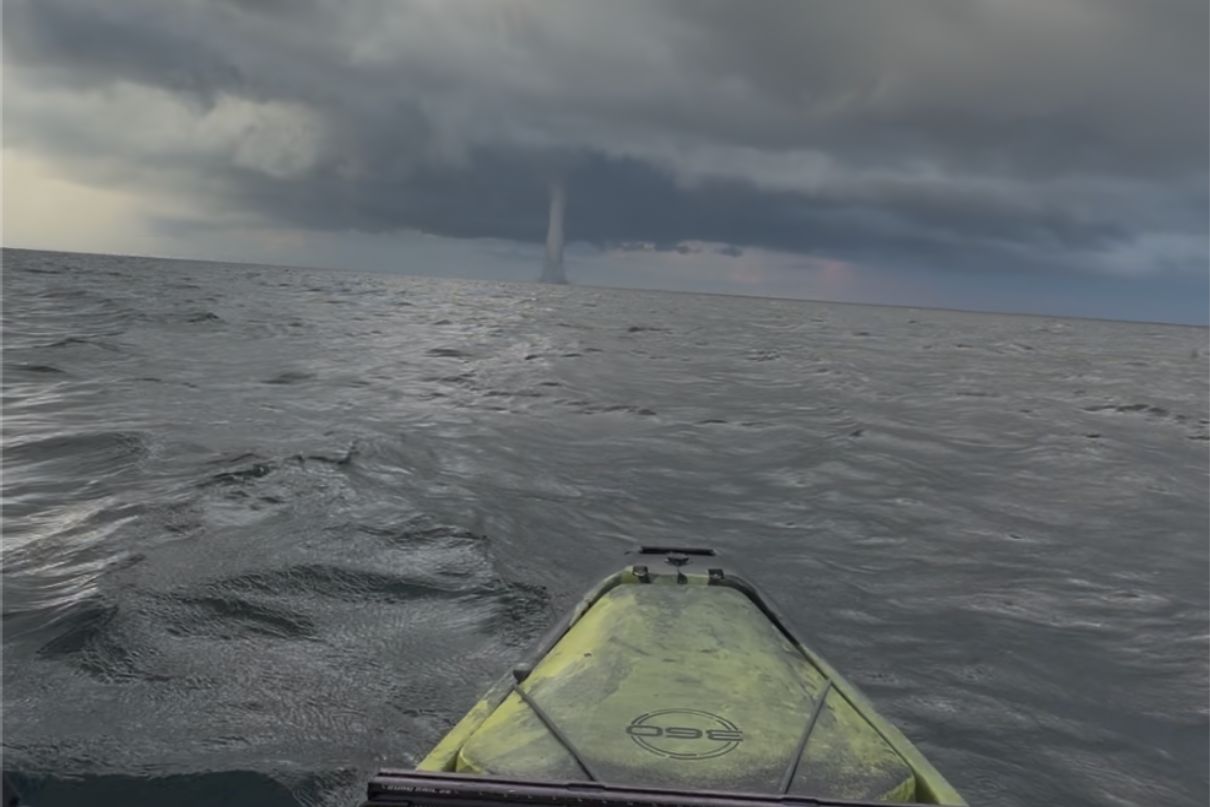
“We actually probably could’ve stayed out there and fished that snapper spot, but it got a little choppy, so we made the right decision. I always try to play it more safe than sorry,” said Barton.
Barton says he usually catches bigger fish when it’s stormy, windy and rainy, but he also never wants to push the limit on safety. He religiously checked the weather before heading out, especially when he’s with clients. On the day of the waterspout, Barton had seen storms on the radar, but they looked like they were going to be further out.
“No fish is worth your life,” Barton said. “Obviously, wear your PFD and try to look at the weather and don’t take any chances. It’s nice to have somebody out there with you, especially with experience, and have some type of communication. And always try to file a float plan so somebody knows when you leave and when you’re supposed to be back.”
What are waterspouts?
The National Oceanic and Atmospheric Administration (NOAA) defines a waterspout as a “whirling column of air and water mist.” According to NOAA, they fall into two categories: fair weather waterspouts and tornadic waterspouts.
Tornadic waterspouts are tornadoes that form over water or move from land to water. They have the same characteristics as a land tornado and are associated with severe thunderstorms. They often bring large hail, frequent lightning and high winds and seas.
Fair weather waterspouts are usually not accompanied by thunderstorms. Instead, they normally form along the bottom of a line of developing cumulus clouds. They typically move very little because they form in light wind conditions. While tornadic waterspouts develop downward in a thunderstorm, fair weather waterspouts develop on the surface of the water and work their way upward.
Regardless of the type of waterspout, you should never move closer to a waterspout to look at it. Some can be just as dangerous as tornadoes. To avoid a waterspout, NOAA recommends moving at a 90-degree angle to its apparent movement.