Lightweight, with a shallow draft and damn near indestructible, a kayak is perfect for bouncing over rocks and twisting through swiftwater. These same qualities make a small, plastic boat ideal for dragging through the woods, lowering down a steep bank and muscling over a deadfall. You also need the right rigging to really get the most of out fishing a river from your kayak, so consult our comprehensive guide.

Ultimate Rigging Guide for River Fishing
In Alabama’s Coosa River Basin, tournament pro Tim Perkins does it all. “Just yesterday I had eight or nine tree crossings,” he groans, then laughs. He also caught several trophy red-eye bass under the deadfalls. Perkin’s biggest obstacle is also his biggest asset, the backwoods angler says simplicity and efficiency are the focus of his rigging.

River Fishing Kayak
To skirt over rocks and trees with plenty of room to pack gear and tackle, Perkins uses a Wilderness Systems Commander 120 hybrid kayak and canoe. The design combines the light weight and open design of a canoe but Perkins can use a kayak paddle. “A hybrid is great for kids and camping,” he adds.

The wide, pontoon hull is stable for standup fishing, but at 12 feet long and only 60 pounds, the boat is easy to drag over obstructions. Perkins compliments the handling, “I’m not fighting the boat in gnarly water and I can turn on a dime to make a pinpoint cast,” he says.
The hybrid design gives Perkins a convenient place to lay rods across the gunnels while he’s fishing. He can quickly store his sticks below to pass under low hanging trees. The frame seat is elevated off the deck to stay dry and comfortable. Unlike a sit-on-top kayak, the hybrid places the seat lower to the water line for improved stability. “It’s like the best of both worlds,” Perkins says.
VIEW ALL HYBRID KAYAKS

Life Vest
In the southern heat and humidity, Perkins chooses a Mustang Survival Elite 28 inflatable PFD. “The hydro static inflator automatically activates if it is submerged under water,” he says. Should Perkins lose consciousness, the PFD will inflate to still float him.
VIEW ALL INFLATABLE PFDS
Transport to the River
A kayak offers easier access to fishing spots that are off the beaten path. “I just discovered a little flow not far from the house that has produced trophy largemouth and red eye,” Perkins says. The place is so difficult to reach, Perkins figures it has never been fished.

To get to the water, an angler often has to traverse fields, woods and steep riverbanks. Perkins uses Wilderness System’s Heavy Duty Kayak Cart with Beach Wheels. “The large, low-pressure tires will pass over anything,” he says. Once he secures the kayak to the cart with a pair of straps, he can pull the boat under or over any obstacle.
VIEW ALL KAYAK CARTS
Kayak Paddle
To beat his way into the tightest flows, Perkins uses a Wilderness Systems Alpha Glass paddle. The durable fiberglass blades will take the abuse of pushing off rocks and scraping bottom while a carbon fiber and fiberglass composite shaft keeps weight down.

Perkins likes an adjustable paddle; the Alpha can be set at 240 cm to paddle from the seat, then extended 20 cm for standup paddling.
VIEW ALL KAYAK PADDLES
Rod Holders
“I hate rods sticking up from my kayak,” Perkins admits. Vertical rods inevitably tangle in overhanging trees. Instead, he prefers to keep rods lying on the gunnels in front of him, or tucked inside the kayak. His crate has six vertical rod holders. “I keep my net in one and a follow-up spinning rod in the other.” If a bass strikes his lure and misses, Perkins will grab the spinning rod with a finesse bait to tempt the finnicky fish.
VIEW ALL ROD HOLDERS
Dry Storage
To keep his gear safe and dry, Perkins uses three sizes of drybag. A five-liter bag holds his keys and wallet. A 10-liter bag will accommodate his puffy jacket and dry clothes. He can fit a tent and sleeping bag in a 20-liter bag. For longer expeditions, he packs a 35-liter drybag with food and gear.
VIEW ALL DRY BAGS & DUFFELS
 Nets, Gaffs and Grippers
 Nets, Gaffs and Grippers
Perkins keeps a YakAttack Leverage Landing Net folded in his tankwell or stuck in a vertical rod holder ready for action.
VIEW ALL FISHING TOOLS

 Storage Crate
 Storage Crate
Perkins looks for a tackle crate that will secure his gear in case his kayak goes over. “The Wilderness Systems Kayak Krate is a complete storage system,” he says. The rotomolded crate is sealed with a lid that Perkins can secure. “I can add up to six rod tubes to the outside,” he says.
VIEW ALL STORAGE CRATES
 Cameras
 Cameras
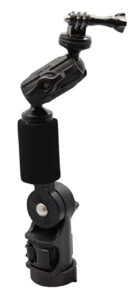
To capture the action, Perkins uses two cameras. One is mounted on a 11-inch YakAttack PanFish Portrait in front. The second camera is on a 33-inch YakAttack PanFish Pro mount behind his seat.
VIEW ALL PHOTO & VIDEO MOUNTS
Electronics
Electronics can cause trouble on a shallow, tangled creek, as the display snags overhangs and the transducer scrapes across rocks. To meet these obstacles, Perkins uses a Raymarine Dragonfly 7 Pro. “It’s simple to operate and simple to rig,” he explains. The compact unit offers fish finder and chartplotter without taking up much room.
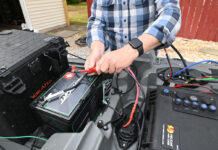
 Perkins mounts the unit to a YakAttack CellBlok attached to a gear track on the gunnel. The CellBlok holds his battery, transducer and display so he can install or remove in seconds. “Everything is compact,” Perkins stresses.
VIEW ALL KAYAK ELECTRONICS
Other Rigging Tips for River Fishing
As a Wilderness Systems pro, Perkins prefers to use the company’s rigging accessories. Keeping it in the family is a good way to ensure fit and function when integrating systems. Many kayak companies produce rod holders, crates, gear tracks and other gadgets designed to complement their boats.

This article was first published in Kayak Angler Issue 43. Subscribe to Kayak Angler’s print and digital editions here, or browse the archives here.
When you’re rigging for river fishing, a hybrid boat lets you skirt over rocks and trees with plenty of room to pack gear and tackle. | Feature photo: Tim Perkins