First, I choose a half dozen topwater lures. Then, I add a half dozen jerkbaits and crankbaits. I grab a handful of jigs and soft plastics and then throw in sinkers and swivels. Before long, I’ve accumulated a pile of tackle taking up too much space in my kayak.
Each angler has a different approach on how to organize their fishing tackle. The first step is cutting the fat. Then, choose a tackle storage system that is robust and compact with corrosion protection and waterproofing. Finally, organize lures and rigs so they are easy to access.

How to Store and Organize Your Fishing Tackle
1 Trays for Days
Tackle organization is as personal as boxers or briefs. Utility tackle trays with internal dividers and a clear lid are versatile and convenient for any type of fishing.
According to Howie Strech, a San Diego angler, utility trays allow an angler to organize tackle by type and size. “Each box has a theme: soft plastics, hard lures, irons.”
His trays range in size from smaller 3400 for terminal tackle to large 3700 trays to hold big lures.
For inshore light tackle fishing, Brandon Barton from Emerald Coast Kayak Charters in Pensacola, Florida recommends 3600- and 3700-size boxes. “This is the standard size that fits in most crates, cubbies, tackle bags and below-deck bins.” He uses a smaller 3400-size tray for terminal tackle.

2 Wear Protection
A kayak is open to the weather and water, so anglers look for protection as well as organization. Bailey Eigbrett, a tournament angler from Buffalo, New York, says his tackle trays are “preferably waterproof.” He looks for a lid sealed with a gasket and large, sturdy latches.

The best utility trays for fishing protect metal lures, hooks and terminal tackle from corrosion. Like magic, the plastic dividers emit a chemical vapor that coats the contents with a corrosion inhibitor.
With sealed lids to keep out water and corrosion protection to inhibit moisture, modern tackle trays extend the life spans of hooks and swivels.
3 Read the Label
To keep track of each tray’s contents, Brandon Barton marks the top and edges of the box with a waterproof label and permanent marker. “Labeling makes grabbing the right lure easier and saves time,” he points out.
For lures and rigs too large for a utility tray, the pros use press-seal plastic bags. Bailey Eigbrett says, “I use several different heavy-duty zipper bags for soft plastics.” These aren’t the Ziploc bags you find in the grocery store, the best bags for soft plastics are made of heavy plastic with a waterproof zipper.
The soft plastic used in fishing lures is volatile. Mix soft plastics together in a closed tackle tray and they will melt into a gooey mess. To avoid conducting a science experiment in the tackle box, store the lures in the original packaging. Soft plastics are sold in packaging that is specially designed to stabilize the rubber. Plus, the packaging is labeled with the size, style and color of the soft plastic to make organization easier.

4 Everything in Place
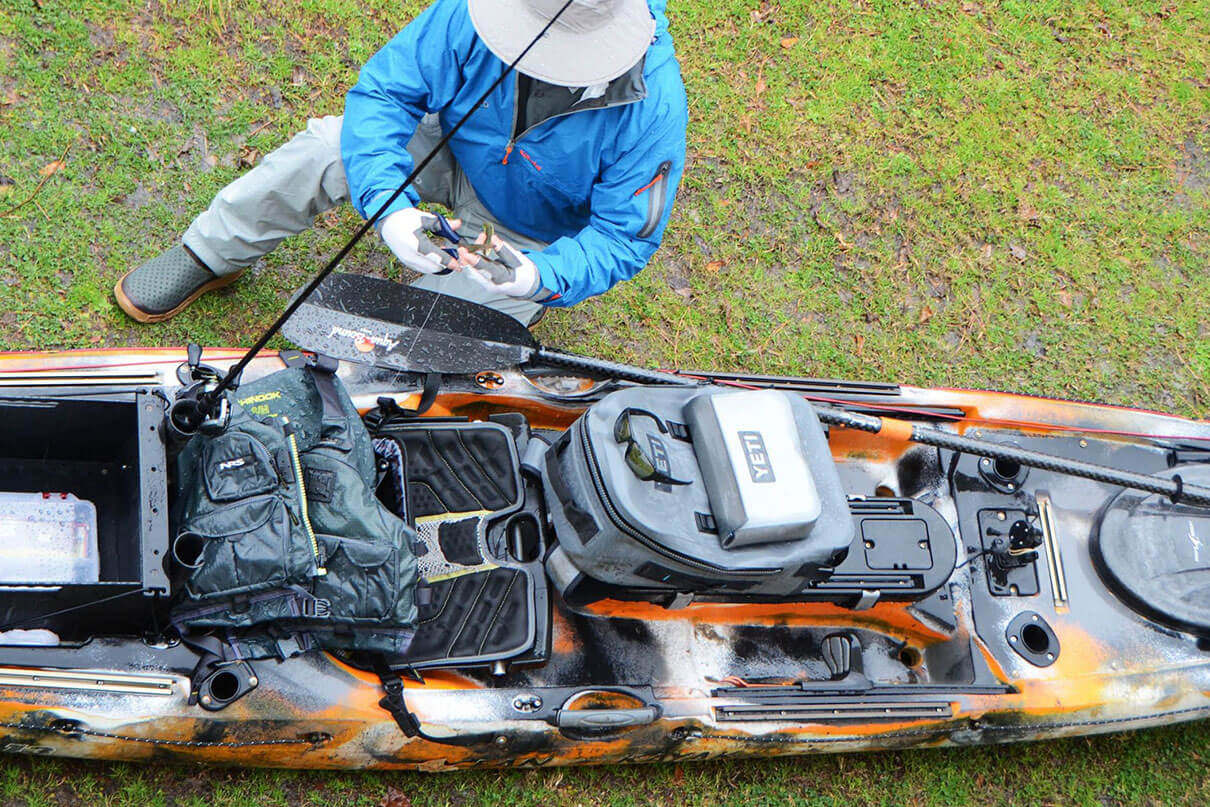
With tackle, lures and rigs separated into individual utility trays and sealed bags, it is easier and safer to store tackle on the kayak. Brandon Barton starts with a large gear crate secured in the tankwell behind his seat. The crate holds a half dozen tackle trays. “Since the crate has a sealed lid, I can leave the tackle trays between trips,” Barton says.
In addition to a large open space behind the seat, many kayaks also have molded spaces in the cockpit to fit a 3600 or 3700 tackle tray. Targeting yellowtail and white sea bass off San Diego, Howie Strech sacrifices his gear crate space for a livewell. He says, “I store tackle trays in the space between the livewell and the tankwell wall.”
A gear crate is mostly used for backup tackle and rigs; the pros like to keep their most-used lures and rigs close at hand. Bailey Eigbrett explains, “My tackle boxes go in a Hobie H-Crate that is stored behind me and out of the way and I have a few smaller boxes for terminal tackle, hooks and split rings in the front hatch.”
All three pros prioritize protected storage space for the essential gear they use most often. Howie Strech says, “In my below-deck storage compartment, I use individual kitchen drawer dividers to separate lures by type. I also store a small clear box with commonly used hooks, split rings and swivels.”
[ Browse the widest selection of boats and gear in the Kayak Angler Buyer’s Guide ]
For pliers, tools, used lures and other flotsam, Strech’s kayak has small tackle caddies close to his seat. “On calm days I keep my smartphone and handheld VHF radio in the caddie.”
Every inch of a kayak is valuable space, and Strech makes use of his seat back for storage. “I use a bag on the back of the seat for snacks, extra pairs of sunglasses, a raincoat, leader material.”
5 Tough Choice
Keeping tackle secure and organized on the kayak is logical. Backwater guru Brandon Barton chants the mantra: “Only take what you need.” Reducing tackle not only reduces weight and increases free space, it also makes it easier to secure tackle in the kayak to prevent loss.
Lake fisherman Bailey Eigbrett and open ocean angler Howie Strech admit to cutting the fat, but their pursuits require more tackle than a skinny water angler. Strech says, “If you’re fishing shallow water, less tackle makes it easier to maneuver the kayak over and around obstacles.”
Bailey Eigbrett points out tournament anglers need a variety of tackle to satisfy a variety of tactics. “I’m afraid I’ll leave something at home and need it on the water.”
Eigbrett admits to bringing everything and the kitchen sink, making storage and organization even more important. “I limit myself to four or six choices to meet the tactics I’m most likely to use,” he says.
Tackle storage comes down to speed and efficiency. Quickly finding and accessing tackle and gear increases time in the game. Howie Strech laughs: “Sometimes a few seconds can be the difference between hero and zero.”

Tackle boxes locked and loaded before a surf launch. | Feature photo: Howie Strech