When I first spotted Hobie’s i11s kayak zooming around Pinewood Reservoir during Outdoor Retailer’s Demo Day, I chuckled. Hobie started with their Sportsman inflatable standup paddleboard and added a MirageDrive, Vantage CTi seat and H-crate to create a hybrid SUP/’yak. “Looks fun,” I thought, “but who needs it?”
Hobie i11 Specs
Length: 11′ 3″
Width: 39″
Weight Rigged: 64.5 lbs
Weight Unrigged: 35.5 lbs
Capacity: 400 lbs
Price: $1,999
It wasn’t until I borrowed an i11s from Wild River Outfitters for a proper test drive that I understood the method behind Hobie’s madness. When I lifted the 35-pound inflatable onto my kayak trailer, the advantage hit me. I could have the Hobie power without lugging around a heavy kayak. Adding the MirageDrive and Vantage seat only increased the weight to 65 pounds. I was able to carry the i11s to the launch without a cart, perfect for grab-and-go fishing trips.
Performs Like A SUP, Rigged Like A Kayak
On the water, the i11s performed like a Hobie. The MirageDrive pedal system fit solidly in the center well. Kicking at an easy pace moved the board at a surprising clip. I turned the hand-controlled rudder, and the board did donuts. The new MirageDrive is tougher and lighter while producing more power than its predecessors.
This was my first test ride on the new Vantage CTi seat and I was sold. The aluminum frame is light and stiff. The mesh back and seat cradle the rider without overheating. I love the cable-driven lumbar support and quick recline adjustment. The seat has two levels, but it must be removed from the boat to adjust from high to low. And the straps that anchor the seat to the deck have to be carefully tightened to make sure the four legs fit into the deck pads. Sitting and pedaling were so comfortable and efficient; I soon forgot I wasn’t on a hard plastic Hobie.
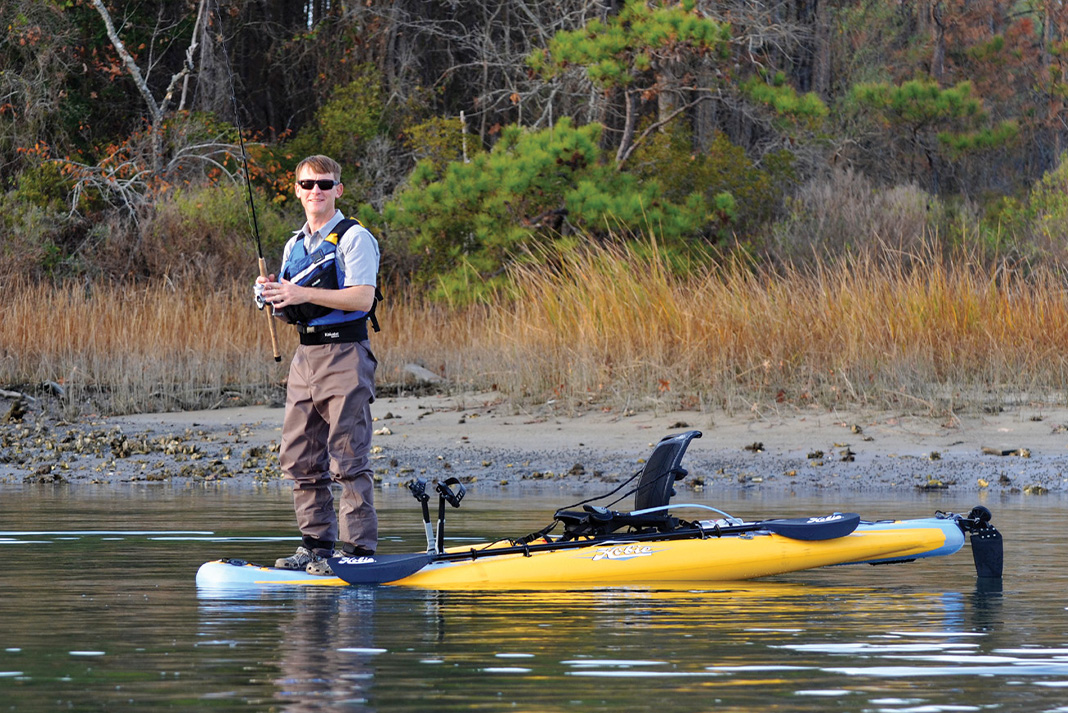
Hobie i11s Fishing Features
- Vantage CTi seat
- MirageDrive
- Integrated rudder
- Bungees and D-rings
- Double-stitch construction
- Accepts Hobie accessories
- Two-piece paddle
Plenty Of Space And Stability
The i11s provides an open and stable platform. This offered more room for fishing rods and gear and left plenty of space for standup fishing. I could easily stand, turn around, bend down and even walk to the bow without hardly a bobble. The i11s uses a flat, reinforced floor with two outer pontoons that improve stability and tracking.
Take out the MirageDrive and insert the plug, and remove the chair and crate to turn the i11s into a capable standup paddleboard that tracks straight and fast. Or, add any of Hobie’s many accessory rod holders, tackle boxes, even a Torqueedo motor option, to turn the i11s into a full-blown kayak fishing platform.
As I was pedaling back to the launch, a boater passed and yelled, “That looks like fun!” I hollered back, “It’s way more than that!”
Watch The Hobie i11s Inflatable Standup Paddleboard In Action
 This article was first published in the Spring 2016 issue of Kayak Angler Magazine. Subscribe to Kayak Angler Magazine’s print and digital editions, or browse the archives.