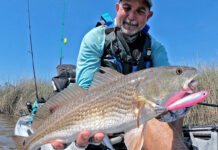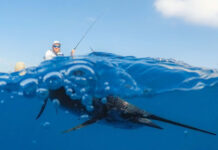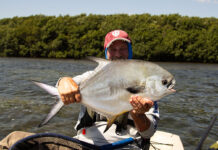
As the biggest and meanest member of the mackerel family, it’s good to be king. Smaller king mackerels are called snakes and big kings are called smokers; the IGFA World Record, caught off San Juan, Puerto Rico, weighed 93 pounds. King mackerel hunt subtropical and tropical waters around the world, but the coast of Florida and the Gulf States are prime grounds for kayak fishing. These two pros are kings of the kings.

How to Catch King Mackerel

Chasing Florida’s Sunshine Smokers

Hot water, swift current and plenty of bait make Florida a haven for king mackerel fishing. Pro guide Austin Collins fishes from Broward to Palm Beach for kings and more. Big, open water requires a seaworthy kayak, so Collins chooses a 13-foot-long and 32-inch wide Viking Pro Fish. “I need a kayak that is fast,” he says, “we might cover many miles on any day.”

“The easiest way to catch a king is slow troll a live google eye at dawn,” he says. Collins rigs the live bait on a double hook stinger rig. He uses #4 to #6 single-strand wire and 3/0 to 5/0 lead J-hook and #4 to #6 treble trailer. “Adjust the size of hooks and length of wire to match the size of the bait,” he adds.

He also targets kings with a vertical jig. “A 100- to 150-gram Jimmy Jig is deadly,” he says, adding that he’ll bump up to a 225-gram Cancun Candy when the fish are holding deep or the current is ripping.

Trolling and jigging require a fast reel and limber pole. Collins uses Accurate’s 500 XGS with a super-fast 6:1 retrieve ratio. Kings will dump line fast then turn and run at the angler just as fast. Light drag and hard cranking are the only way to keep up with one of these speed demons. “Don’t horse the fish,” Collins cautions, “work it easy or you’ll pull the hooks.”
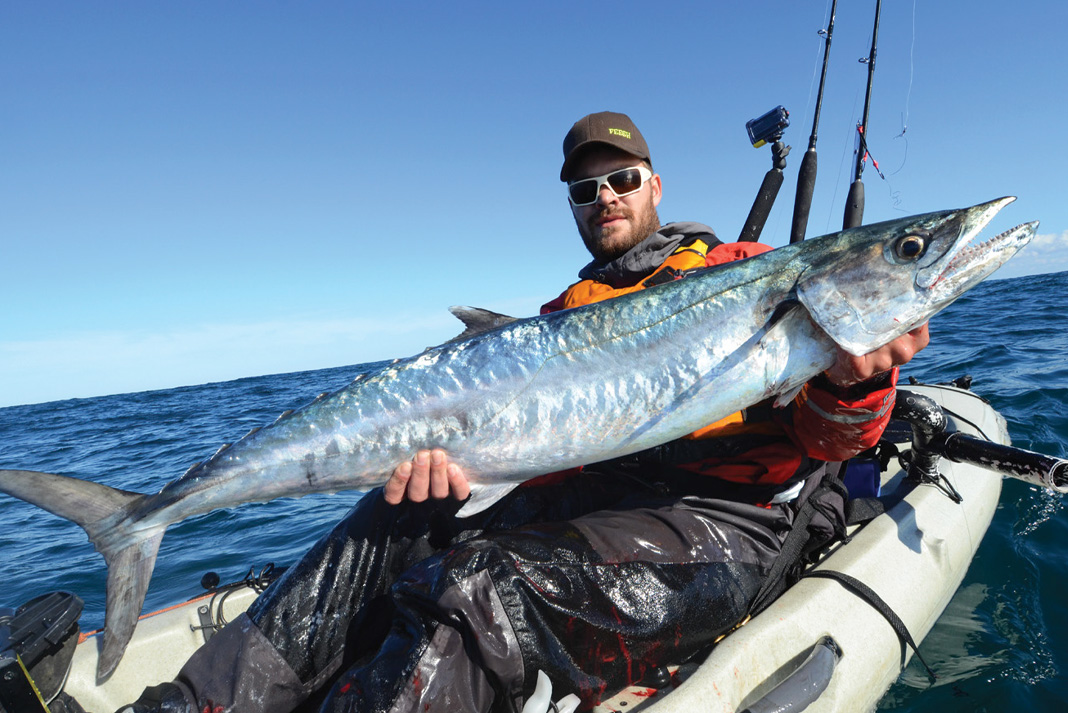
IT TAKES SHARP HOOKS, LIGHT DRAG
AND WIRE LEADER TO LAND A SMOKER. | PHOTO: RIC BURNLEY

Fishing the King Mackerel of the Coast

King mackerel are an easy target close to shore from one end of the Gulf Coast to the other. Ty Southland of 30MilesOut Fishing Charter chases the fish throughout their range, but his home waters of North Padre, Texas, offer some of the best action. Big kings are a no-brainer around the near-shore oil rigs. “We troll to the rigs then anchor and fish live baits,” he explains.

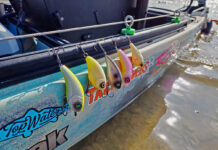
For the troll to the rigs, Southland chooses a frozen ribbonfish on a live bait rig and a Rat-L-Trap 1.5-ounce Super Trap. “The biggest king I ever caught was on the Rat-L-Trap,” he adds. Choose a rod with a light tip for kings, they are often lightly hooked and a limber rod and light drag will forgive the fish’s violent head shakes.

[ Browse the widest selection of boats and gear in the Kayak Angler Buyer’s Guide ]

Once he arrives to the rig, Southland uses a Sabiki rig to catch blue runners for live bait. Then he deploys the anchor and sets out the live bait. “Freelining a live bait is the easiest way to catch a big king,” he says. The combination of warm water, structure and bait mean kings will not be fair away. “If you put in the time, you’ll catch a smoker!”


This article was first published in the Winter 2016 issue of
Kayak Angler Magazine.
Subscribe to Kayak Angler Magazine’s print and digital editions, or browse the archives.

Previous articleHow To Catch Monster Panfish (Really)
Next article5-Time Winner Vermont Master Angler Award, Brian Cadoret Shares His Secrets
Kayak Angler editor Ric Burnley has been kayak fishing since the dawn of the sport. In 2007, Burnley wrote The Complete Kayak Fisherman, with chapters on how-to make a PVC rod holder and glue a fish finder transducer to the hull. In 2013, he landed his dream job as editor of Kayak Angler magazine. Burnley is a regular contributor to Salt Water Sportsman, Sport Fishing, Outdoor Life, In the Bite and other print and online publications. Burnley lives in Virginia Beach with his wife, adult daughter, daughter’s boyfriend and daughter’s two cats. Experience In 2004, Ric Burnley stole his first milk crate from behind a 7-Eleven and fashioned it into a gear crate for his Ocean Kayak Prowler 15. Many years and many milk crates later, Burnley has witnessed the rise of kayak fishing from a bastardized fringe element to a legitimate industry with millions of devotees. The journey to becoming an angler started early in Burnley’s life. His father, Eric Burnley, is a renowned outdoor writer and former fishing guide, so the boy grew up in the cockpit of a charter boat and in the pages of national magazines. After college, Burnley lost easy access to his father’s boat, but not his passion for fishing. Once he had exhausted the limits of land-based angling, Burnley decided to try out a new thing called kayak fishing. About the same time, Burnley was looking for extra work to pay for his expensive addiction. His father, editor of the Mid-Atlantic Fisherman Magazine, offered him freelance assignments for the weekly publication. That led to a position as regional editor at Salt Water Sportsman, publication of The Complete Kayak Fisherman and editorship of Kayak Angler. Meanwhile, Burnley and his partner-in-crime, “Kayak Kevin” Whitley were exploring the boundaries of kayak fishing. With the bountiful Chesapeake Bay and Atlantic Ocean as their playground, the two anglers were the first to target big red drum, cobia, trophy striped bass, monster black drum, sheepshead and many other species. Once inshore species were exhausted, Burnley loaded his kayak onto motorboats and fished for bluefin tuna, blackfin tuna, king mackerel and amberjack. All the while, Burnley shared his experiences and knowledge with anglers through print, photos, video, radio, seminars and online. Almost 20 years later, Burnley continues to fish obsessively and share the stories. His recent projects for Kayak Angler cover the latest trends in forward-facing sonar and remote-controlled electric motors. Over the past two decades, kayak fishing and Ric Burnley have come a long way from PVC rod holders and stolen milkcrates. Education ● Radford University: BA English; Virginia Teacher’s License. Highlights ● Other Interests: Mountain biking, traveling, hiking, surfing and skateboarding ● Day Job: High School English teacher at an alternative school for at-risk students Fun Fact Ric’s name is a contraction of Eric. Ric is named after his father, Eric Sr. To differentiate between the two Erics, Mrs. Burnley removed her son’s E. To this day, she writes the boy’s name ‘Ric, with an apostrophe replacing the E.

Leave a Reply