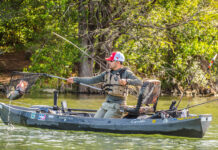
There I was, a fishing fanatic strapped into a cramped, six-foot-long whitewater kayak staring down a rocky river of boiling whitewater. As a coastal kayak angler, I’ve paddled bluewater and green water, even brown and red water, but never whitewater. Bobbing next to me in his kayak, Rapid Media publisher Scott MacGregor, a former river guide and my boss, assured me that the cauldron of rocks and foam was “nothing,” adding, “I took my mother-in-law down this backwards.”
The School of Hard Rocks: A Kayak Angler Tries Whitewater

A few minutes before, Scott gave me a crash course on kayak control. He showed me how to enter the current by first paddling upstream, then leaning downstream to turn and launch into the rapids. I tested the small boat’s handling and learned how to shoot across the current and carve into an eddy. We played around in some riffles to try out my new moves before facing the gauntlet.

“Just ferry into the current, then go right, left and right,” Scott yelled over the roar. I tightened the strap on my helmet and entered the raging river.
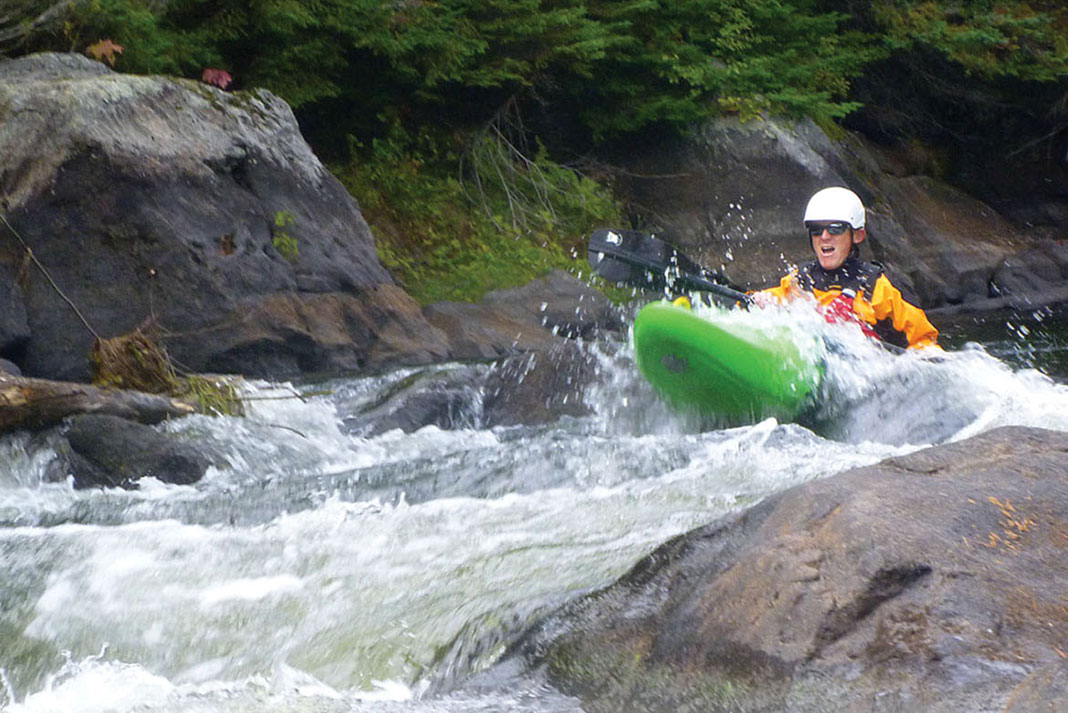
kayak fisherman tries whitewater paddling
The kayak fishing editor in whitewater, WAY outside his comfort zone. | Feature photo: Scott MacGregor

A few days later, I’m back at home on Chesapeake Bay, paddling my 12-foot sit-on-top through the tightly packed pilings of the Hampton Roads Bridge Tunnel. The tide is flooding at three knots and the wind is blowing 15. As the water rushes past my kayak, I lean hard downriver, ferry across the current and land in an eddy behind one of the pilings—the trick I learned from my whitewater experience. Not only does the move save time and energy, but it feels cool to let the water do the work.

Always Something New to Learn

One of the things I love most about kayak fishing is the endless opportunities to learn something new. Whether it’s tying a new knot, targeting a new species of fish, exploring a new body of water or learning a new move in my kayak, every trip is a chance to improve my game and increase my advantage over the fish.

Too often, I get tunnel vision when I focus my efforts on one species. Bull red drum make me myopic each spring. And big striped bass control my brain all winter. But this year, I resolve to learn how to fish for largemouth bass, cast a fly rod and surf on a standup paddleboard. While I don’t plan to become an expert in any of these fields, the skill and tricks I pick up will certainly have value when I head out to chase my favorite targets.

Kayak Angler magazine is dedicated to dispensing the best kayak fishing skills, latest news and freshest trends in this growing sport. While this magazine contains plenty of material that speaks to any reader, there is also value in learning about unfamiliar disciplines and exploring virgin waters.

In the never-ending race to outthink a fish, the best lessons are often learned from outside your comfort zone.
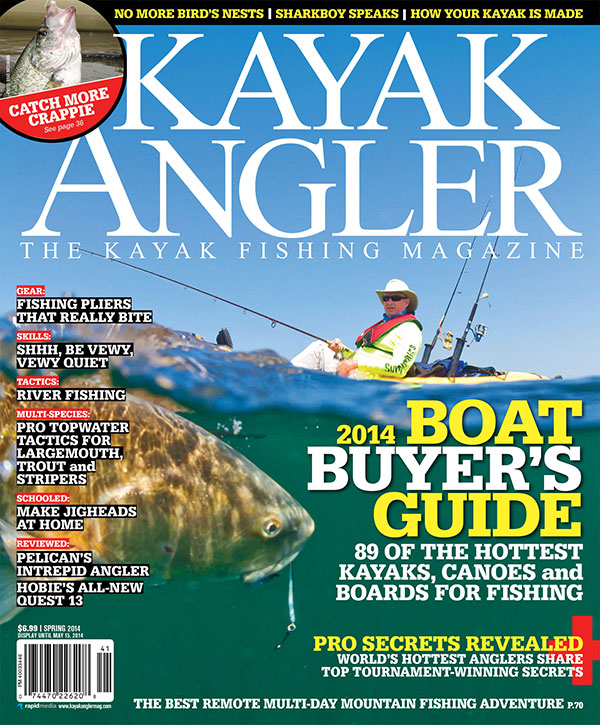
Cover of the Spring 2014 issue of Kayak Angler MagazineThis article was first published in the Spring 2014 issue of Kayak Angler Magazine. Subscribe to Kayak Angler Magazine’s print and digital editions, or browse the archives.


The kayak fishing editor in whitewater, WAY outside his comfort zone. | Feature photo: Scott MacGregor
 

Previous articleKaku Kayaks Finalizes SUP Design
Next article6 Pros Share Their First Fish Of Spring
Kayak Angler editor Ric Burnley has been kayak fishing since the dawn of the sport. In 2007, Burnley wrote The Complete Kayak Fisherman, with chapters on how-to make a PVC rod holder and glue a fish finder transducer to the hull. In 2013, he landed his dream job as editor of Kayak Angler magazine. Burnley is a regular contributor to Salt Water Sportsman, Sport Fishing, Outdoor Life, In the Bite and other print and online publications. Burnley lives in Virginia Beach with his wife, adult daughter, daughter’s boyfriend and daughter’s two cats. Experience In 2004, Ric Burnley stole his first milk crate from behind a 7-Eleven and fashioned it into a gear crate for his Ocean Kayak Prowler 15. Many years and many milk crates later, Burnley has witnessed the rise of kayak fishing from a bastardized fringe element to a legitimate industry with millions of devotees. The journey to becoming an angler started early in Burnley’s life. His father, Eric Burnley, is a renowned outdoor writer and former fishing guide, so the boy grew up in the cockpit of a charter boat and in the pages of national magazines. After college, Burnley lost easy access to his father’s boat, but not his passion for fishing. Once he had exhausted the limits of land-based angling, Burnley decided to try out a new thing called kayak fishing. About the same time, Burnley was looking for extra work to pay for his expensive addiction. His father, editor of the Mid-Atlantic Fisherman Magazine, offered him freelance assignments for the weekly publication. That led to a position as regional editor at Salt Water Sportsman, publication of The Complete Kayak Fisherman and editorship of Kayak Angler. Meanwhile, Burnley and his partner-in-crime, “Kayak Kevin” Whitley were exploring the boundaries of kayak fishing. With the bountiful Chesapeake Bay and Atlantic Ocean as their playground, the two anglers were the first to target big red drum, cobia, trophy striped bass, monster black drum, sheepshead and many other species. Once inshore species were exhausted, Burnley loaded his kayak onto motorboats and fished for bluefin tuna, blackfin tuna, king mackerel and amberjack. All the while, Burnley shared his experiences and knowledge with anglers through print, photos, video, radio, seminars and online. Almost 20 years later, Burnley continues to fish obsessively and share the stories. His recent projects for Kayak Angler cover the latest trends in forward-facing sonar and remote-controlled electric motors. Over the past two decades, kayak fishing and Ric Burnley have come a long way from PVC rod holders and stolen milkcrates. Education ● Radford University: BA English; Virginia Teacher’s License. Highlights ● Other Interests: Mountain biking, traveling, hiking, surfing and skateboarding ● Day Job: High School English teacher at an alternative school for at-risk students Fun Fact Ric’s name is a contraction of Eric. Ric is named after his father, Eric Sr. To differentiate between the two Erics, Mrs. Burnley removed her son’s E. To this day, she writes the boy’s name ‘Ric, with an apostrophe replacing the E.

1 COMMENT

Leave a Reply