
When kayak fishing guide Cory Routh moved to Back Bay in the rural south side of Virginia Beach, the first thing he noticed, “It looked real fishy.” Routh knew miles of marshy shoreline and thousands of acres of open water had to hold hundreds of largemouth bass.
How the Legendary Back Bay Bass Fishery was Reborn
Back Bay was supposed to be dead.
Fifty years ago, the shallow bay was full of subaquatic grass and big largemouth. The bay hosted fish camps, tournament stops and was even featured on television fishing shows.
As Virginia Beach grew, the bay died. Runoff clouded the water making it impossible for the grass to grow. Overfishing and mismanagement were too much for the bass to beat. By the late ‘80s, the fish and fishermen were gone.

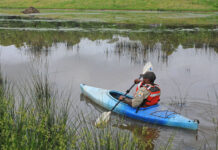
When Routh moved to the area, he explored the shallow bay in his kayak. “It was easy to dump the kayaks and fish isolated areas of grass,” he says. What he discovered was a resurgence and inspired him to make a film.
Working with online outfitter, Flymen Fishing Company, Routh chronicles the rebirth of Back Bay into a world-class fishery that hasn’t been rediscovered, yet.
“The whole idea was to draw attention to the recovery efforts and its success,” Routh says.
The film, titled Back Bay, explores the area’s fishing and history. Routh interviewed the old-timers and kayak fished with current sharpies. He spent hours trading stories with outdoor writer and fly fishing instructor Lefty Kreh and Walt Cary, inventor of the Walt’s Popper. “That fly pattern was designed for Back Bay,” Routh discovered.
[ Browse the widest selection of boats and gear in the Kayak Angler Buyer’s Guide ]
At the center of the story, Chad Boyce, a biologist at Virginia Department of Game and Inland Fisheries (VDGIF), has been behind the efforts to restore the bay.
Boyce grew up in the area and was familiar with the legends of glory days.
A few years after Boyce started working on the bay, he noticed something. “We were finding more bass,” he says, “and more areas of grass.” He suspects the early stages of the recovery were due to a drought in the early 2000s.
The initial success allowed Boyce to score 70,000 fingerling largemouth. “They were left-over from another stocking operation,” he laughs. “That’s all we could get.”
With an influx of fish, Boyce worked with other agencies to right some of the wrongs. “The National Wildlife Refuge purchased land surrounding Back Bay,” he says. They also installed a weir at an important source of runoff. Experimental turbidity booms protected young grass from sediment and current.
The results were encouraging. Surveys of the bay recovered stocked bass, which had been marked with a dye, and more homegrown bass.
The big push came from 2013 to 2015 when VDGIF added 400,000 bass. Since then, Boyce says “The results have been off the charts.”
They’ve recorded a huge increase in bass numbers in the past 10 years. “In 2007 electro-fishing surveys I was recovering seven bass per hour. That number jumped to 40 bass per hour in 2017.”
Boyce is most excited about another number. “Surveys of anglers show that fishing contributed over $275,000 to the local economy in 2016.”
The Back Bay story is part of a larger tale of inter-agency cooperation and new technology combined with increased public awareness to bring about a culture change. “I can’t point to one thing bringing this together,” Boyce admits. “It was a combination of forces.”
Most recently, Boyce has been genetically testing the bass in Back Bay. The VDGIF has discovered the natural bass are mostly Florida bass. “We should be averaging four-to six-pounders with eight-pounders and bigger ones thrown in,” he brags.
Boyce says one of the biggest challenges has been luring anglers back to Back Bay. “We’ve installed a new boat ramp and we’re working to educate the public on the recovery.”
Routh’s film has gone a long way towards this. “We’ve already got thousands of views and caught the attention of film competitions and festivals,” he says. Routh looks forward to following the story in subsequent films.
For Boyce, Routh and other anglers, the payoff is returning Back Bay to its former glory. “I won’t stop until it is a bass mecca again,” Boyce says, only half joking.
Routh says he’s already getting calls about guiding on the bay. When he asks his clients why they want to take a chance on this forgotten fishery. “People are interested in the fishing,” Routh says. “But they are coming for the story.”
This article was first published in the Spring 2018 issue of Kayak Angler. Subscribe to Kayak Angler Magazine’s print and digital editions, or browse the archives.
Back Bay was supposed to be dead. But conservation efforts have brought it back from the brink. | Feature photo: Courtesy Walt Cary




Where is the new boat ramp Boyce was talking about?