A master angler stands in front of a crowd of parents and their kids. The fisherman holds a hook and line. “This is how you tie a Palomar knot,” he demonstrates and the hopeful anglers follow along. The audience is full of families who have come together to learn to fish.
The class is part of Fishing’s Future, a nonprofit organization committed to getting more people onto the water. Michael Scherer, vice president of operations, explains, “People want to go fishing, but they don’t know how.”
What is Fishing’s Future?
Fishing’s Future is part of a growing army of anglers committed to teaching beginners how to cast. By providing basic instruction and follow-up support, regional chapters get families started and keep them fishing.
“I’ve had new anglers call me and ask questions,” says Scherer. He even admitted to parking at a local fishing hole in case anyone needed help. “I wanted to be ready but not get in the way,” he laughs.

Angler outreach has been a focus of the tackle industry since fishing became big business, but angler recruitment has taken a more important role as recreational fishing battles for resources and access. Classes at Fishing’s Future go beyond how to catch a fish. “Families learn stewardship, habitat and regulations,” Scherer says.
[ See the largest selection of boats and gear in the Kayak Angler Buyer’s Guide ]
Plano Fishing is an iconic tackle box maker and a supporter of Fishing’s Future. “So many people come to the sport through Plano, we are obligated to new anglers,” says Chris Russell, Plano’s marketing manager.
How Does More Anglers Lead to Greater Influence in the Halls of Government?
Angler recruitment has been the focus of industry trade organizations like Recreational Boating and Fishing Foundation (RBFF) and American Sportfishing Association (ASA), but tackle manufacturers are reaching beyond the traditional fishing crowd.
“Fishing’s Future allows us to reach new anglers at a grassroots level with a program we believe in,” Russell says.
We have 70 chapters in 20 states and we’ve reached over a million anglers
Recent studies show many anglers first come to the water with their mothers.
“Grandpa is dead,” Scherer quips, explaining the tired stereotype of gramps taking junior to the fishing pond isn’t relevant. “We have 70 chapters in 20 states and we’ve reached over a million anglers,” he adds.
On the other end of the spectrum, to attract traditional anglers to fly fishing, the gurus at Orvis host free beginner fishing clinics, online video courses, events and instructional trips to guide anglers through all levels of the sport.
Orvis’ marketing manager Tom Rosenbauer knows the effect these resources have. “Many anglers have reported learning to fly fish through our programs,” he beams.
Recently, Orvis started the 50/50 program. The company encourages outfitters to hire more female guides and staff pro shops with women. “We are challenging the whole industry to encourage diversity,” Rosenbauer says.
Fly fishing has an uphill battle to break the old-guy-in-waders stereotype. “We talked to women about challenges and barriers to learning fly fishing,” Rosenbauer explains.
In addition to hundreds of online and in-person classes, Orvis is hosting women-only fishing trips and clubs. The company now features more women in its catalog and marketing. “We want to show women fly fishing and having fun,” he says.
We are sitting at 50 million anglers with a goal of 60 million
For tackle manufacturers, efforts to add new anglers does more than just increasing the bottom line. “Anglers are dedicated conservationists committed to taking care of the resources,” Tom Rosenbauer explains.
Plano’s Chris Russell adds, “As a large group, fishermen are a powerful demographic.” In a democracy, the majority wins. Russell cites, “We are sitting at 50 million anglers with a goal of 60 million.”
The combined voice of 60 million voters carries weight with policy makers. When it’s time to divide up the fish pie, recreational anglers want the biggest piece.
To make it work, angler recruitment must include advocacy and responsibility. Fishing’s Future’s curriculum is dedicated to understanding and caring for the fish and their environment. “Before our students go fishing, we teach parents and kids about stewardship,” Scherer says.
There may be more anglers on the water, and it translates to more power over resources. Growing numbers are good for everyone.
This article was first published in the Winter 2018 issue of Kayak Angler. Subscribe to Kayak Angler Magazine’s print and digital editions, or browse the archives.
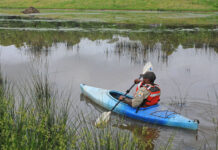
The future of fishing depends on anglers. | Feature photo: Courtesy of Eddyline Kayaks