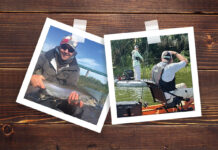
Memory is a curious thing. When someone asks me to tell a good fish story, I can only recount a few of my most stellar catches. Strange, because I have fished thousands of days over many years.
Many of my strongest memories are significant firsts: my first big brook trout, steelhead, muskie, New Zealand brown trout.
That leaves thousands of fish I’ve caught and released in my fishing history. For the first few years fly fishing I logged each trip with details about the location, temperature, water conditions, flies and the fish I caught. Reading over my notes, I don’t remember any of the trips. Total blank.
I spend each summer guiding fly fishing anglers. At the end of the day, my clients often ask me how many fish they caught. They don’t remember. Maybe they remember the first one or the biggest, but they forget the average fish.
What Do We Remember When We Make Memories?
Memory was once thought of as dusty photo albums in our mental attic. Recent advances in cognitive neurology and neuro-imagery are rewriting what is known about how we use memory. Turns out memory is tied to decisions, emotions, habits and routines. Memory is the key driver in how we react under pressure.
This theory says memory is not stored away until I choose to look back at my life. Instead, memory is the primary filter for assessing every environmental cue my five senses collect. Those seemingly insignificant cues are tested against any existing memories. This is super-computer caliber instantaneous processing occurring way below conscious thinking.
This deep memory instantly recalls and assesses my prior actions. Then my brain decides if the previous experience is relevant to this new situation. Based on the results, I react instantly. I’m not making a decision but relying on memory.
When I feel a tug on my fishing line—I don’t stop to think about how hard I should set the hook. Instead, my memory of prior tugs instantly directs my muscles. If a situation comes up when there are no options available in memory, then the slow cognitive machine of conscious thinking has to wake up and sort through the options. By that time the fish is long gone but the experience gets filed away in memory.
This is an interesting point: experience is really about memory. My experience is merely the accumulation of memories. Past actions identify future options. My memories define what is normal and what is abnormal.
Even if I don’t consciously remember every fish I catch, the unmemorable catches are integrated into a vast memory bank. Significant days and the less notable trips form the bulk of my un-remembered memories. They become an indistinguishable base that makes up my experience. This experience is the raw material for on-the-fly reactions that comprise the subtle craft of fishing.

The mandate is clear: go fishing more often. The more events I pack into my memory, the larger the sample size. A larger databank of memories includes variations, boundaries and experiences—all of which improve my reaction when it really matters.
I feel reassured knowing un-remembered catches are still in my head, doing their part to set me up to catch the next memorable fish.

A picture is worth a thousand words. | Feature photos: Jeff Jackson