A new fishing kayak is like a blank canvas, ready to paint with a personal touch. Modern boats are outfitted with gear tracks, mounting plates, open spaces and removable pods, begging for rod holders, cup holders, electronics and other accessories. With all those accessories, the question is how best to mount them on the kayak.
Where should you use a gear track, flush mount or a deck mount base? Each choice has advantages. Get it wrong, and expensive gear goes into the water. Follow these tips to get it right.
VIEW ALL MOUNTS, TRACKS & ACCESSORIES
3 Ways to Mount Accessories on Your Fishing Kayak
1 Gear tracks
Gear tracks and fishing kayaks go together like peas and carrots. Transporting and storing a fishing kayak requires accessories to be quickly removed. A gear track uses a long, metal groove mating with a T-bolt on the accessory. Slide the T-bolt into the groove and turn the accessory to tighten the bolt.
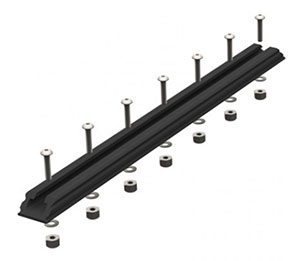
With gear tracks, an accessory can be mounted anywhere on the track and pointed in any direction. Loosen the T-bolt and the accessory slides out of the track. Most accessories are compatible with other manufacturer’s gear tracks so it’s easy to mix-and-match brands.
Many kayaks come pre-rigged with gear tracks in strategic locations along the stern well and the cockpit. For custom rigging, tracks can be mounted with self-tapping screws.
Gear tracks are the most adaptable but least sturdy connection. The small T-bolt and thin track provide limited support. To increase strength, some accessories use a double T-bolt mount.

Gear tracks work best for light duty accessories. Cup holders, rod holders not used for fishing, fish finder display or camera mounts are a perfect fit for the gear tracks.
VIEW ALL TRACKS & RAILS
2 Flush Mount
The strongest connection for an accessory is flush mounted to the deck. With the rod butt or mounting spline below the deck, the center of gravity is lowered for a solid connection that will take a lot of pressure.
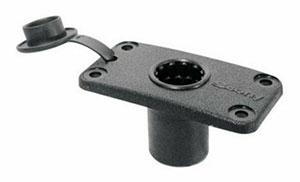
Flush mounted rod holders are best for trolling or soaking baits. Angle the rod holder away from the kayak to spread out the rod tips. To install a standard flush mount, use a two-inch hole saw, stainless screws or pop rivets and plenty of marine sealant. Be sure to use flush mounted rod holders that are sealed at the end.
Some accessories can be mounted flush to the deck. Flush-mounted accessories use a base that goes through the deck. The accessory mount uses a spline that clicks into the recessed base. Installing the accessory, like a fish finder display or rod holder, places most of the pressure on the deck of the kayak. When the accessory is removed, the mount is below the deck so it doesn’t interfere with casting or paddling.
Flush mounts are strong and low profile, but they can’t be adjusted or easily removed. Cutting a large hole in the kayak is hard to repair.
Flush mount rod holders in the bow and behind the seat are perfectly positioned for trolling or soaking baits. A flush mounted fish finder display in front of the cockpit is a solid connection out of the way and easy to remove.
VIEW ALL FLUSH MOUNTS
3 Deck mount
Deck mounted accessories use a spline connecting to a base mounted to the deck. The spline clicks into the base for a solid connection, then unlatches to be removed. Another option is a ball and socket connection. The ball is mounted to the kayak and the accessory clamps to the ball.
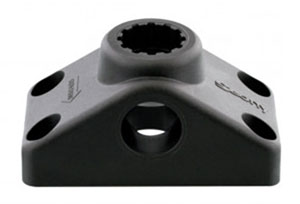
Most deck mounted bases are attached to the kayak with four bolts, making it easier to repair or replace the mount. Use a backing plate inside the hull to provide extra support for the accessory.
Deck mounts can accept compatible accessories within the brand, but most won’t take a spline from a different manufacturer. In other words, you can’t use a rod holder from one company with a base from another company. However, the bolt patterns often match so when you switch accessories you can switch bases without drilling new holes.
Anglers choose deck-mounted rod holders to elevate the reel away from the water. The rod holder can be turned any direction then locked into place.
A deck-mount base is a good choice for accessories that aren’t removed after each trip. Paddle clips, electronics brackets and other semi-permanent rigging features will stay in place until removed.
Ball mount bases allow the accessory to be adjusted quickly on the fly. Attach a fish finder display to a ball mount and loosen the socket enough to move the display with a little pressure. The display can face down when the angler is sitting or angled up to stand and fish.
VIEW ALL SIDE OR DECK MOUNTS
Mix and Match for Even More Flexibility
Combination mounts offer the best of both worlds. Spline-mounted accessories connected to the kayak with a track mount are a great compromise. The track mount allows the accessory to slide forward and back while the spline mount permits the accessory to be adjusted 360 degrees and removed quickly.
With so many choices for accessory bases, and so many uses for accessories, there’s a setup perfect to rig any kayak for your fishing needs.
Track mounts and kayak accessories go together like peas and carrots. | Feature photo: Courtesy of Scotty