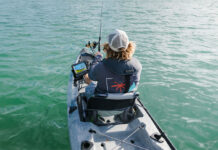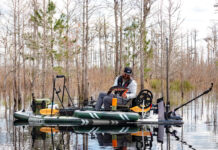
When I’m far away from the launch and the last bar on my smartphone disappears, I get nervous but I don’t stop paddling. The best fishing is often far away from crowds and beyond the reach of cellular towers. So, I have a backup plan to stay in touch when I’m out of reach. The latest generation of emergency communicators take over where a smartphone leaves off.
Mayday! Mayday! 3 Emergency Communicators to Keep You in Contact

1 Personal Locator Beacon
Adding a personal locator beacon (PLB) is a no-brainer. For a few hundred dollars, adventurers get a direct connection to rescue services.

A PLB is a pocket-size device with a small antenna and a button. Hit the button and the PLB transmits a signal to a network of government-operated satellites. The satellite sends location information to the appropriate rescue service and help is on its way.
A PLB is inexpensive and doesn’t require a subscription service. Popular models include ACR ResQLink, Ocean Signal PLB1 and McMurdo FastFind 220. It is also compact and nearly indestructible. The best models have a small screen displaying a notification when the distress call has been received and answered. One of the limitations is the battery needs to be replaced every few years.
Because a PLB only offers one-way communication, it is for serious emergencies where self-rescue is not likely. Once you hit the SOS button, you cannot cancel the alert.
[ Kayak Angler Buyer’s Guide: View all safety & rescue gear ]
A PLB offers priceless peace of mind at a minimal cost. Every minute emergency services search for a victim is expensive for the victim and the taxpayer. Anyone who leaves the sidewalk and heads into the wild should carry a PLB.

2 VHF Radio
The easiest way to maintain two-way verbal communication is with a handheld very high frequency (VHF) radio. This small device provides direct connection to anyone with a VHF radio tuned to the same frequency. That inclues emergency services monitoring the VHF signal for distress calls.
The latest VHF radios offer more than two-way communication. Michael Campbell at Icom America points to Automatic Identification System (AIS) and Distress Signal Calling (DSC) as extra layers of safety. “The Icom M94D is the first to offer AIS with GPS and DSC making it a perfect companion for kayak anglers,” he says.
In addition to receiving and transmitting voice calls, the M94D has a multifunction display screen. Users can monitor AIS to see the location of other vessels or use the GPS for basic navigation.
In an emergency, the DSC feature turns the VHF radio into a signal beacon. Hit the button and the VHF transmits a signal to emergency services and nearby boats.

A handheld VHF’s boat-to-boat range is limited to line of sight, but the Coast Guard can pick up a handheld VHF at least 20 miles away. For kayakers sitting close to the water, that may only be a mile or two. To increase range, Campbell recommends a separate speaker microphone. “Raise the transceiver over your head with one arm while transmitting and receiving via the speaker microphone.”
Campbell says the biggest advancement has been reliability. “Proper maintenance and use of your handheld VHF is very important if you want it to work perfectly when you need it.” The M94D radios are IPX7 waterproof and capable of being submerged 30 meters for 30 seconds. “Don’t worry about losing this radio; it floats and flashes when it hits the water, even if it is turned off,” Campbell says. Wherever I paddle, a VHF radio is an essential communication device. Even with a PLB and messenger, the VHF radio provides voice communication in the last stages of a rescue.

3 Emergency Messenger
For anglers who regularly leave the cellular safety net, the next step is an emergency messenger. Pay an annual or monthly subscription and the emergency messenger offers SOS, basic two-way communication and navigation.
Rehan Nana, media specialist at Garmin International, has seen satellite messenger technology change from communication with a smartphone interface to standalone devices with powerful navigation and communication capabilities. “Garmin’s inReach was born from a desire to communicate from the backcountry to friends and family back home.”
Like a PLB, an emergency messenger works on a network of satellites. Push the SOS button to alert operators at an emergency coordination center. The operators then contact local search and rescue.
In addition to emergency calls, satellite messengers provide two-way communication. Users can text message anyone with a cellphone. The device also sends location information and allows tracking. Some models can even send emails.
Garmin’s early messengers worked in conjunction with a smartphone. Then, the satellite messaging feature was included with a handheld GPS. Their latest release, the inReach Mini 2, fits in the palm of your hand and includes two-way messaging, various navigation and tracking features, and weather.

The inReach handheld devices can pair with a cellphone, so users can use their phone for messaging/SOS/Mapping through the Garmin Earthmate/Explore/Messenger App, or they use the inReach as a completely standalone device for messaging/SOS/and more.
When orchestrating a rescue, reliable communication reduces time and risk. Unlike the PLB Nana explains, “The device user is able to reply to messages from the Garmin Response team. The more information the rescue team has, the better equipped they are to provide assistance.”
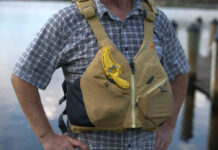
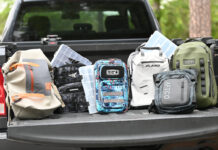
I hope I never have to use my emergency signaling systems, but I always carry a VHF, PLB and satellite messenger in a waterproof bag. When I’m in the wild, pocket-sized emergency communication devices give me peace of mind to enjoy fishing and worry less about rescue.

Stay in touch: New emergency communicators offer more features in a smaller package. | Feature photo: Courtesy Icom