I’ve been looking for a standup paddleboard that I can carry across the dunes for quick trips to the other side of the breakers. Spanish mackerel and bluefish hunt the backside of the surf line and a SUP is perfect for overland hauls and a short sprint. To qualify, a board has to be light enough to throw under my arm, quick enough to shoot through the surf and seaworthy in current and chop.

Boardworks Tracker Sepcs
Length: 11′
Width: 36″
Weight: 43 lbs
Thickness: 5″
Max Capacity: 285 lbs
Price: $1,849
boardworkssurf.com

Boardworks’ new Tracker SUP is the perfect answer. At only 43 pounds, it features a beefy handle in the middle of the deck to make it even easier to carry to the water. I don’t hang out at Muscle Beach, yet I was able to lug my board, rod, paddle and bag of tackle to the launch in one trip. Try that with another 11-foot-by-36-inch hard board.

The Tracker really shined on the water. Long enough to glide easily and very stable at 36 inches wide, the Tracker had no problem skipping over the waves, then stopping to fish. The flared nose rises over waves and a broad tail improves stability. A unique double-concave bottom and a single touring fin further increase stability and tracking. Best of all, it is low to the water for less wind resistance. If Lamborghini made a pick-up truck, they would do well to take notes from the Tracker.
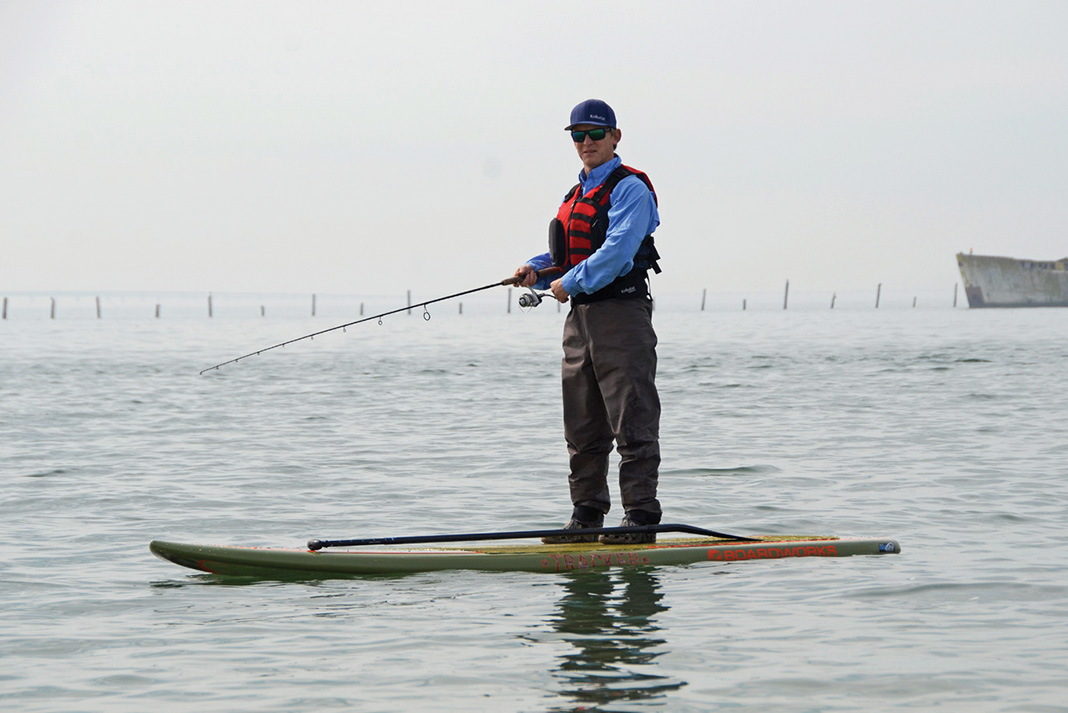
Boardworks Tracker | PHOTO: KAYAK KEVIN WHITLEY
FISH FRIENDLY FEATURES:
• Double concave bottom
• Low profile
• Multi Connex deck plugs
• Flat deck
• LiftSUP handle
• Single touring fin
• Realtree camo accents
• Durable Krypto- Mat construction

The topside is a blank slate. A flat deck offers plenty of room for fishing and gear. Closed cell foam keeps my feet in place and padded. Nine leash plugs and four screw-in plugs make it easy to add and arrange accessories. I rig up with a single Zooka Tube rod holder attached with a YakAttack Leash Plug Adapter for quick trips. For longer expeditions to the flats and creeks, I’ll use YakAttack Vertical Tie Down to secure a cooler or BlackPak crate.

Jumping on the Tracker and paddling away from the launch, the board picks up speed quickly and skips through the water. The low profile keeps the board from being blown around, just don’t expect gear to stay dry on the deck. Using Boardworks’ FGR adjustable carbon fiber paddle, propelling the Tracker was easy compared to other SUPs I’ve tested. Even though this board feels like a flyweight, the Tracker is constructed with a foam core and Boardworks’ Krypto Mat outer shell for a light board that can take a beating. RIC BURNLEY


This article was first published in the Early Summer 2016 issue of Kayak Angler MagazineSubscribe to Kayak Angler Magazine’s print and digital editions, or browse the archives.
Previous articleJames Lebowitz Memorial Tournament Sept. 10
Next articleFool The Fish With Camouflage Kayak Fishing Gear
Kayak Angler editor Ric Burnley has been kayak fishing since the dawn of the sport. In 2007, Burnley wrote The Complete Kayak Fisherman, with chapters on how-to make a PVC rod holder and glue a fish finder transducer to the hull. In 2013, he landed his dream job as editor of Kayak Angler magazine. Burnley is a regular contributor to Salt Water Sportsman, Sport Fishing, Outdoor Life, In the Bite and other print and online publications. Burnley lives in Virginia Beach with his wife, adult daughter, daughter’s boyfriend and daughter’s two cats. Experience In 2004, Ric Burnley stole his first milk crate from behind a 7-Eleven and fashioned it into a gear crate for his Ocean Kayak Prowler 15. Many years and many milk crates later, Burnley has witnessed the rise of kayak fishing from a bastardized fringe element to a legitimate industry with millions of devotees. The journey to becoming an angler started early in Burnley’s life. His father, Eric Burnley, is a renowned outdoor writer and former fishing guide, so the boy grew up in the cockpit of a charter boat and in the pages of national magazines. After college, Burnley lost easy access to his father’s boat, but not his passion for fishing. Once he had exhausted the limits of land-based angling, Burnley decided to try out a new thing called kayak fishing. About the same time, Burnley was looking for extra work to pay for his expensive addiction. His father, editor of the Mid-Atlantic Fisherman Magazine, offered him freelance assignments for the weekly publication. That led to a position as regional editor at Salt Water Sportsman, publication of The Complete Kayak Fisherman and editorship of Kayak Angler. Meanwhile, Burnley and his partner-in-crime, “Kayak Kevin” Whitley were exploring the boundaries of kayak fishing. With the bountiful Chesapeake Bay and Atlantic Ocean as their playground, the two anglers were the first to target big red drum, cobia, trophy striped bass, monster black drum, sheepshead and many other species. Once inshore species were exhausted, Burnley loaded his kayak onto motorboats and fished for bluefin tuna, blackfin tuna, king mackerel and amberjack. All the while, Burnley shared his experiences and knowledge with anglers through print, photos, video, radio, seminars and online. Almost 20 years later, Burnley continues to fish obsessively and share the stories. His recent projects for Kayak Angler cover the latest trends in forward-facing sonar and remote-controlled electric motors. Over the past two decades, kayak fishing and Ric Burnley have come a long way from PVC rod holders and stolen milkcrates. Education ● Radford University: BA English; Virginia Teacher’s License. Highlights ● Other Interests: Mountain biking, traveling, hiking, surfing and skateboarding ● Day Job: High School English teacher at an alternative school for at-risk students Fun Fact Ric’s name is a contraction of Eric. Ric is named after his father, Eric Sr. To differentiate between the two Erics, Mrs. Burnley removed her son’s E. To this day, she writes the boy’s name ‘Ric, with an apostrophe replacing the E.

Leave a Reply