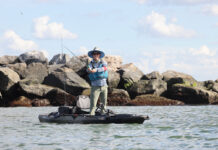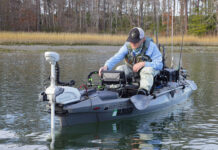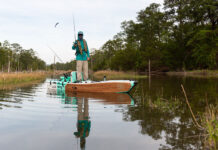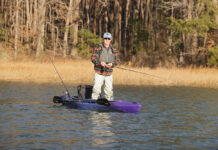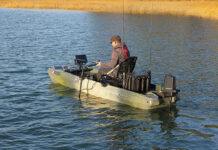

You’ve got kayaks for fishing in a pond. Other boats are designed to target rivers. Then there are kayaks specifically for fishing in a lake. With so much specialization in kayak design, it’s refreshing to see a do-it-all paddle boat capable of actually doing it all.
I first met the Manta Ray years ago when I tested the original 12-footer. I loved its spunky attitude and simple accouterments, but I couldn’t get comfortable in the seat. Since then, Native Watercraft has updated the saddle in the original 12. And now I’m stoked to see the Manta Ray 12XT with a frame seat.
Native Watercraft’s Manta Ray 12XT Fishing Kayak
When I received a test boat from Appomattox River Company in Hampton, Virginia, I couldn’t decide where to fish. I knew the boat would be equally at home on my neighborhood pond as the open bay. I settled on a local marsh creek where I expected calm conditions and a shot at striped bass and speckled trout.
Neither the fish nor the weather cooperated, but the Manta Ray 12XT worked great. I had to push my truck door open against the pounding wind and keep one hand on the paddle at all times. Luckily, I only had a couple hundred yards of open water to hop between sheltered creeks and coves.
Just like I remembered, the high-volume bow bounced over the wind chop, pushing spray out and away. Rounded chines and a little rocker improved the XT’s bounce. An Aqua-Bound Angler Carbon paddle provided extra torque to push the little boat through chop and slop.
Native Watercraft’s Manta Ray 12XT Specs
Length: 12’7″
Width: 33″
Weight: 68lbs
Capacity: 325 lbs
MSRP: $899www.nativewatercraft.com
I shifted the seat into the low position to drop my center of gravity and lower my profile. Native basically invented the frame seat. The XT features a lightweight frame covered with hand-sewn, breathable mesh.
The support straps are low and out of the way. Following the keep-it-simple school, the seat fits snuggly in molded inserts. To go from high to low, simply lean forward and lift the seat.


Manta Ray XT’s Features
Unlike specialized boats, the Native XT performs well in any conditions. Not only does it bob over wind chop, but a 33-inch beam keeps it steady for standup fishing. You could dance in the large, open deck, but despite the XT’s girth, its primary stability is a little loose allowing the boat to roll in the waves. Nonetheless, we certify the XT stable for all but the clumsiest anglers.
The 68-pound waistline allows for easy transport and paddling. The kayak fits perfectly in my six-foot truck bed and is easy to drag to the launch. Minimal rigging also reduces weight making the XT more manageable for grab-and-go fishing trips.
The XT doesn’t have many bells and whistles, but it has the right bells and whistles. Native put a hatch in the bow, large enough to offer easy access without taking up too much space.
A large covered console in the cockpit keeps tools and tackle out of the elements. A pair of molded-in rod holders behind the seat are angled for trolling and a simple bungee secures gear in the large tankwell.
I like the a taco-style paddle holder because it’s easy to secure the paddle with one hand. Native didn’t go overboard on rigging, allowing anglers to fill in the details.
Native did splurge on the side handle and gear track combo, saving space and weight.
My favorite features are the bow and stern handles. After dragging every make and model of kayak around the yard, I know a good handle. Manta Ray XT’s low-profile metal bars are easy on hands and wrists without snagging fishing line.
Even if the fish weren’t biting and the wind was blowing, the XT is a joy to paddle and easy to fish. I’ll add it to the arsenal for a grab-and-go boat and recommend it as an all-around fishing machine.
Go anywhere, fish anytime; Manta Ray 12XT is an all-around paddle boat with a great seat. | Feature Photo: Roberto Westbrook