Ancient Chinese philosopher Laozi says the journey of a thousand miles begins with one step. For beginner kayak anglers, the journey begins with the right gear and a few basic skills. Kayak Angler’s Beginner’s Guide to Kayak Fishing is full of expert advice from experienced anglers who started their journey from scratch. Believe it or not, our pros admit they began kayak fishing with the wrong boat and too much gear. Through years of trial and error, the best guides, outfitters, tournament competitors and instructors learned hard lessons the hard way. Start slow and build skills. Buy quality gear. Keep tackle to a minimum. Tie down everything. Safety first. And enjoy the process. With our guide to getting into kayak fishing, new anglers start their journey a few steps ahead.
Lake and Pond Fishing
Stillwater offers easy access and a captive audience
Wherever you live, you’re probably near a lake or pond full of fish. Lakes and ponds offer easy access to captive fish—a perfect training ground for new anglers.
Jared Schuster guides anglers lake fishing in the North Carolina Smoky Mountains. “I take people fishing seven days a week and many of them are first time anglers,” he says. The lakes are filled with a diverse list of species from rainbow trout to bass to panfish. “Depending on the weather and season, we may be jigging, casting or trolling,” he says.
To accommodate anglers in any scenario, Schuster recommends an all-around kayak that is comfortable and easy to handle. “I carry it myself and spend all day fishing,” he says. Comfort is a premium for new anglers. “If you’re pedaling, be sure to adjust the seat so your legs aren’t overextended. For paddling, a low seat with solid support produces the best paddling position. “You don’t have to break the bank, it’s about having fun,” he says.
Gear track mounted rod holders allow the angler to adjust the location without drilling holes in the boat.
Schuster is frugal with his electronics. He uses a seven-inch fish finder and GPS combo to locate fish and structure, monitor water temperature and track his location on the lake. “I don’t want fish finder screens and forward-facing systems all over my kayak,” he explains. He says new anglers often get confused looking at the fish finder. “A simple system makes it easier to mark the fish and drop a line,” he says.
Gear and rod storage is handled by a gear crate and a couple rod holders. “Before installing a rod holder, make sure you are comfortable with the location and angle.” Gear track mounted rod holders allow the angler to adjust the location without drilling holes in the boat.
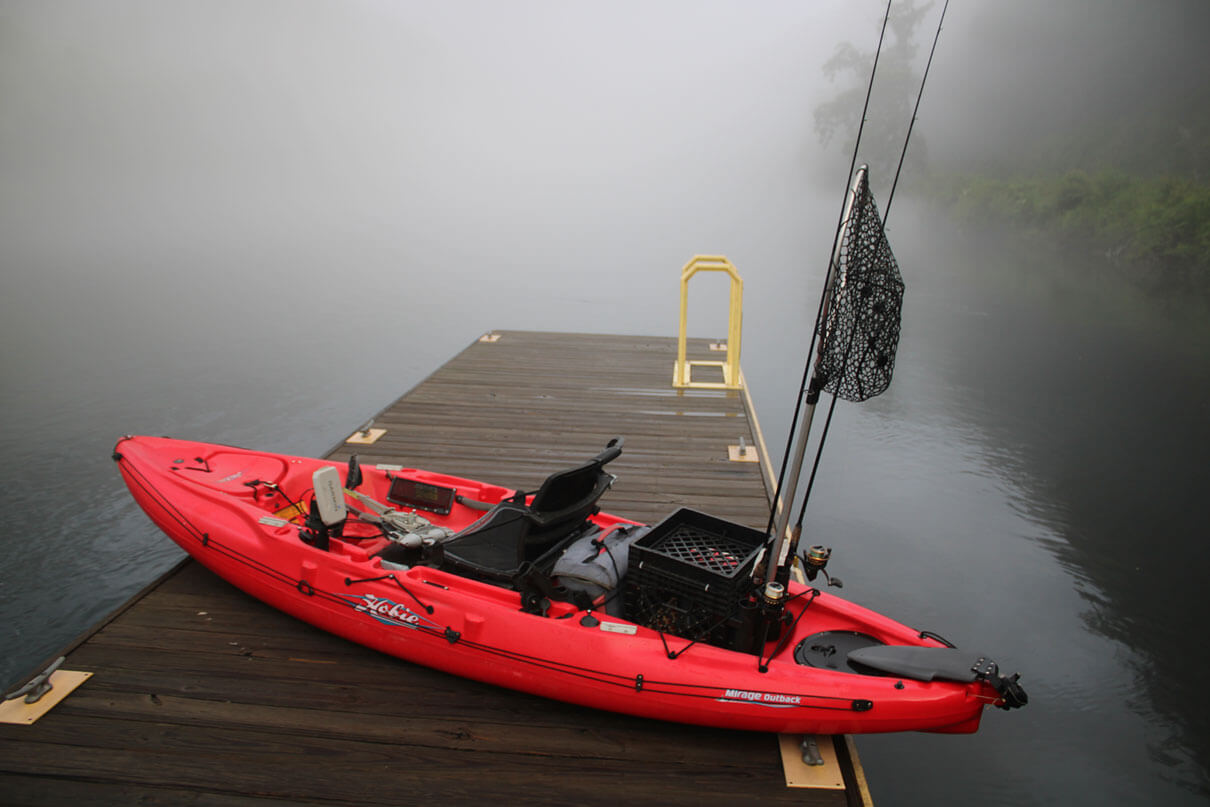
One of Schuster’s most important accessories is a small landing net with a rubberized mesh basket. “The rubber prevents snagging hooks and reduces damage to the fish,” he explains.
Schuster’s fishing rods include a medium-light spinning rod for panfish, medium-action spinning rod for bass and a heavier conventional rod with line counter for trolling. “Fishing rods tend to go overboard, so I use inexpensive rods with good quality,” he says.
To target a wide variety of fish, Schuster relies on old-favorite lures like plastic worms for beating the bank, flukes, hardbaits, stickbaits, squarebill and deep diver crankbaits.
One of the biggest mistakes Schuster sees new anglers make is losing the fish at the boat. “Take your time,” he coaches. Schuster often observes new anglers losing focus and making a mistake. “Make sure you don’t have anything else going on when you are fighting the fish,” he says. Then, reel the fish so it is a few feet from the rod tip. “I see people reel the fish right up to the rod tip,” he laughs. Lower the net into the water and use the rod to direct the fish into the net. Schuster’s advice goes for all aspects of kayak fishing: slow down, be careful, relax and prepare. “Do it slow and it happens naturally,” he says.
Inshore Fishing
Go skinny water for easy access to big fish
For coastal anglers, inshore fishing is a gateway drug. Relatively sheltered water, aggressive saltwater fish and simple rigging make the skinny water scene an easy entry into the sport. Don’t be fooled, inshore locations are subject to changing tides and swift current presenting a challenge to planning a backwater trip.
Backwater guides Chris Tweedy out of Charleston and Brandon Barton from Pensacola got hooked on kayak fishing in the marsh mud. Barton says, “I was motivated to catch the biggest fish possible from a kayak.” Tweedy had a more practical approach, “A kayak seemed like the ideal answer for fishing the marsh.”
After mastering the skinny water, these anglers dedicated their careers to sharing knowledge and experiences to hook other anglers. Tweedy admits, “Everyone starts out making mistakes, no one is an expert overnight.”
To cut the learning curve, both guides recommend a versatile boat. Tweedy points out, “I have several launch points that vary from sheltered flats to open bays and the deep Intracoastal Waterway.” He likes a stable boat with a sea worthy hull that can go from shallow water to big seas.
Even though inshore waters are shallow and sheltered, both guides stress the importance of a comfortable life vest. “A PFD is the number one essential accessory,” Barton says; don’t be lulled into carelessness.
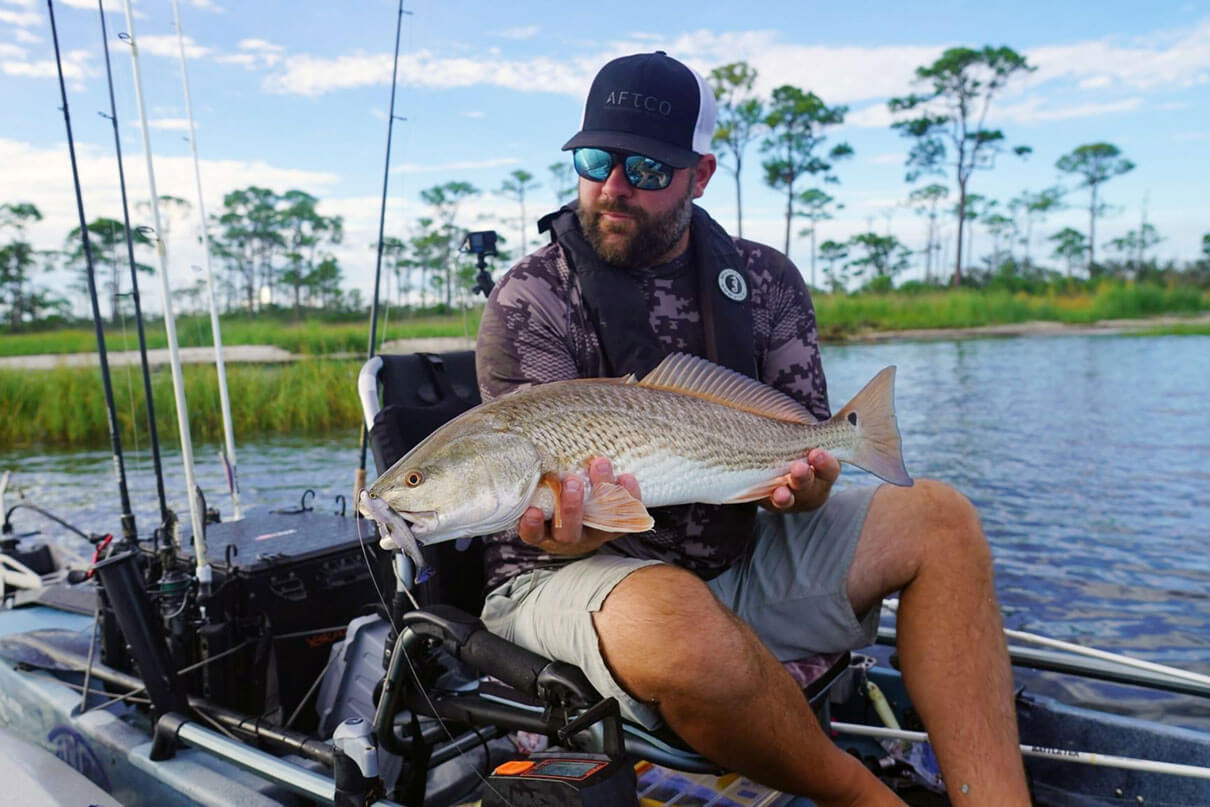
Tweedy keeps rigging to a minimum. “No reason to clog up a new angler’s mind with a bunch of stuff he may not need.” He recommends life vest, pliers, fish grippers, a six-foot stakeout pole and a small cooler with ice for drinks and lunch.
For electronics, Barton uses a single nine-inch fish finder and GPS unit. “I find structure and fish with the fish finder and use the GPS to navigate and track speed and distance,” he says.
To fish ultra-shallow, Tweedy doesn’t bother with electronics. He points out the obvious: “I don’t need a fish finder when I can see tailing redfish.” In deeper water, he uses current and water conditions to find fish. “I look for actively feeding fish and adjust my plan,” he says.
Tweedy uses several apps on his smartphone. “I use SailFlow for wind, Garmin Boating for navigation and currents, Tides Near Me, MyRadar, and The Weather Channel app.” The guides also carry a VHF radio for emergency communications and weather reports.
Both guides use an almost identical three-rod quiver to cover their three most popular inshore lures. To fish topwater lures, Barton uses a seven-foot, six-inch medium-light rod paired with a 2500 spinning reel and 20-pound braid. Twitchbaits and jerkbaits call for a seven-foot, extra-fast rod and 2500 reel with 20-pound braid. Finally, soft plastic and light lures need the finesse of a seven-foot medium-action rod and 2500 spinning reel.
To target sheephead around dock pilings, Tweedy carries a five-foot, 11-inch spinning rod with 4000 spinning reel that allows him to get close to the structure.
Inshore fishing allows anglers to simplify their tackle box. Fishing the Florida Panhandle, Barton uses topwater lures like the Rapala Skitter Walk to cover water in search of fish. His sub-surface search bait is a MirrOlure MirrOdine twitchbait. A Rapala X-Rap jerkbait entices a fish with the exaggerated jerk action. When the water is rough, Barton switches to a Southern Salt The Goat wake bait. To sight fish in clear water, he throws a shrimp imitation.
Tweedy uses the same style lures and he adds a popping cork with natural or artificial shrimp to draw in fish. He also likes a ⅛- to ½-ounce jig to dangle a bait to sheepshead hiding in heavy structure. “Simplicity is the key for beginners,” he says.
Tweedy’s best advice is to overcome the mental game. “A lack of confidence is most important.” He encourages anglers to build on their knowledge, even if their previous experience is freshwater fishing. “Fishing a river seam for smallmouth is similar to fishing a current seam for redfish,” he explains.
When it comes to finding fish, Barton recommends anglers rely on Google Maps satellite images. “I look for areas similar to places I have caught fish before,” he says. Then, he plans his fishing trip to coincide with favorable tides and peak feeding times. “Go and explore, that’s the fun of kayak fishing,” he says.

Offshore Fishing
The ultimate horizon is just beyond the surf zone
Some people say ocean fishing in a kayak is crazy. New kayak anglers are intimidated by the open water, unpredictable weather, raging surf, long distances and sharks. But coastal anglers are attracted to the challenge of overcoming the environmental obstacles to target the biggest fish in the sea.
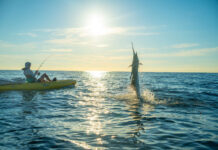
Eric McDonald is one of the first Florida fishing guides to specialize in offshore kayak fishing. Newbies may think offshore fishing is off limits to inexperienced anglers, but McDonald has been leading anglers of all levels into the Atlantic Ocean to target tuna, wahoo, king mackerel and sailfish for over a decade.
“I learned to kayak fish through trial and error,” McDonald says. His early offshore adventures weren’t always successful. He says his biggest mistake was overconfidence. “I thought: I can handle Mother Nature, I’ll be fine.” McDonald disregarded weather and sea conditions before heading out. “I pushed my limits in the surf only to get tossed out of the kayak and break my equipment.”
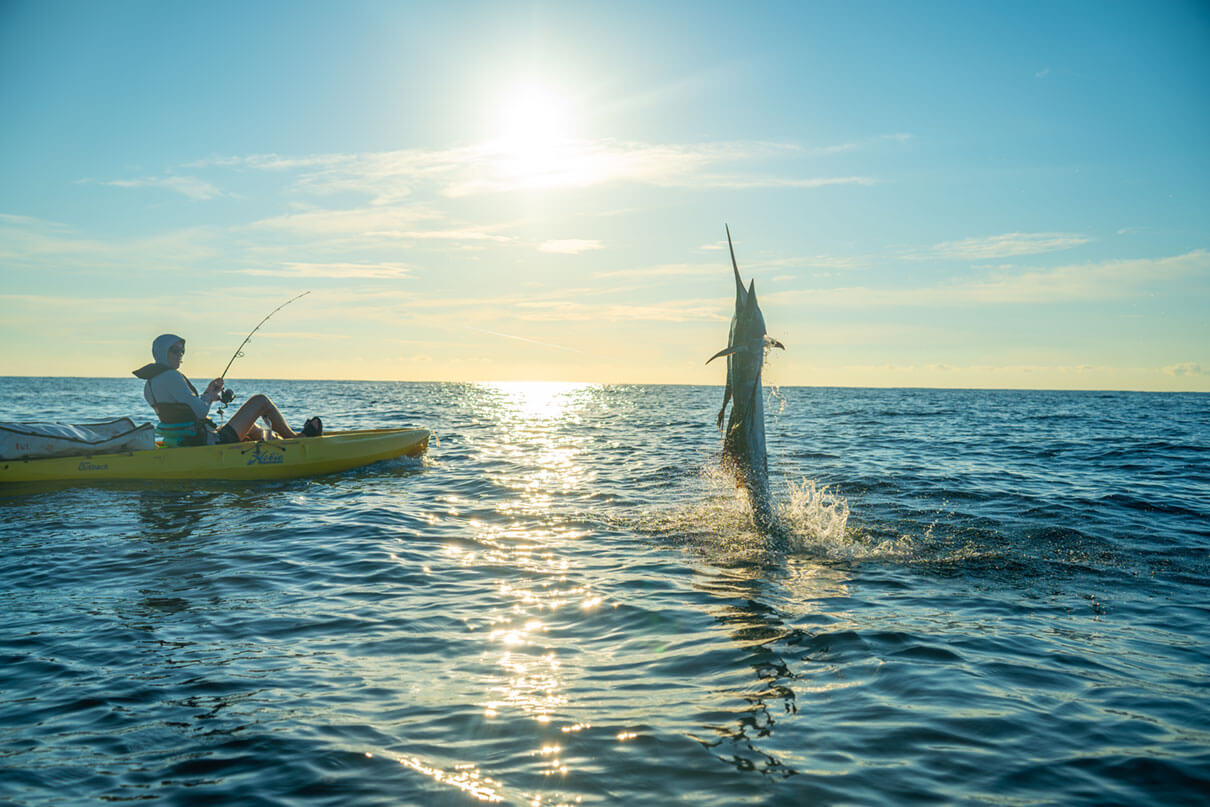
Over time, McDonald learned the value of patience. He points out, “Time on the water equals more fish.” Entering the offshore scene slowly and learning the ropes builds skills that pay off when a big fish is on the line. “It may take a few trips before you’re comfortable kayaking in the ocean, setting baits, managing tackle and gear, and getting a feel for how the weather and water conditions affect fishing.”
The best kayak for offshore fishing is maneuverable to weave through the surf zone. Once outside the breaking waves, the boat should be fast and efficient to cover miles of open water.
“I like a stable kayak with a dry seat,” he adds.
McDonald uses a pedal kayak for speed and distance on open water. Motorized kayaks, with a heavy battery, extensive wiring and expensive outboard motor are too risky to wreck in the surf zone.
Offshore anglers need the area for landing big fish and a ton of gear is a liability in the surf.
McDonald keeps accessories and electronics to a minimum. “I think less is more,” he explains; less gear results in more space for fishing. Storage for gear and tackle, a few rod holders and a five-inch fish finder and GPS display. “I don’t want my cockpit cluttered,” he says. Offshore anglers need the area for landing big fish and a ton of gear is a liability in the surf.
Despite the wide variety of fish in the ocean, McDonald relies on a few rigs and tactics. Whether he’s fishing live bait or casting lures, McDonald uses a seven-foot, medium-heavy spinning rod and 5500 spinning reel. To vertical jig, he has a six-foot rod and 6500 reel. Both outfits are spooled with 50-pound braid and a section of 40-pound fluorocarbon leader.
“My tackle box is full of stinger rigs and vertical jigs,” he says. The stinger rigs are for live bait and he carries vertical jigs in a variety of sizes and shapes to match the conditions and depth. To catch bait, McDonald uses a crappie jig. “I always carry a few Rapala X-Rap lures in case I run out of live bait,” he adds.
Despite the challenging conditions, offshore kayak fishing is pretty simple. Less stuff saves weight to reduce fatigue when paddling or pedaling for miles. Limiting the tackle and gear pays off when a huge fish is on the line. McDonald laughs, “Just be sure your knots are good when it counts.”

River Fishing
Go with the flow to shoot the rapids and target swiftwater fish
One thing new anglers learn quickly is easy access equals crowded water and fewer fish. To take full advantage of kayak fishing, search out new areas that are more difficult to reach. Swift-moving rivers are too shallow and rough for motorboats and pedal kayaks so the fish see fewer lures. Don’t let the obstacles obscure the excitement of exploring moving water for unpressured fish. Exercise some caution to access a river’s bounty.
ACA certified kayak fishing instructor Eric Goodson knows too well about the river fishing learning curve. “My first time kayak fishing I capsized and lost $1,000-worth of gear,” he remembers. After a friend enticed Goodson back onto the river, he discovered, “Fishing the river is exciting because I never know what is around the next bend.”
To assuage his fears, Goodson loaded up on training. Learning to navigate the rapids, fish in moving water, rescue swimmers and practice safety builds confidence to feel comfortable on the water. Always wear a life vest, wear a helmet in rocky water, dress to swim, secure gear on the kayak and fish with an experienced friend.
Kayak choice is critical in swift water. Goodson uses a paddle kayak with shallow draft and a wide beam for standup stability. “A 10- to 12-foot kayak is the perfect size to navigate the rapids and still track straight on flat water,” he adds. He likes a reliable bow hatch for dry storage. Below-deck rod storage is a bonus for bouncing down the roughest rapids.
For simple fish finder functions, Goodson uses a castable fish finder transducer that displays on his smartphone. “When I encounter rocks or laydowns, I pull the transducer out of the water and store it in the kayak,” he says.
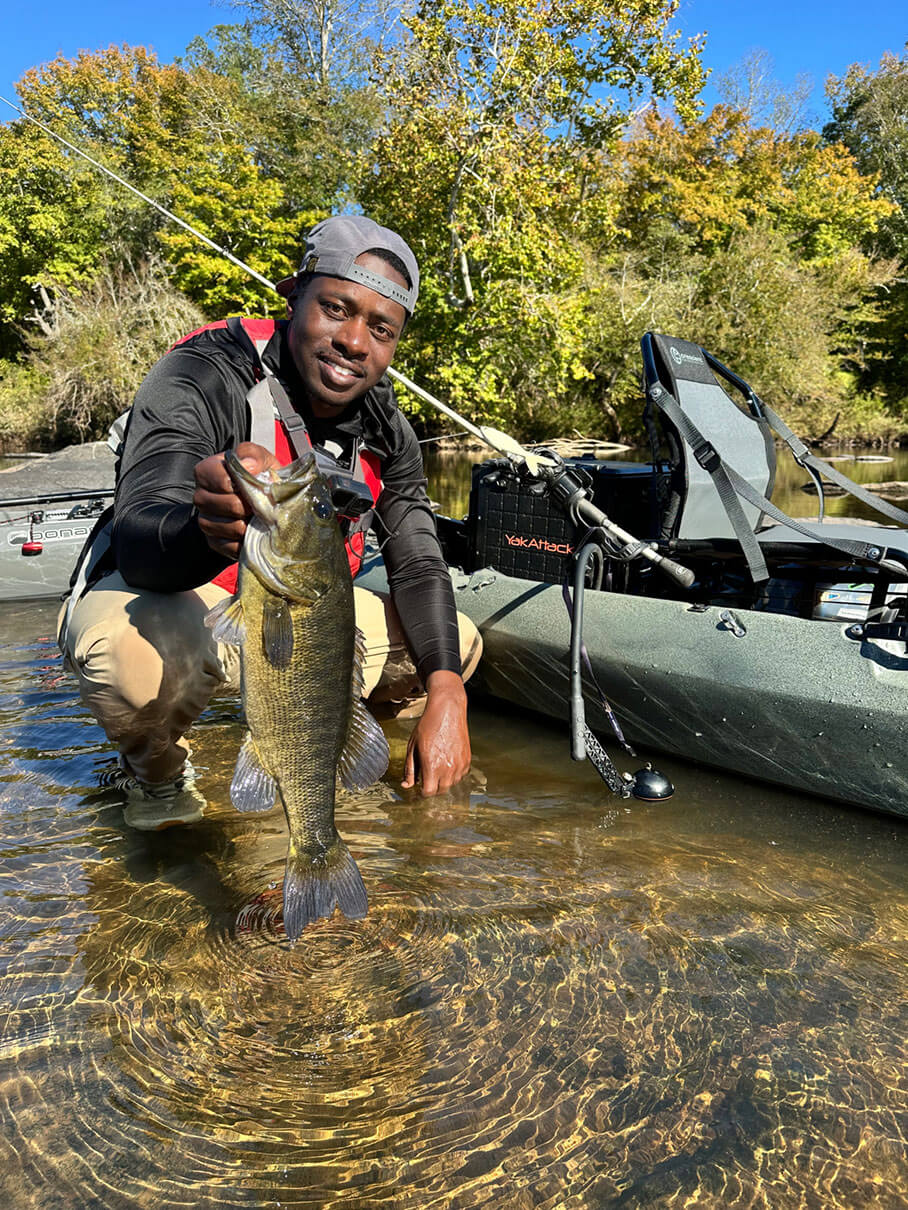
Goodson’s accessories include a gear crate, dry bag, drag strap, first aid kit and anchor system. Anchoring in moving water can be extremely dangerous as the boat is pulled by the current. If the paddler falls out of the anchored kayak, he risks drifting away and losing the boat. Practice the skill in calm, still water and build skills, slowly moving into faster current.
River fishing requires the angler to cut tackle and gear to the bare minimum. “I need the freedom to paddle correctly without hitting phone holders or other accessories.”Excess tackle gets in the way, prevents the angler from reentering the kayak and risks loss if the boat flips. Goodson carries a medium-action spinning rod and 2500 reel for flukes, jerkbaits and shaky heads. He uses a medium-heavy, fast-action casting rod for jigs, Texas rigs, underspins and buzzbaits. For topwater, ploppers, buzzbaits, crankbaits, spinnerbaits, swimbaits and chatterbaits, he uses a medium-heavy casting rod.
To find fish, Goodson offers two pieces of advice. First, he encourages anglers to target high-probability locations. “Focus on river bends and structure; don’t waste time fishing straight sections of the river with no structure,” he says. Second, he emphasizes casting accuracy. “Fish set up behind a stump or right on the river bank or in a cut, so success is a matter of inches,” he says.
Even though Goodson’s first kayak fishing experience was negative (and expensive), he overcame his fears, learned the skills and built his confidence. “Now I’m motivated to explore new rivers; it’s all about the adventure and finding fish that have never seen a lure.”

It’s never too early to start offshore fishing. | Feature photo: Eric McDonald