Ancient Chinese philosopher Laozi says the journey of a thousand miles begins with one step. For beginner kayak anglers, the journey begins with the right gear and a few basic skills. Kayak Angler’s Beginner’s Guide to Kayak Fishing is full of expert advice from experienced anglers who started their journey from scratch. Believe it or not, our pros admit they began kayak fishing with the wrong boat and too much gear. Through years of trial and error, the best guides, outfitters, tournament competitors and instructors learned hard lessons the hard way. Start slow and build skills. Buy quality gear. Keep tackle to a minimum. Tie down everything. Safety first. And enjoy the process. With our guide to getting into kayak fishing, new anglers start their journey a few steps ahead.
Beginners Guide To Kayak Fishing: Boats & Gear

Choosing a Kayak
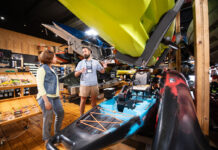
The biggest decision and the biggest investment is purchasing a fishing kayak. Choosing the best fishing kayak is critical to comfort, safety and success. Many anglers are tempted to buy a cheap kayak to get started. “When you are ready to step up, come and see me,” Dean Lokey, owner of OC KAYAK in Ocean City, Maryland, says. Many of Lokey’s customers bought a “starter” kayak only to step up to a better boat.
Chase Christianson, manager of Great Outdoor Provision Company in Virginia Beach, puts it this way, “Buy once, cry once.” He explains an angler is better off spending more money upfront for a quality kayak than buying a bargain boat and later upgrading. “The biggest problem is a new angler who has a bad initial experience and quits kayak fishing to take up golf.”
Christianson and Lokey encourage anglers to choose a kayak from a reputable kayak company with a pedigree of design, durability and versatility. Christianson says a good kayak uses premium materials and sturdy construction. “The plastic is heavier and the boat has a solid feel,” he explains. He looks for a quality seat, rudder system, rod holders, hatches and gear tracks. A fishing kayak is more than a plastic shell—there are dozens of features to improve function and comfort.
A quality kayak is designed and built by people who fish from a kayak. The best kayak companies use professional kayak anglers to test and develop their products. The result is a kayak that performs better with parts that will last the test of time. The same designs trickle down to the company’s less expensive models.
For anglers on a tight budget, bargain boats offer an affordable way to get on the water and into the action. For an angler interested in getting his feet wet without jumping into kayak fishing headfirst, a budget-friendly kayak will provide a taste of the experience. Lokey and Christianson say many of their customers start simple and then come to their shop to upgrade.
Transportation and Storage
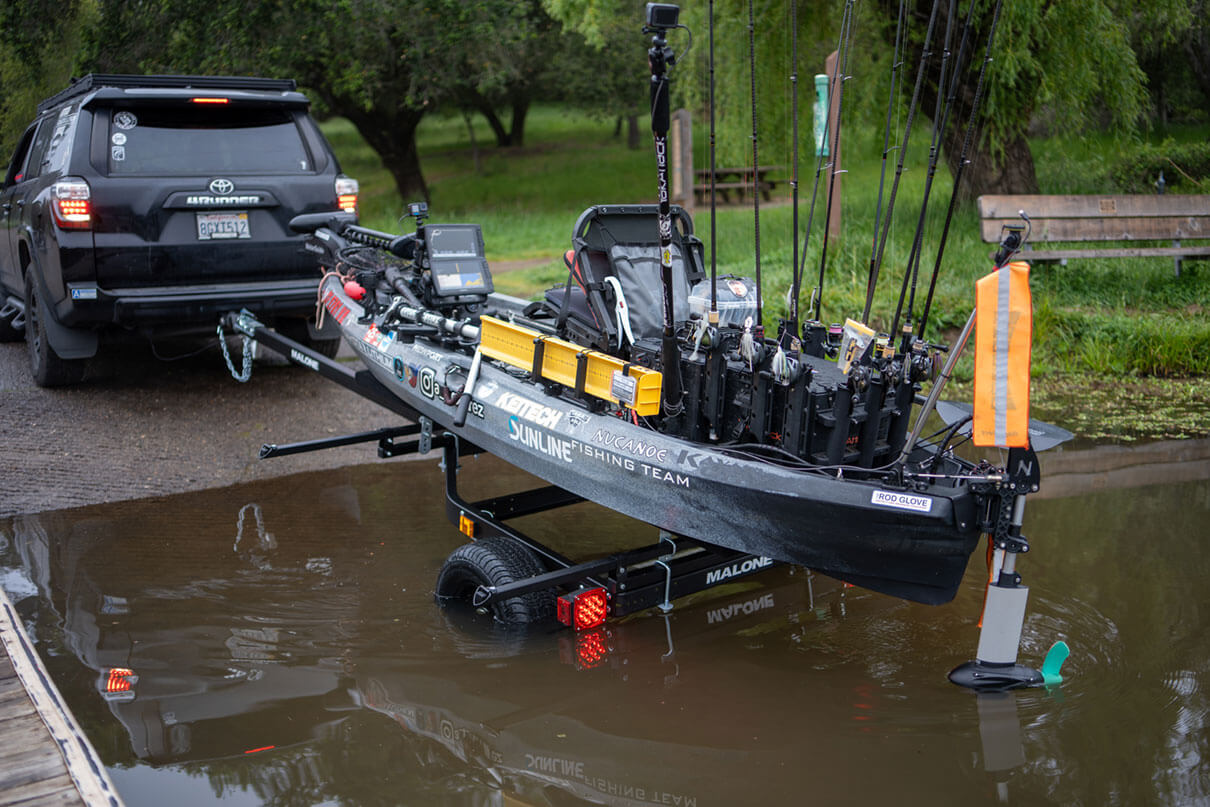
The final question can be a deal-breaker: how will you transport and store the kayak? Christianson puts kayaks in three categories: car-top, truck bed and trailer. “A kayak under 80 pounds rides flat on roof racks,” he says. A kayak from 80 to just over 100 pounds can be wrestled into a truck bed. “Use a bed extender for a kayak over 10 feet long,” he recommends. Heavier, wider and bulkier kayaks, especially motorized kayaks, require a small kayak trailer. “A lightweight trailer is a great idea for cars and SUVs,” Christianson adds.
Most fishing kayaks are too big and awkward for an angler to carry without a small cart. “Be sure to match the cart cradles to the hull shape,” Christianson adds. The kayak needs to be stored on its side or standing on end to protect the plastic from warping. “Be sure there is room in the yard for the boat,” he says.
To narrow the kayak choices down to the perfect fit, filter through fishing needs, propulsion preference, transport, storage and rigging potential. Lokey says, “There are a lot of options and one boat will match the angler’s needs.”
Paddle, Pedal or Motor
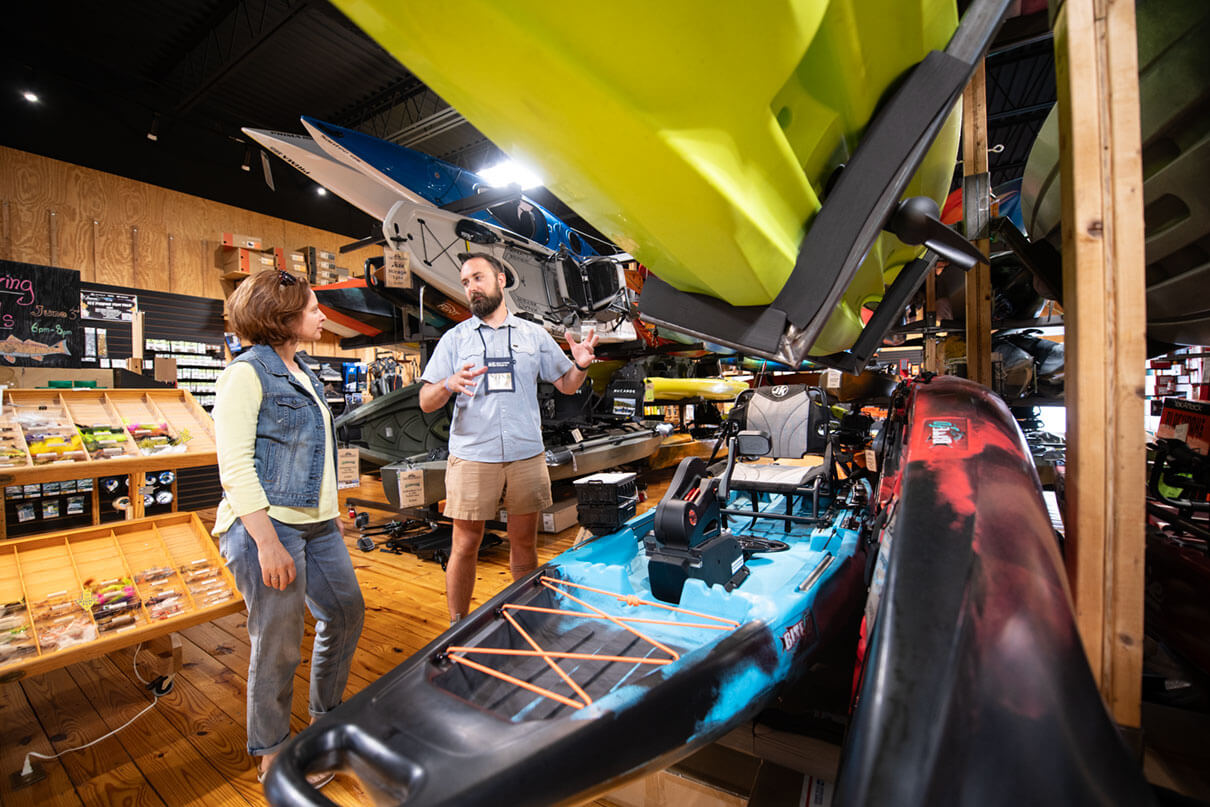
Once money talk is out of the way, the outfitters focus on fitting the kayak to the owner. Christianson and Lokey first ask where the customer plans to fish. Lokey explains, “If you are fishing in ponds, we go with a shorter, wider kayak for maneuverability and stability. For saltwater or large lakes, I recommend a longer, more seaworthy kayak.”
Once the customer’s primary target is settled, it’s time to choose a propulsion system. Christianson breaks it down like this: “Paddle, pedal or motor, each has advantages and disadvantages.”
Paddle kayaks require less maintenance and are easier to transport and store. Lokey says, “A paddle offers complete control of the kayak. I can spin 360 degrees or move sideways with a paddle,” he says. Lokey reminds customers a pedal or motor kayak still requires a paddle to make these maneuvers.
The wide open cockpit free of pedals provides more space for fishing. Christianson adds, “A paddle kayak is better for fly fishing because I lay the line in the cockpit.”
A paddle kayak is ideal for shallow or vegetation-choked water that would foul a pedal or motor drive. “A paddle kayak is best for pond or river fishing,” Lokey says.
Hull design and seat placement are important in a paddle kayak. Christianson describe the best paddle kayak as “light and streamlined, providing less water and wind resistance.” The best paddling kayaks have a low-profile seat and narrow beam with a long central keel with a slight bend called rocker.
Pedal drives have become popular because they increase the boat’s range and speed without overly taxing the angler. Lokey tells customers, “Pedals are more ergonomic and I can go farther.” For open water plagued by current and waves, a pedal system offers the most efficient propulsion. A pedal system also allows an angler to fish from a wider, heavier kayak with greater stability and capacity.
Pedal systems come in two flavors: fin drive and propeller drive. Christianson says the first test is customer preference, “Some people prefer the back and forth motion of the fin drive while other people like the prop drive’s bicycle pedal rotation.” Each system has other advantages. “Prop drives offer instant reverse for hands-free control,” he says. The prop drive is sealed against water and dirt, making it easier to maintain.
For open water plagued by current and waves, a pedal system offers the most efficient propulsion.
A fin drive is lighter and more compact so it is easier to transport and store. Christianson adds, “A fin drive instantly goes into shallow water by pushing one of the pedals forward to flatten the fins against the bottom of the boat.” Some fin drives have a kickup feature that lifts the drive if it hits an underwater obstruction.
Motorized kayaks are the latest craze, but Christianson and Lokey warn new anglers against jumping in with both feet. “Motors require a lot of work and money,” Christianson says. Installing and maintaining the motor and batteries takes time and effort. “A motorized kayak has to be registered,” Christianson adds. The best bet for new anglers is a factory motorized kayak with the motor and battery system integrated in the kayak. Many paddle and pedal kayaks are pre-rigged to add a motor. “You can get the kayak now and add the motor later,” Christianson says. Motor systems are easier than ever to install with readily available kits and powerful, durable and light lithium-iron batteries. Zooming around with an electric motor takes the work out of kayaking so the angler can focus on fishing.
Pick a Paddle
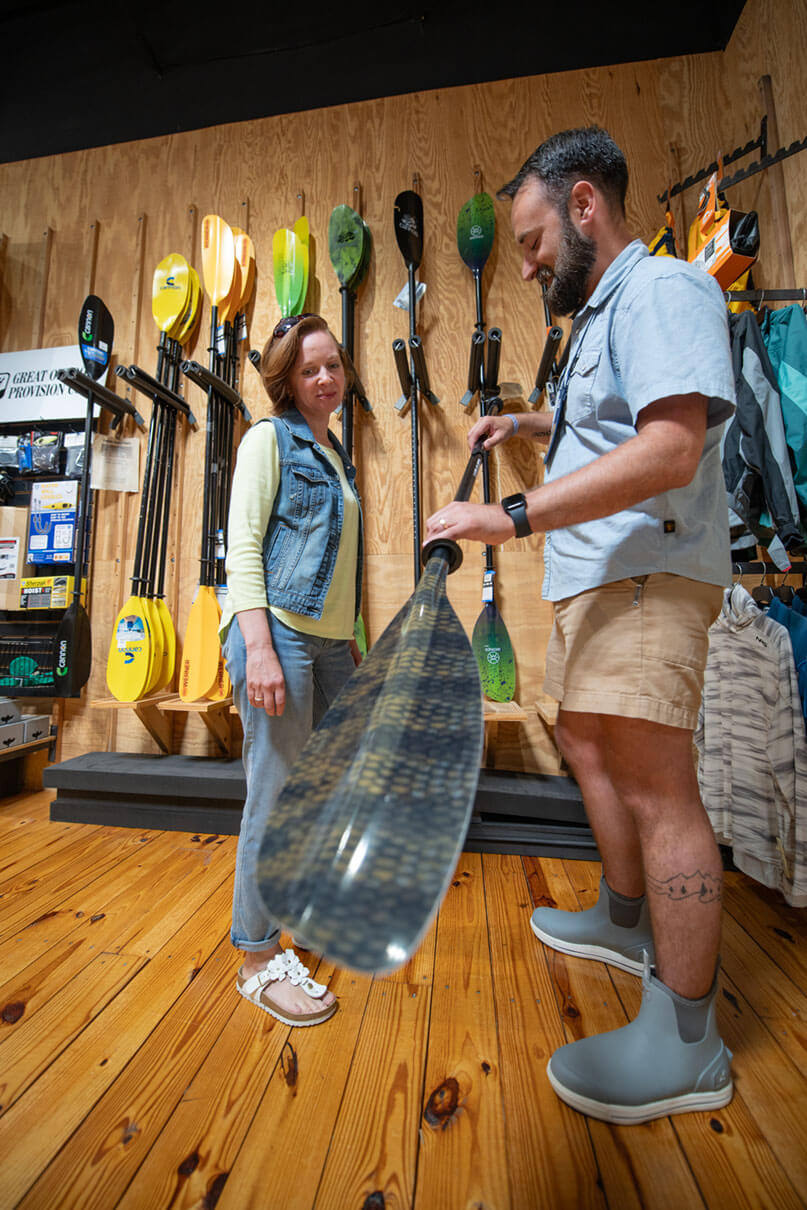
The next purchase is a paddle. Christianson points out, “Even a pedal or motor kayak requires a paddle to maneuver.” Paddle anglers require the best paddle available. “Every paddle stroke depends on the quality of the paddle,” he says. A light and stiff paddle including carbon fiber and fiberglass is up to the job.
Pedal and motor owners may be tempted to save with an aluminum and plastic paddle. Christianson reminds his customers, “Don’t forget you may have to paddle back to the launch if the pedal drive or motor fail.” He recommends a paddle with a carbon fiber shaft and fiberglass blades to combine performance with durability. “A stiff, lightweight paddle makes a big difference in efficiency and speed,” he says.
Paddle length is crucial. “The proper shaft length allows the blades to reach the water and stay close to the boat,” he says. An elevated seat requires up to a 270-millimeter shaft, a low-profile seat only needs a 215- to 220-millimeter shaft. Boat width and freeboard is another integer to compute. The paddle blade or shaft shouldn’t bang the side of the kayak. “There’s no exact formula for paddle length,” he says.
A kayak with a high seat needs a high-profile blade with more surface area to create more torque. A low-to-the-water paddle kayak is better served by a long, low-profile blade that passes easily through the water.
Safety Regs
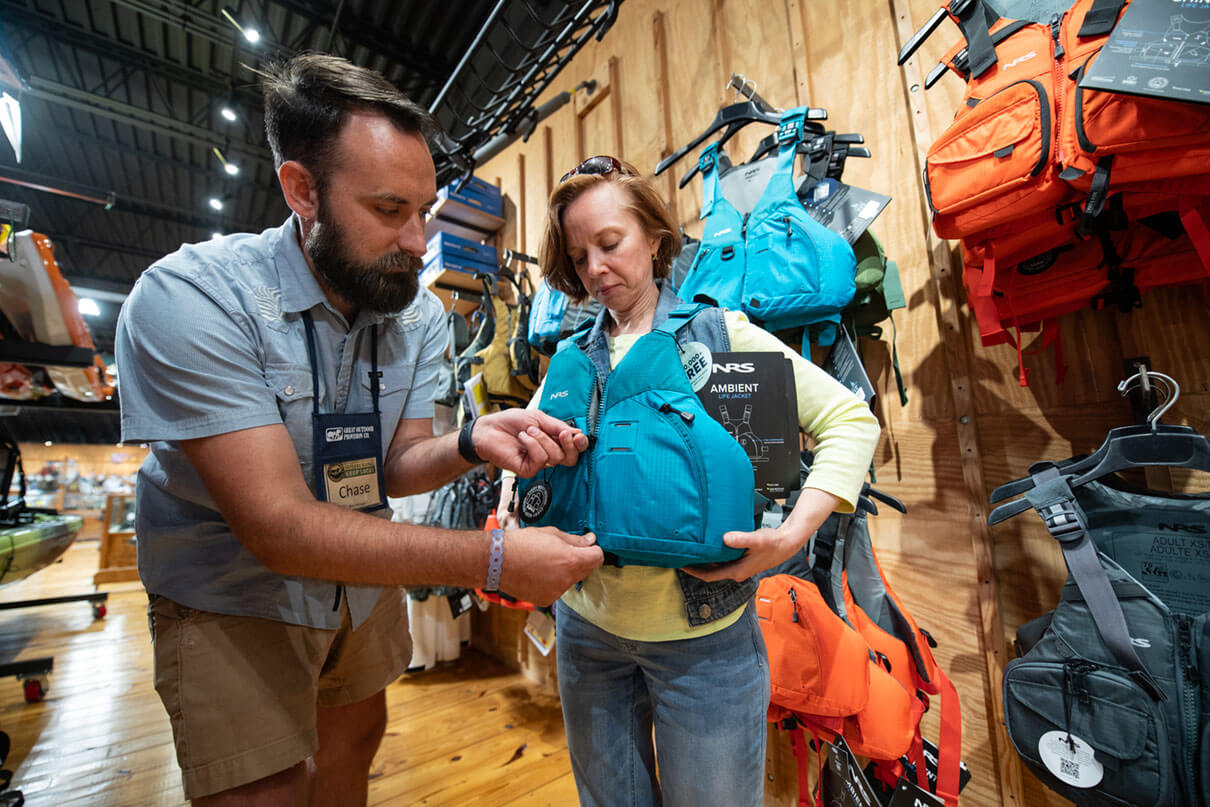
Along with a kayak and paddle, don’t leave the outfitter without a comfortable life vest. Christianson says, “You’ll immediately realize the value of a comfortable PFD.” Kayak fishing life vests come in two styles: foam and inflatable. Foam life vests offer immediate flotation but they are bulky and hot. An inflatable PFD uses compressed air to blow up latex bladders in the vest. When the life vest isn’t needed, the bladders fold up into pockets, making the vest lighter and cooler. In order to meet Coast Guard requirements, anglers must wear the inflatable at all times.
A foam fishing life vest has flotation high on the back to accommodate the high-back seat. On the front, pockets and loops hold small gear items and tools. Lokey and Christianson recommend a foam life vest for beginner anglers.
In addition to an approved life vest, according to Coast Guard requirements, paddle and pedal anglers need a white safety light and a signal whistle. These are minimal requirements.
Accessories
Adding rod holders, cup holders, anchor systems, tackle and gear storage is the fun part. Christianson suggests purchasing accessories after a thorough test-drive. “Don’t get lost in the weeds,” he says. Instead of buying a bunch of accessories, fish the boat a few times to determine where to install bells and whistles.
Lokey encourages anglers to carefully plan their accessory layout. “Be sure you can reenter the kayak if you fall overboard,” he stresses. Lokey has seen anglers with poorly placed rod holders and electronics fall overboard and struggle to climb back into the boat.
To start out, most anglers need a gear crate with rod holders behind the seat for secure storage. An open milk crate style crate holds gear and saves weight while a crate with solid sides and a lid provides protection from the elements.
Electronics
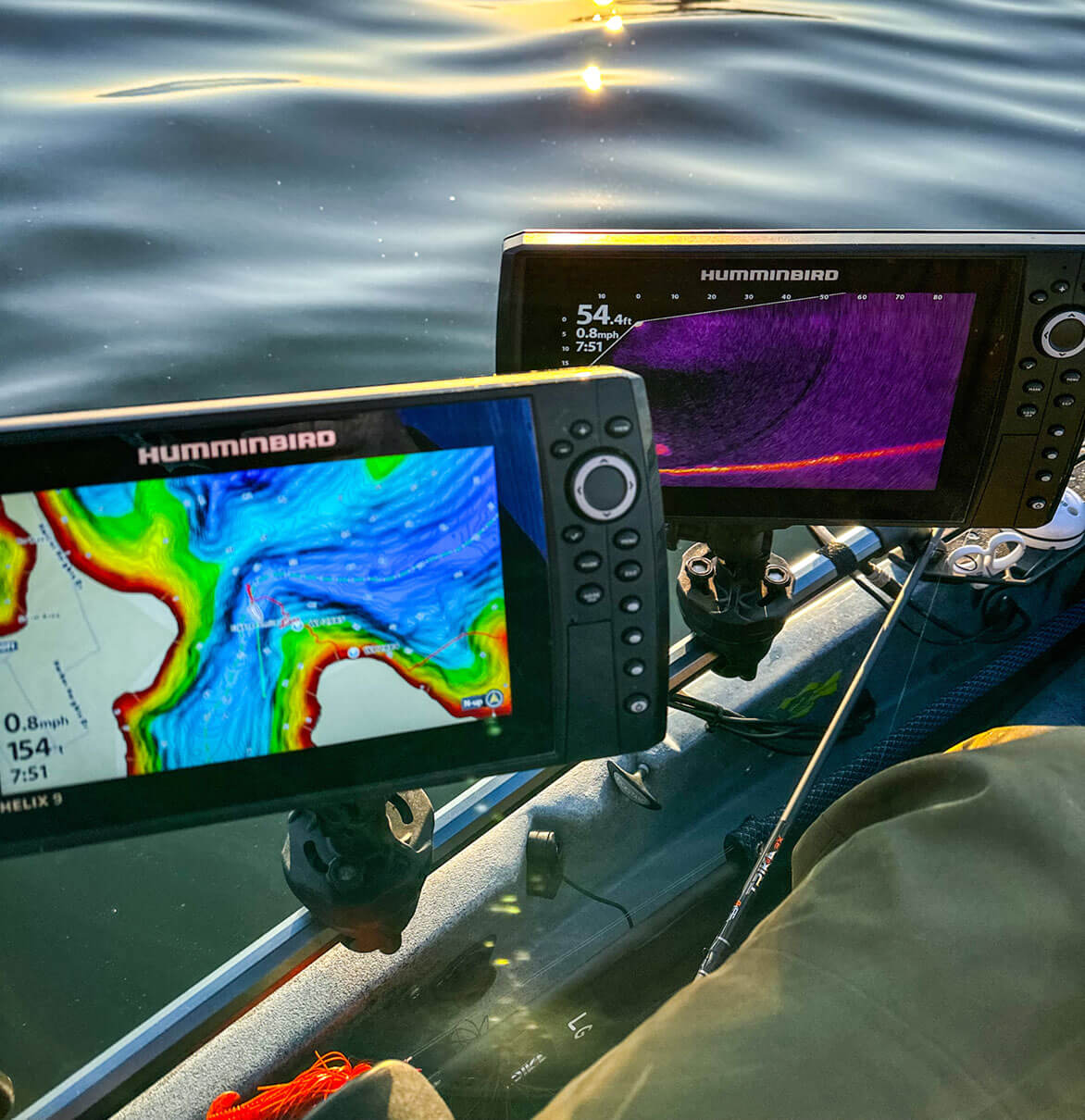
Most anglers want to install a fish finder and navigation system. Lokey points out, “Electronics are incredibly powerful and navigation software improves fishing and safety.” He suggests purchasing a kayak designed with mounting space for the display and routing for the sonar transducer. “You can go for a simple fish finder and GPS or go all the way with forward and side-view sonar along with detailed charts and navigation information.” Christianson recommends starting out with a simple system and later adding forward-facing sonar and advanced charts.

Clothes
Many new anglers neglect purchasing water-specific performance clothes. “A good hat is invaluable,” Christianson says. He suggests a wide-brim hat for all-around coverage. “The underside of the brim should be black to cut glare,” he recommends.
Long sleeve shirts and pants provide full sun coverage. “Fishing in a kayak exposes sensitive skin to the sun,” Christianson says. The material should be light, sun-protective, breathable and quick drying.
Christianson emphasizes solid shoes. “Flip-flops offer no protection or slip resistance if you have to get out and wade,” he says. Christianson likes quick drying and draining shoes with a sole designed for traction on wet surfaces. “There is no substitute for good shoes in the kayak,” he says.
For cold-weather fishing, Christianson’s first choice is a drysuit with sealed gaskets at the neck and wrists. The next best option is waterproof bibs and boots. He explains, “If you fall overboard, the bibs won’t fill up with water.”
From the kayak to clothes, these outfitters emphasize comfort and safety as the first consideration. Christianson points out, “If you are uncomfortable, you will quit.” Disregard for safety has more severe consequences. Matching the kayak, propulsion, accessories and transportation to the kayaker’s needs assures years of happy fishing.
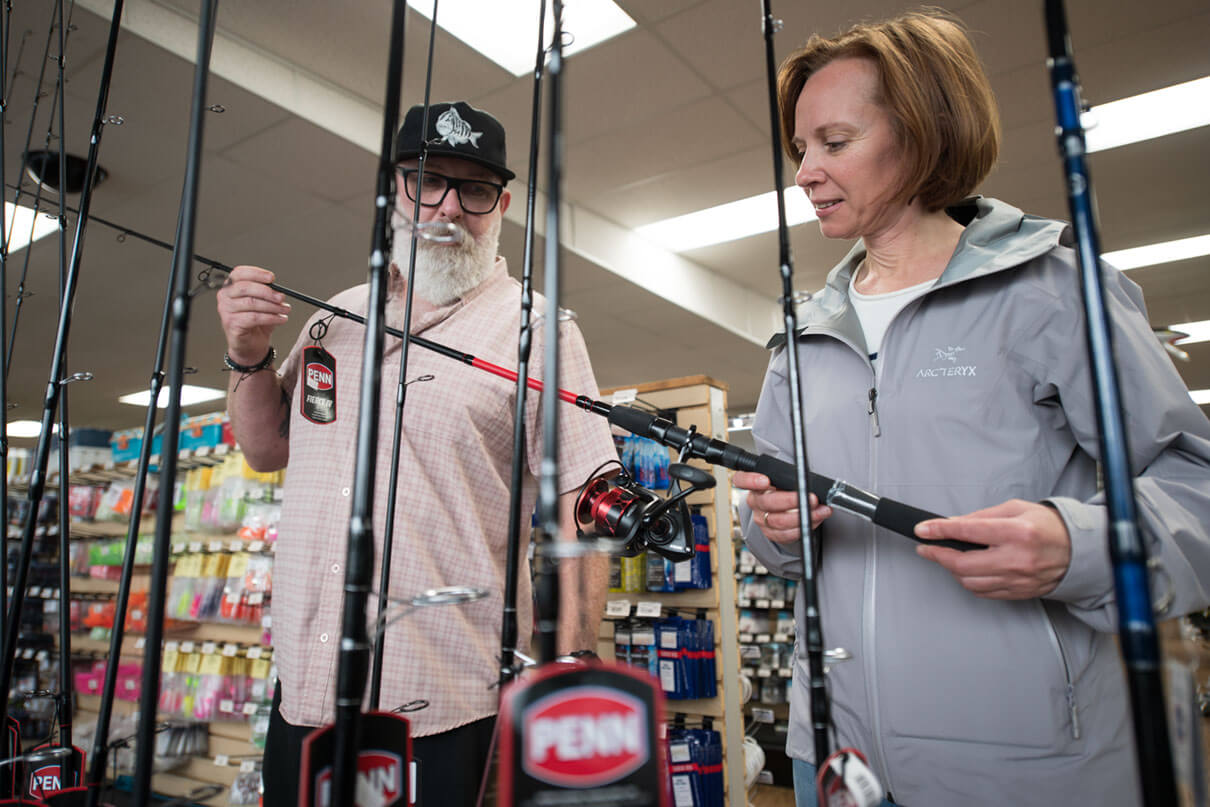
The journey begins in the kayak shop. | Feature photo: Ric Burnley