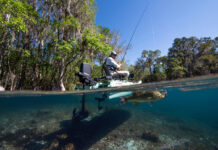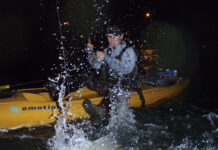
There’s an axiom that describes each angler’s progression in the sport: any fish, many fish, big fish, hard fish. A fisherman starts out happy to catch anything that will bite the hook. Then, he wants to load the bucket with fillets. Next, target the biggest examples of a species. Finally, a life-long angler will spend his old age chasing unicorns with pixie sticks, targeting the most illusive trophies with the most challenging tackle.

That’s where I am. I’ve caught everything, lots of ‘em and big ones. Starting with any panfish, then bailing many school-size stripers, then horsing on big drum, each stage of the progression led to the next.

THE PRICE IS WORTH THE PRIZE;
WE FISH BECAUSE IT IS DIFFICULT. | PHOTO: RIC BURNLEY

Last spring, after landing two big drum in my kayak on the first trip of the season, I decided to take it to the next level. I dedicated my life to catching a big drum in the surf.

Targeting big drum in the surf is my favorite type of fishing. Nothing compares to beating a 50-pound freight train from the beach. Braving the breakers to launch a half-pound of bait and lead 100 yards with a 12-foot surf rod is my idea of fun.

Since my favorite beaches in North Carolina were shut down to protect an endangered bird, I’ve been looking for a new place to fish. The barrier islands of Virginia’s Eastern Shore also hold big drum, but the only way to get there is by boat. Using the kayak as my assault vehicle, I decided to go full metal jacket on old drum in the breakers.

I spent a month paddling to the island, fighting the surf, battling rays, packing, unpacking, rigging, rerigging, break offs, hook pulls, shivering, burning, hiking, slapping flies, cursing, worrying, experimenting, learning and staring at the horizon. I fished after work, into the night, on weekends and even camped out for days. Most of my trips were solo, few people share this passion. On the last afternoon of prime season, I finally hooked and landed a big drum in the surf. The payoff didn’t disappoint. The run, the fight, wrestling in the white water and hoisting the fish for a quick photo before releasing it back into the surf had my head spinning and my knees weak.

Every fish I ever caught contributed to that catch. Hours spent daydreaming at work and nights spent working in the garage prepared me for one big bite. Fishing’s greatest fun isn’t the catch, it’s the hours spent readying for the catch. On page 38, we profile five trophy hunters who chase big fish the hard way. Then, on page 45 we give you 67 skills to get the job done. The editorial staff is dedicated to packing the pages with what, where, when an


This article was first published in the Winter 2016 issue of Kayak Angler Magazine. Subscribe to Kayak Angler Magazine’s print and digital editions, or browse the archives.
 

Previous articleThree Ways to Fish the New SubSurface Pro Lure from Williamson
Next articleHow Fishing Tournaments Plan To Deal With Cheaters
Kayak Angler editor Ric Burnley has been kayak fishing since the dawn of the sport. In 2007, Burnley wrote The Complete Kayak Fisherman, with chapters on how-to make a PVC rod holder and glue a fish finder transducer to the hull. In 2013, he landed his dream job as editor of Kayak Angler magazine. Burnley is a regular contributor to Salt Water Sportsman, Sport Fishing, Outdoor Life, In the Bite and other print and online publications. Burnley lives in Virginia Beach with his wife, adult daughter, daughter’s boyfriend and daughter’s two cats. Experience In 2004, Ric Burnley stole his first milk crate from behind a 7-Eleven and fashioned it into a gear crate for his Ocean Kayak Prowler 15. Many years and many milk crates later, Burnley has witnessed the rise of kayak fishing from a bastardized fringe element to a legitimate industry with millions of devotees. The journey to becoming an angler started early in Burnley’s life. His father, Eric Burnley, is a renowned outdoor writer and former fishing guide, so the boy grew up in the cockpit of a charter boat and in the pages of national magazines. After college, Burnley lost easy access to his father’s boat, but not his passion for fishing. Once he had exhausted the limits of land-based angling, Burnley decided to try out a new thing called kayak fishing. About the same time, Burnley was looking for extra work to pay for his expensive addiction. His father, editor of the Mid-Atlantic Fisherman Magazine, offered him freelance assignments for the weekly publication. That led to a position as regional editor at Salt Water Sportsman, publication of The Complete Kayak Fisherman and editorship of Kayak Angler. Meanwhile, Burnley and his partner-in-crime, “Kayak Kevin” Whitley were exploring the boundaries of kayak fishing. With the bountiful Chesapeake Bay and Atlantic Ocean as their playground, the two anglers were the first to target big red drum, cobia, trophy striped bass, monster black drum, sheepshead and many other species. Once inshore species were exhausted, Burnley loaded his kayak onto motorboats and fished for bluefin tuna, blackfin tuna, king mackerel and amberjack. All the while, Burnley shared his experiences and knowledge with anglers through print, photos, video, radio, seminars and online. Almost 20 years later, Burnley continues to fish obsessively and share the stories. His recent projects for Kayak Angler cover the latest trends in forward-facing sonar and remote-controlled electric motors. Over the past two decades, kayak fishing and Ric Burnley have come a long way from PVC rod holders and stolen milkcrates. Education ● Radford University: BA English; Virginia Teacher’s License. Highlights ● Other Interests: Mountain biking, traveling, hiking, surfing and skateboarding ● Day Job: High School English teacher at an alternative school for at-risk students Fun Fact Ric’s name is a contraction of Eric. Ric is named after his father, Eric Sr. To differentiate between the two Erics, Mrs. Burnley removed her son’s E. To this day, she writes the boy’s name ‘Ric, with an apostrophe replacing the E.

Leave a Reply