When I close my eyes, I dream of white sand beaches, deep blue skies, crystal clear water and all the fish I can catch. When I open my eyes, I’m standing on the beach in Panama City, Florida about to launch my Hobie Revolution through the surf. This is the last day of a nearly week-long fishing bender that I spent with the folks at Hobie Fishing on Florida’s Forgotten Coast, the stretch of sand, from Mexico Beach to St. Marks.

Kayak Fish and Rediscover Florida’s Forgotten Coast
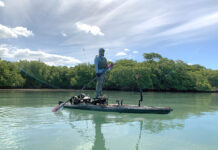
The trip started three days earlier on St. Joseph Bay near Blacks Island. Even though the wind was blowing and rain was falling, the water was still crystal clear. Our guide, Jerry McBride, found a sheltered spot where we were able to catch sea trout and flounder by working a weighted worm hook and three-inch Aqua Dream soft plastic jig over the grass and through sandy spots.
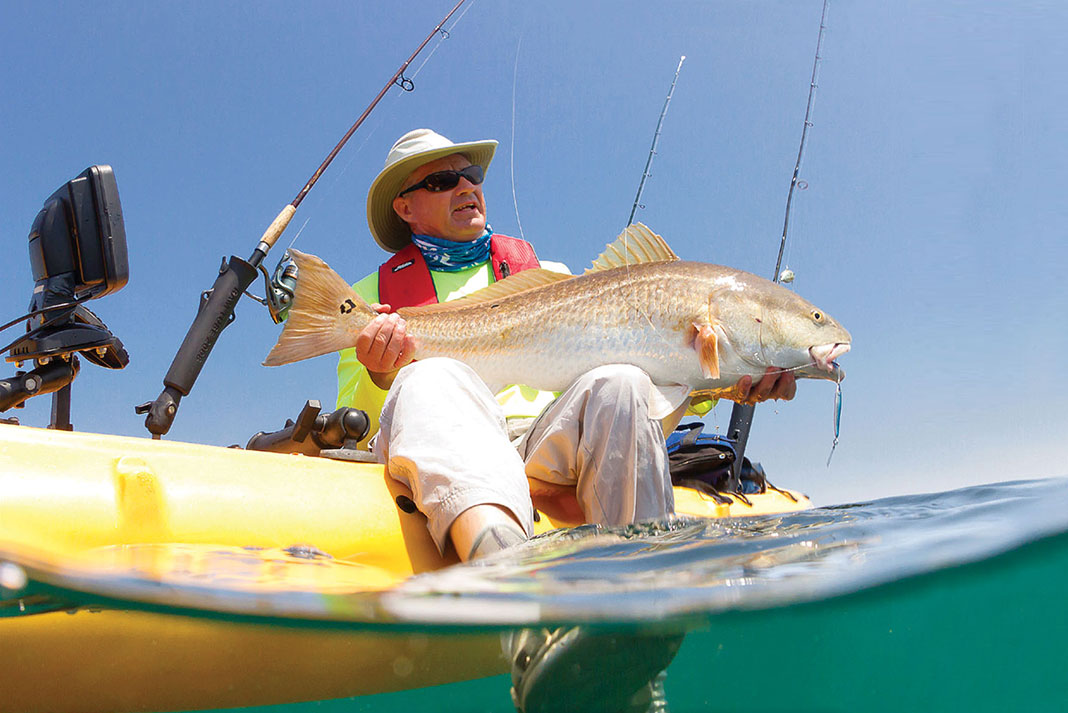
The next day, Cheryl Little, of Bay County Outdoors, led us to a small creek mouth near Crooked Island Military Base. Once again we found acres of submerged grass and clear water, but this time big trout and reds were in the area, too. Live Target swimming plugs and Aqua Dream soft plastics drew strikes from each species.
I spent the day sight casting to reds and trout with a four-inch fluke rigged on a 1/8-ounce jighead. At one point a huge school of big drum surrounded my kayak, but when I cast into the melee, I pulled out a big bluefish!
Fishing was even good at night. Local backwater guru, Nathan Chennaux, took us to East Bay where we found 10- to 20-pound reds exploding on the surface. All we had to do was cast a big Live Target swimming plug up current and work it slowly back to the kayak. Whammo!
But the real treat came on the last day of the binge. Cheryl rounded up local anglers, Hannes Venter and John Ritchey, who agreed to take us to their honey hole off Panama Beach. A little after 9 a.m., we launched through the surf and paddled less than a mile to an artificial reef in 50 feet of water.

By using a fish finder to mark the structure and a GPS to track our drift, we were able to bounce vertical jigs in front of the fish hanging on the reef. The action started slowly, but when the current dropped out, the fishing picked up. Our crew first caught a few flounder and a couple triggerfish. Then someone got a small grouper. Another angler hooked into something nicer, a big red drum. Three more anglers hooked into big drum. Then I caught a big red snapper and, moments later, another big snapper. It was a blitz!
The action lasted a couple hours before the wind and current picked up again and we decided to pack it in. As I paddled through the emerald green water back to the snow white beach, I recalled the great fun, beautiful surroundings and spectacular fishing that would become my memories of the Forgotten Coast.
Tackle Tips
Rod and Reel: For inshore fishing, choose a seven-foot, six-inch medium-action spinning rod and a 4000 series reel. Cobia and tarpon require a heavier spinning set-up. To fish the offshore reefs, a medium-action jigging combo and a selection of two- to five-ounce vertical jigs will catch everything from red snapper to red drum. Troll a swimming plug with a medium action casting set-up to score kings and tuna. A Carolina rig and cigar minnow or live bait is deadly on grouper, snapper and flounder.

Don’t Miss
In addition to great fishing, St. Joseph Bay offers incredible scalloping. The season is open from June 29 to September 24. To spend a day off the water, check out flora and fauna at St. Joseph Bay State Buffer Preserve. Or join the wildlife in downtown Panama City, with shopping, eating and activities that are fun for all ages.
Home Base
Windmark Beach Cottages: Condos and cottages with good food and great shopping nearby. (850) 229-6344, windmarkbeach.com
Dixie Belle Motel: Clean, convenient and cheap—the trifecta for kayak anglers. (850) 227-1443, dixiebellemotel.com
Seasons on the Water
January to March: Trout, redfish, sheepshead, black drum, pompano and flounder
April to June: Trout, redfish, flounder, cobia, tarpon, Spanish mackerel, king mackerel, bluefish and jacks
July to September: Tarpon, trout, redfish, bluefish and jacks
October to December: Flounder, pompano, redfish, trout and king mackerel
Tourist Info
More lodging, dining and things to do: visitgulf.com
Fishing reports, how-to, and fishing with Nathan Chennaux: baycountyoutdoors.com
Florida’s Forgotten Coast offers both inshore and offshore fishing in uncrowded waters. | Feature photo: Jeffrey Fortuna