

I had to fight my way through the convention center crowd, pushing sales representatives and reporters out of the way, to reach Feelfree Kayaks’ booth at ICAST. Squeezing through bodies, I found an opening large enough to see a bright blue trimaran outfitted with motor, pedals, digital display and a dozen LED lights.
Like townies at a UFO sighting, the throng had gathered to behold the most advanced kayak in the galaxy. But I knew I would be one of the first to get a ride.
The Introduction Of The Dorado 125
A few years ago, Feelfree introduced the world to their Dorado 125 concept boat at the ICAST tackle show in Orlando, Florida. Feelfree designer Peter Murphy introduced the boat, “To get ahead of the expanding pedal market, we knew we had to give customers more than they expect.”
Standing in the crowd of gawkers, I was looking at the future of kayak fishing, a fully functional mini-boat with pedals, paddle or motor.
When Appomattox River Company in Hampton, Virginia received the Dorado 125, I was first in line for a test drive.
First, let me address the elephant in the room. The Dorado weighs 124 pounds. Add the pedal system, a 12-volt marine battery and all the rigging and the boat outweighs me. But this isn’t your grandfather’s sit-on-top kayak.
The Fully-Rigged Fishing Kayak
It’s a member of a new age of personal fishing craft—the mini boat.
On the water, the Overdrive counters the weight issue. With the right power, a heavy kayak performs better. I used my Malone Micro-Sport trailer to transport the boat to the launch.
Feelfree’s famous Wheel in the Keel makes it possible to move around the yard and roll down the ramp. The boat’s weight isn’t an issue with the right transport system.
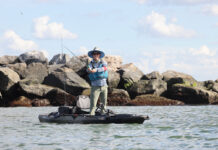
Now the air is cleared, I could enjoy the Dorado 125 for what it is: a fully-rigged fishing platform for serious anglers.
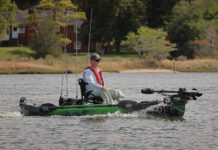
The trimaran hull keeps the 12-foot, five-inch-long boat rock solid and straight as an arrow. The boat’s weight further improves handling and stability. I had no problem moving it with the pedals.


The Dorado 125 Features
Feelfree installed a healthy, Beavertail rudder to turn the boat. A cool-looking stick-shift arm with eight-ball knob controls direction. It took some practice to index the center of the rudder control and the stick got in the way, but I felt like Cletus Snow in Smokey and the Bandit trucking across the water.
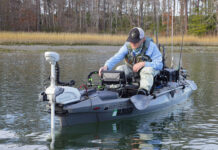
The topside is equally pimped out. A small tankwell comes with gear tracks and bungees to secure gear. Behind the seat, four flush mount rod holders (two on each side) are easy to reach and angled for trolling. A unique thru-hull is rigged with a lever to lift and lower the transducer.
Between the tankwell and seat lies the Dorado’s brain. A sealed battery compartment, big enough for a 12-volt battery, is prewired to control the boat’s electronics.
The Dorado is rigged to run power to the optional Overdrive motor, two USB ports, a 12-volt cigarette lighter, electronics and 10 flush-mounted LED lights.
Since the Dorado is designed to run an electric motor, red and green navigation lights in the bow and a white light in the stern keep it legal. The rest of the lights illuminate the cockpit, gear hatch, tankwell and hull of the boat.
Most fishing tournaments start in the dark, and serious anglers usually fish into the night, so the lighting will be appreciated. With the 12-volt battery running the show, there’s plenty of power.
The Mini-boat pedigree
The Dorado has a flat, padded deck that is open bow to stern. A pod in the center of the deck is pre-wired for fish finder and GPS and large enough to hold the day’s tackle.
Of course, Feelfree outfitted the Dorado with their famous Gravity seat. Using the magic of mechanical engineering, the seat ratchets up and down for the perfect height. The frame is mesh-covered and molded like an office chair.
To adjust pedaling position, slide the seat forward and aft on a notched frame.
The lights, rigging, seat and design are a worthy showboat for Feelfree’s Overdrive system.
The world has waited for the first working pedal and motor combination drive, the Overdrive does not disappoint.
Unfortunately, the test boat didn’t come with the motor drive. The electric motor, about the size of a loaf of Italian bread, fits inside the pedal drive. An LED screen displays information about battery power, speed and performance.
The Dorado Comes With Proper Toys
A wired remote controls direction and speed. The boat is pre-wired to connect the motor to the 12-volt battery, just plug and play.
The motor and frame are cast aluminum making the Overdrive bulletproof, and a little heavy. Remember, we’re not worried about weight on this rig. The base is wedged into the scupper and is held in place with a thumb screw. There is some flex, but not enough to seriously affect performance.
The rubber meets the road when I put the Dorado in the water and let her go. With the seat adjusted, I pulled two spring-loaded pins, and the propeller dropped into the water. Turning the pedals, the Overdrive propelled the kayak without complaint. I always over pedal, turning the cranks faster than necessary.
I found a steady pace to push the kayak at a good clip, even into a stiff wind and head sea. The Dorado goes anywhere with little effort. Bigger, heavier, purpose-built pedal boats actually perform better than hybrid pedal-or-paddle kayaks. The Dorado was designed for power, and handles it well.
Specs For The Dorado 125 Fishing Kayak
Length: 12’11
Width: 37″
Weight: 124 lbs
Capacity: 450 lbs
MSRP: $2,999
www.feelfreeus.com
The world’s first pedal and motor combination doesn’t disappoint.
Photo: Roberto Westbrook




Fun to read Review and made me excited about ordering the V2 version of this Kayak, I am blessed enough that I could have purchased any Kayak on the Market, but this one , wow, it has it all… and seems very well built, not to mention the colors are impressive as well….. Heavy does not concern me at all as I have always had to Trailer my Kayaks to the lakes around me … so that is a none issues and really its in the ball park with its competitors weight wise……. I just nailed a sweet Deal on mine at 2499…… All I can say is wow, I can not wait to get it…..
Thanks
Charlie