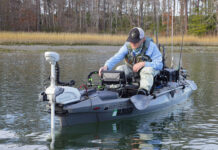
Daylight savings time sucks. Every fall, just as speckled trout fishing gets good, for some ancient reason, I’m ordered to cut an hour off my after-work fishing time. This fall, I had a plan to add an hour back to my day.
Instead of rushing home after work and loading my gear, I decided to pack the night before and hit a spot closer to work.
The only problem is this spot is not close to the parking lot, requiring me to cart my kayak a couple hundred yards to the water.

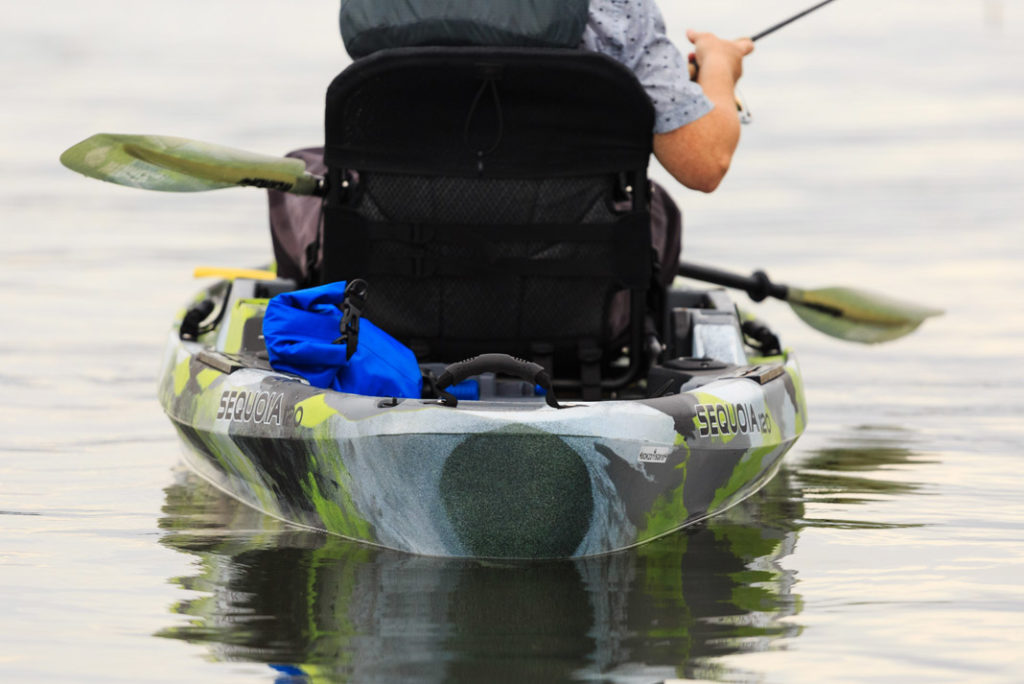
Evoke’s Sequoia 120 Standup Hybrid
The plan required cutting down on gear and rigging to save weight and time. To pull it off, I would stuff the kayak with rods, tackle, paddle and PFD. Water bottles, a ham sandwich and a handful of granola bars were packed in a rucksack.
For this excellent adventure, I would need a time machine to travel one hour back into the past. I found the perfect platform at last summer’s Paddlesports Retailer trade show in Oklahoma City.
Evoke’s Sequoia 120 Hybrid Specs
LENGTH: 12’6″
WIDTH: 35.6″
WEIGHT: 94 lbs
CAPACITY: 500 lbs
MRSP:$999
In 2017, two giants in the plastic molding world, KL Outdoor and GSC Technologies, combined to make Hemisphere Design Works. Hemisphere says the merger creates the world’s largest kayak manufacturer; the company estimates it controls one third of the market.
Wes Mooney, vice president of sales explained to me, “The combined entity is the only kayak company who can make twin-sheet thermoformed, blow molded and rotomolded kayaks.”
[ Kayak Angler Buyer’s Guide: See All Hybrid Kayaks ]
Putting out a half-million kayaks a year also allows Hemisphere to cover the gambit from recreational sit-insides to pimped-out fishing kayaks.
Photos: Roberto Westbrook
Evoke is their premium line and the Sequoia 120 represents their first stand-up hybrid. “Our pro staff loves the stability and abundant storage,” Mooney added. I was all about the storage.
I took my first ride on the Sequoia at PSR demo day on a windy and choppy section of the Oklahoma River. A quick spin in snotty conditions planted a seed in my mind—I knew a perfect place to use this new kayak.
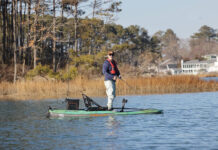
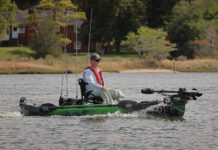
The boat features an open deck from stern to bow for maximum fishing room
A few months later, Evoke delivered a camo green Sequoia 120 to the Kayak Angler man cave. When the days started getting shorter and the speckled trout and striped bass moved into my favorite fishing hole, I put the stand-up stand out into rotation.
Evoke’s line-up consists of nine boats. A 10- and 12-foot sit-inside, a recreational sit-on-top and fishing sit-on-top in two sizes, and the Sequoia, a hybrid paddleboard and kayak. With the do-it-all design covered in Evoke’s other eight boats, the Sequoia is a niche boat aimed at stand-up, skinny water anglers.
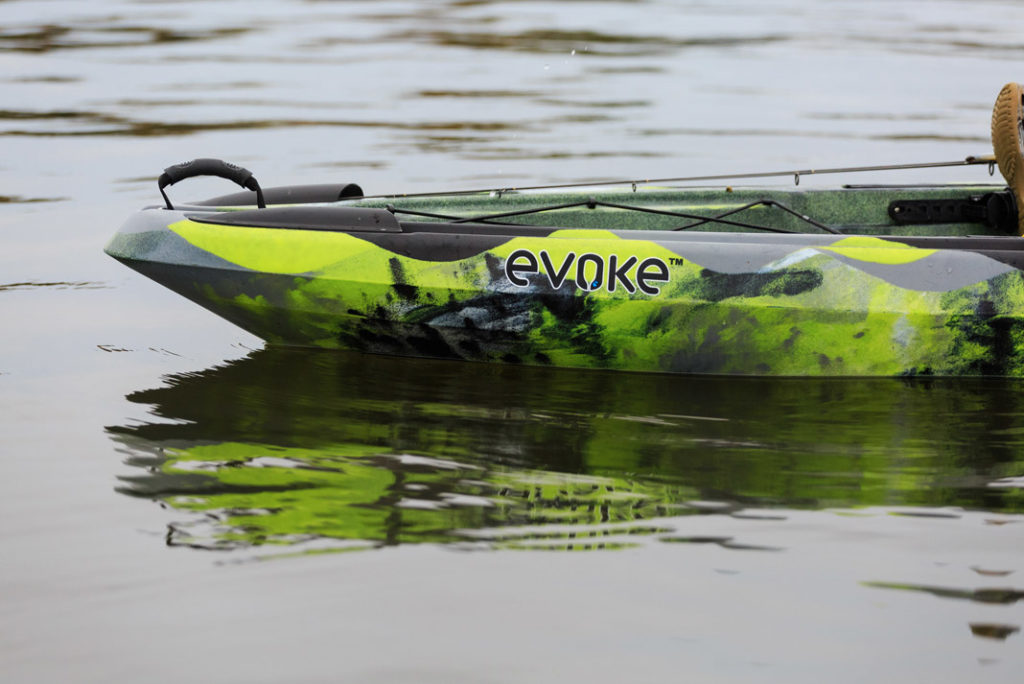
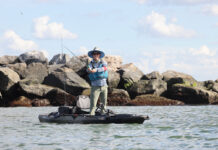
The boat features an open deck from stern to bow for maximum fishing room. I can move fore or aft to fight a fish or reach gear without a wobble. Ridges and grooves make the deck sturdy for stand-up fishing. They even included a handy stand-up assist strap with fish ruler.
The open design also allows anglers to pile the boat with gear, coolers and crates. A 500-pound capacity provides plenty of flotation to take everything and the kitchen sink. A mesh gear cover in the stern and crisscrossed bungees in the bow make it easy to add gear and keep it in reach. By stuffing a drybag with warm clothes under the bow bungees and sliding my tackle box and rucksack in the stern, I avoided taking a crate, saving one more step in rigging the boat.
Design features like rod tip protectors in the bow are perfect for paddling deep into the brush
Even though the Sequoia can carry it all, I appreciate the boat for minimalist, quick trips off the beaten path. Design features like rod tip protectors in the bow are perfect for paddling deep into the brush. I was able to lay my rods on the deck, with the reels under the seat, for low-profile performance.
The Sequoia’s mesh-covered frame seat can be moved from high to low position, folded out of the way or removed to turn the kayak into a SUP. With the seat removed, the space fits a cooler for dry storage and an elevated casting platform.
[ Kayak Angler Buyer’s Guide: See All Hybrid Kayaks ]
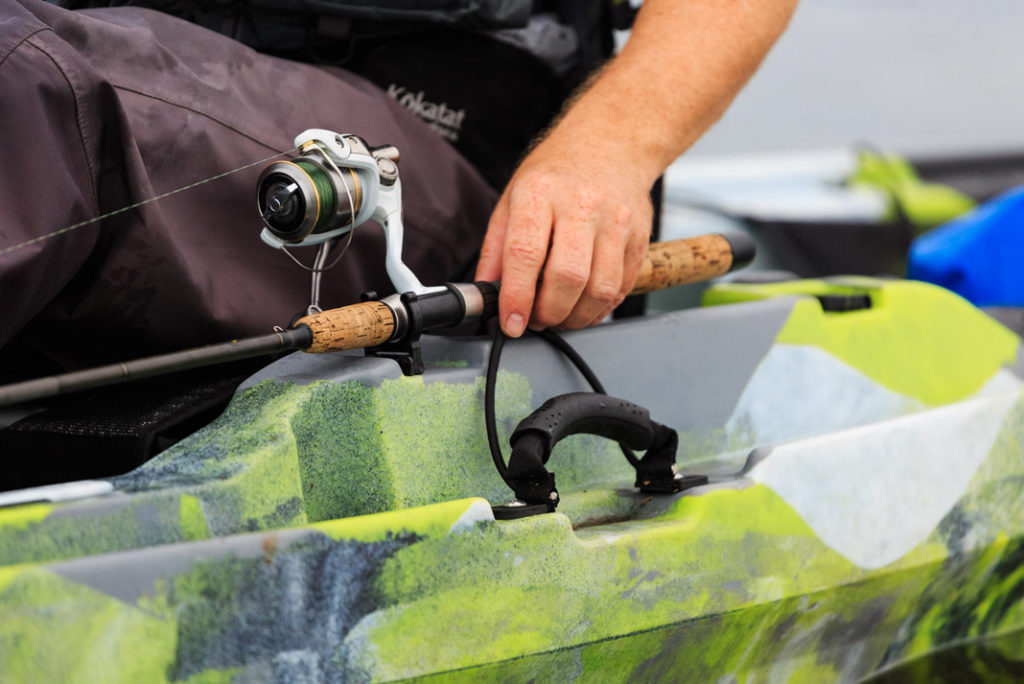
Flush mount rod holders behind the seat are convenient for storing rods and set at an angle for trolling. Gear tracks on the gunwales at mid-ship and in the stern allow anglers to customize the design with rod holders and other accessories.
VIEW ALL ROD HOLDERS
The hull is designed for standup fishing, too. A virtually flat keel with a ridge running down the outer edge is rock solid when standing. The unique design improves tracking without hindering maneuverability. The boat is fast on the straightaways and quick in the turns, whether I was paddling from the seat or standing up.
The smart design, with easy-access hatches in the bow and stern, makes it possible to pack my gear in the boat so I’m ready to hit the water at a moment’s notice. I could leave my paddle, PFD, rods and tackle boxes in the boat and out of the elements.
The Sequoia shined in the backwaters where I do more fishing than paddling. Keeping gear below deck allowed me to drag the kayak through the sticks and lower it down steep embankments.
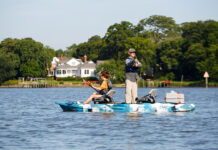
The user-friendly layout and easy stability and handling make the Sequoia a great choice for new paddlers
With any new design, there will be growing pains. The flat deck never seemed to drain completely, so puddles form in the bow and stern. The seat is comfortable and light, but a little sparse for all-day sitting. Fold-down clips on either side of the seat are convenient for holding paddles or fishing rods lying on the deck, but the plastic clips require two hands to use.
I found myself grabbing the Sequoia when I was heading to out-of-the-way destinations or carting through my neighborhood to the local bass pond. The user-friendly layout and easy stability and handling make the Sequoia a great choice for new paddlers, it’s the first boat I grab when inviting a guest on one of my backwater adventures. I’ve also found the standup hybrid a perfect addition to the fleet for a grab-and-go boat with minimalist rigging and an open design adding hours to my fishing schedule.