
I discovered the spot by accident. I had just moved across town and started exploring nearby rivers to stay in shape over the winter. Using local paddle shop Wild River Outfitter’s interactive website, I crossed off one public access after another until I stumbled on a forgotten kayak launch at the back of an obscure city park.
After a few miles on the river, I realized it dumped into one of the area’s mythical fishing holes. Old-timers tell stories about the place. Few people know about it anymore and hardly anyone fishes there. My secret launch gives me access to the shallow headwaters of the river, where boaters can’t reach and other kayak anglers haven’t discovered. Since it was the off-season and nothing was biting, I put the info in the back of my mind with plans to return in the fall.
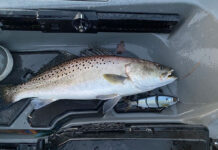
Through spring and summer, I turned my attention to other locations. Everywhere I went, I was confronted with crowds of kayak anglers. Though I’m happy to see the sport’s popularity grow, I’m not crazy about it growing in my favorite fishing hole. It seems one angler’s success spawns a half dozen other anglers and before long everyone is fishing the same places, leaving trash and beating up the fish. Finally, in the fall I returned to the secret spot to test the waters. My first cast, I hooked up to a speckled trout. Then I caught a redfish and a striped bass.
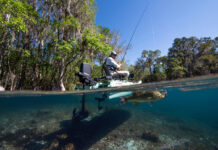
I hit my spot at least once a week; it’s on my way home from work. I explored every bend in the river, dock piling, deep hole and shallow flat. I never once saw another kayak angler and only spotted a couple guys in a small skiff who were as surprised to see me. As the water cooled and the specks and reds moved out, big striped bass showed up and I ended the season with the best striper fishing in five years.
The power of the experience didn’t really hit me until I was writing the Conservation column about the restoration of Back Bay, a legendary bass spot.
Like me, kayak fishing guide Cory Routh discovered a hidden gem when he moved across town.
“The place looked fishy,” Routh told me. “I gave it a try.” Exploring the area from the marshy bank would be impossible and a motorboat would get tangled in the thick mats of subaquatic grass. “A kayak is the only way to fish the bay,” he said.
Routh’s discovery of a forgotten bass haven inspired him to make a film about the bay’s recovery. His film has gone viral, drawing more attention to assure this important body of water will never be forgotten again. After discovering this connection, I thumbed through this issue looking for other kayak fishing discoveries.
In “Bunsby Brouhaha,” on page 40, two old-school paddlers use motorized kayaks to discover new fishing grounds. Each of the Tactics columns, starting on page 30, is the result of the discovery that would not have happened without a kayak. Every page holds a discovery not possible without kayak fishing.
[ See the largest selection of boats and gear in the Kayak Angler Buyer’s Guide ]
When asked why they kayak fish, most anglers point to the low cost and simple convenience. Don’t forget our small, shallow-draft, indestructible boats offer easy access unmatched by motorboaters or bank fishermen. Not only do we get away from the crowds, but we take the pressure off popular, over-fished spots becoming choked with trash.
Sure, it’s easy to roll your kayak down to the popular spots and fight the crowds, but the discovery is the soul of kayak fishing. This year, pull out a map, befriend an old-timer, get out and explore. You might be surprised by what you find.