When I launched from my local beach, the waves were lapping on the shore. Sometime in the two hours and three miles I paddled, the current kicked up and the wind whipped offshore. By the time I returned to the beach, the surf was pitching and peeling, perfect A-frames.
Shit! I’ve got $3,000 of gear on a kayak and the Graveyard of the Atlantic between me and home. This is when the lizard brain kicks in.
According to an article on Scientificamerican.com by brain researcher, Ben Thomas, in the 1950s, Doctor Paul D. MacLean theorized how the physical parts of the brain work together to control behavior. Basically, he broke the brain down into the human, animal and reptile. The human controls empathy, the animal covers habits and the reptile, or lizard brain, fires our most basic instincts.
Thomas says the theory has been debunked by modern psychology, but it still presents a simple understanding of brain function and human behavior. In popular culture, the amygdala is associated with instincts, primal urges, fight or flight. Urbandictionary.com defines the lizard brain as “where gut feelings originate.”
On the Internet, the lizard brain doesn’t get a lot of respect. Seth Godin, marketing guru and host of Seth’s Blog, says the lizard brain keeps people from achieving great things, taking chances, running the risk. “Why did the chicken cross the road,” he asks. “Because the lizard brain told it to.”
Brain researcher Ben Thomas illustrates the lizard braid with a scene from Hunter S. Thompson’s Fear and Loathing in Las Vegas.
[ See the largest selection of boats and gear in the Kayak Angler Buyer’s Guide ]
Drunk and high, Gonzo journalist Raoul Duke hallucinates gamblers in a casino turning into giant lizards. “Someone is giving them alcohol and it won’t be long before they tear us apart,” Duke frets.
The excessive debauchery in a Las Vegas casino is the fruition of our lizard brain unleashed. In the modern world, where everything from fluorescent lights to air conditioning is predictable and controlled, the lizard brain can turn people into animals.
Not to malign the animal world. I’ve spent enough time in nature to watch the constant struggle for survival play out in real time. Every living creature, from a titmouse to a great white, is constantly worried its next minute will be its last. I admire this, greatly.
It may not be good for business, or pretty in captivity, but I love my lizard brain.
In the kayak, I worry about everything from sharp, little hooks to giant thunder clouds. On land, my lizard keeps me alive when a 10-ton dump truck swerves and nearly runs me off the highway. Or when I have to talk fast because my wife figured out the kayak I’ve been “holding for a friend,” is actually mine. Or, when I’m sitting outside the surf zone, stowing my gear and preparing to paddle through a washing machine.
Some guys would just shoot the surf. Kowabunga! Paddle like hell and hold on. Something is wrong with their lizard brains.
Our ancestors evolved for thousands of years before the invention of the microscope or anesthesia. Back in the day, if a person was sick or hurt, they likely suffered and died. Facing head-high waves breaking in shallow water, I was more worried losing my gear would take me off the water in the middle of the season.
I sit outside the surf zone, waiting for a lull in the rollers, lining up a deep slough through the outer bar. When I see my opportunity, I paddle like hell, reptiles kicking in my skull.
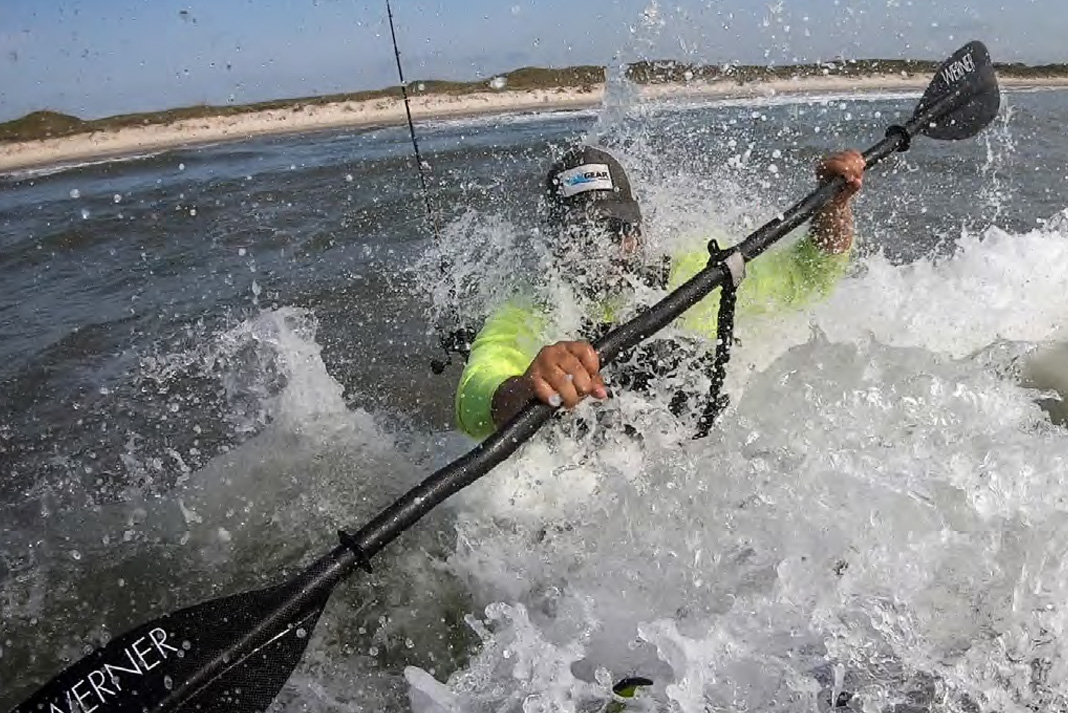
Breathing hard and churning the water, I manage to scoot through the outer bar into the first slough. The beach is 25 yards away, but I can’t celebrate, yet. I cross the shallow inner bar just as a three-foot wave is breaking behind me. The white water flips my kayak and knocks me into the water.
I resurface to see the kayak floating upside down in the deep slough. I swim over and flip the boat. Then, I grab the bow handle and sidestroke for shore. Coughing and struggling, I drag the boat far enough up the beach to be out of the lick of the surf. I strip off my dripping life vest and take stock of my loses.
Tearing apart the crate, my drybag, tackle box, lunch bag, gaff, grippers and three water bottles are still on board. I pull off the center hatch and my rods and electronics are unscathed. Sunglasses and cellphone safe. Wait. Hold on. Damnit, I lost my favorite pair of scissors.
The part of you responsible for primitive survival instincts such as aggression and fear | Featured photo: Chris Castro