The current landscape for fishing kayaks is dominated by pedals and motors, but a throwback paddle kayak may be the most important new boat of the year. While the technology, weight and price of fishing kayaks is on the rise, many anglers are asking for a simple, paddle-power kayak that won’t break the bank. Vibe delivered with the Hydra 130.
Vibe Hydra 130: Reviewing the New Performance Paddle Kayak
Vibe Hydra 130 Specs
Length: 13’3”
Width: 29”
Weight: 75 lbs
Capacity: 440 lbs
MSRP: $949 USD
vibekayaks.com
Fishy Features
Vibe’s Hydra 130 is its first new paddle-focused kayak in a decade. But just because the Hydra is all about paddling doesn’t mean it’s not a serious fishing machine.
Starting in the bow, the Hydra has two rubber flaps that serve as horizontal rod holders. When I lay rods down on the deck, the flaps secure the rod tips to keep the rods in place. Between the rod tip protectors is a bungee that holds the paddle blade when I lay the paddle on the deck. The rod and paddle stagers allow me to go from paddling to casting in an instant.
A large sealed bow hatch latches closed to stay watertight and secure. Inside the hatch, a removable pouch keeps my gear in easy reach.
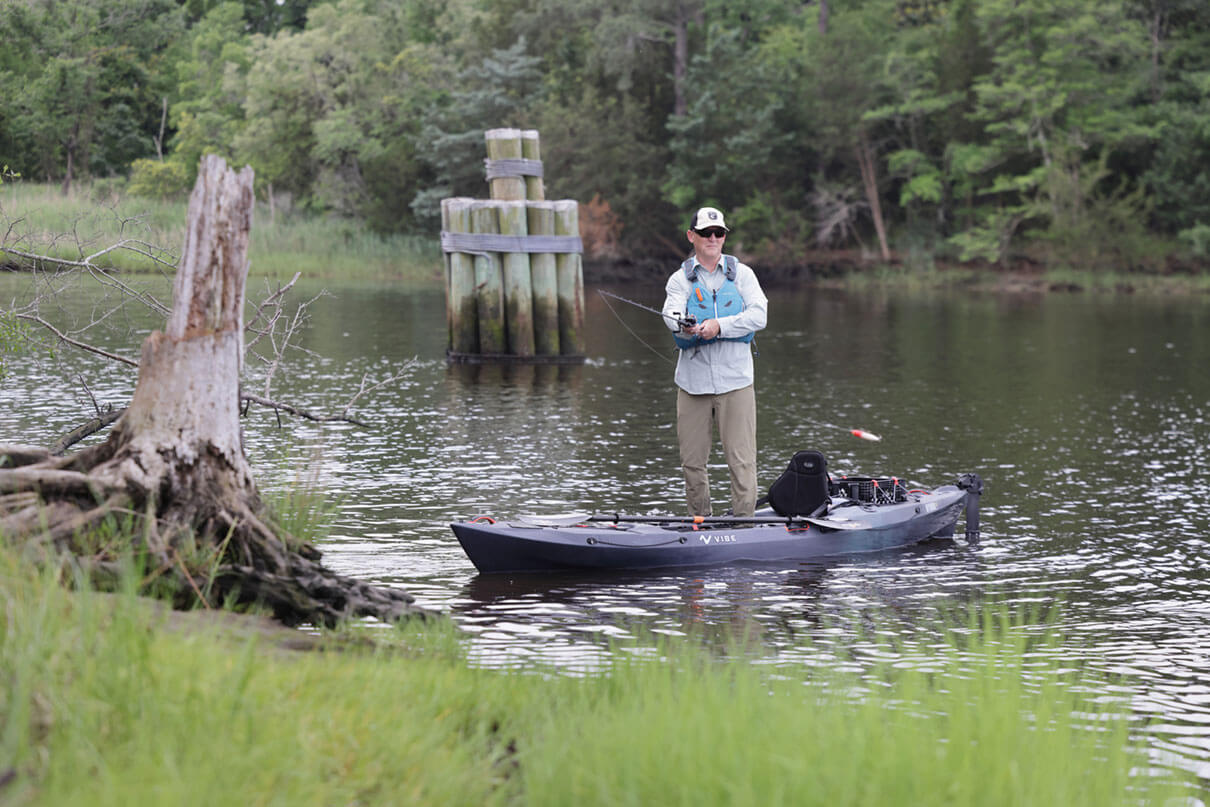
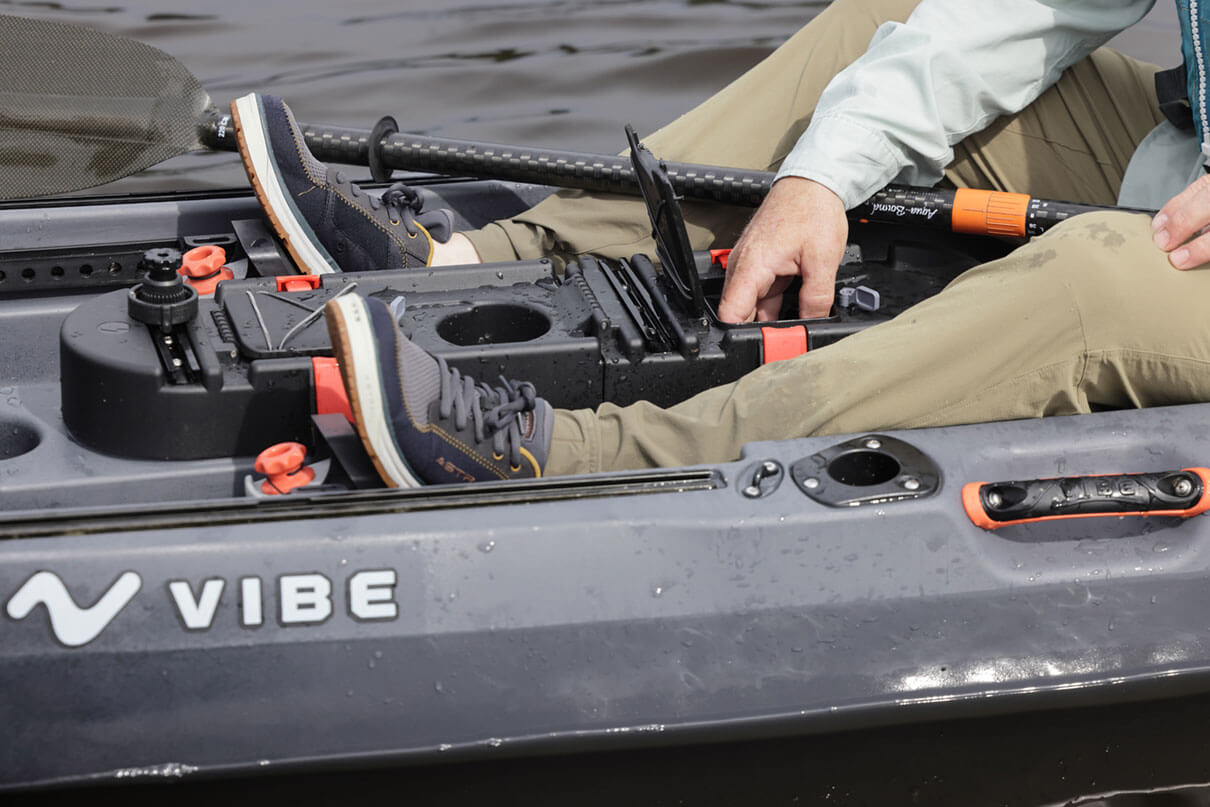
The footwells and deck are flat for plenty of standing space. The flat surface also channels water to the large scuppers. In the center of the cockpit, a molded hatch with removable lid is perfect for storing items I use most.
The Vibe 130 has four flush mount rod holders. Two holders behind the seat are positioned for trolling. Two rod holders in front of the seat are convenient for soaking baits or holding my rod for rigging and unhooking fish.
A large tankwell fits a full-size crate and a couple tackle trays. A round hatch in the tankwell provides access to work on the rudder cables. Gear tracks in the bow, cockpit, tankwell and stern allow me to add accessories and customize the boat.
Seat
A paddle kayak needs a low-profile seat that places the paddler close to the water using a shorter paddle shaft to produce more power. Also, a low seat is more aerodynamic to reduce wind resistance.
Best of all, I can easily upgrade the seat with a low-back seat or a seat with more padding. I can add padding under the seat or lumbar support in the back.
To the people who say a frame seat is more comfortable, I say they haven’t tried a dialed-in low-profile seat. The seat back catches my lower back and the sides of the seat cradle my lateral muscles for complete support.
Rigging
To complete the Hydra setup, rig the Hydra with a seven-inch fish finder screen and a side-scan sonar transducer. Use a ball-mount arm to attach the display to the pre-rigged inserts, run the cable through the scupper and install the battery in the cockpit hatch and run the battery wire under the hatch lid.
Add a full-size 16-by-16-inch crate to the tankwell. The tankwell is large enough to accommodate a tackle tray ahead of the gear crate with space for grippers beside the crate.
The most important accessory for a paddle kayak is the paddle. To get the most out of the Vibe Hydra, I use a low-profile carbon fiber paddle. Paddle length is an important consideration. The perfect length paddle keeps the paddle blade close to the boat for maximum power and control.
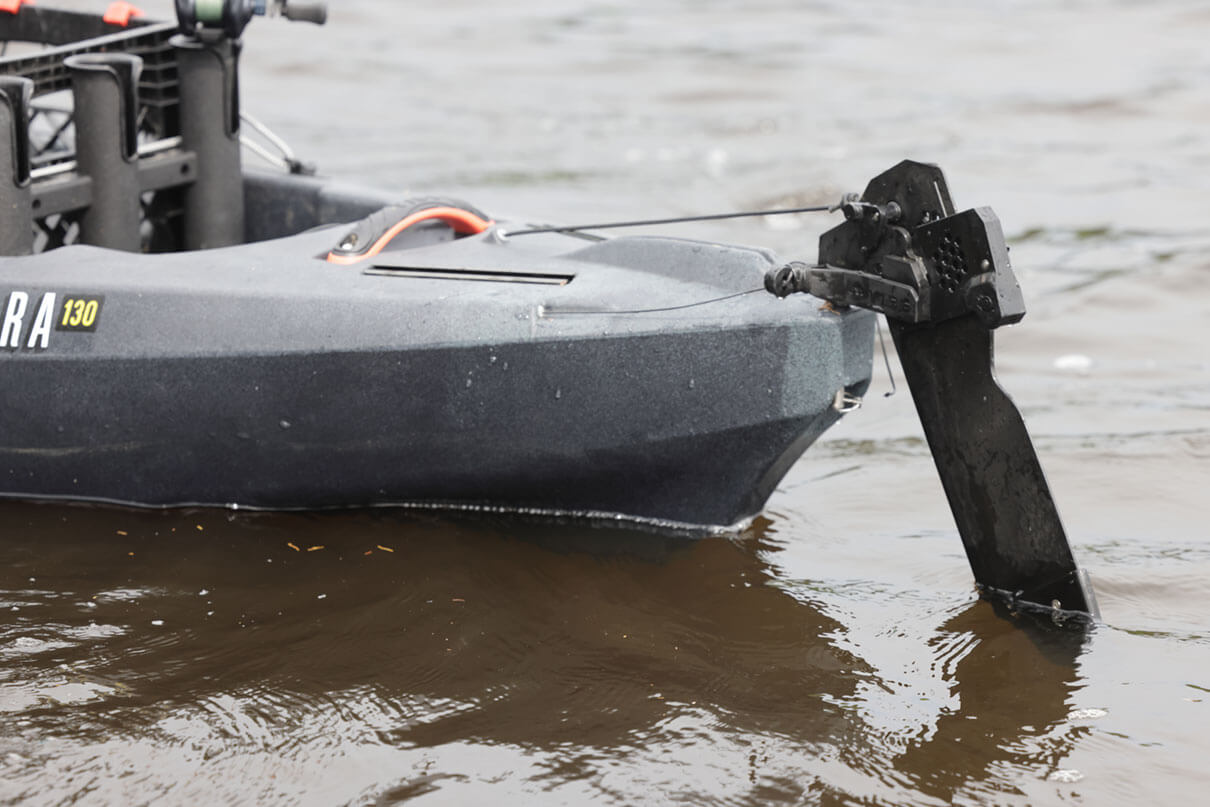
Vibe’s Gravity Rudder is quick to deploy and the blade effectively turns the kayak. The foot pegs are easy to adjust for the perfect fit. The rudder blade is predrilled to mount a Bixpy motor connected to a Bixpy battery pack in the tankwell. The compact impeller motor has the power to propel the kayak for the long trip to and from the fishing grounds.
While the rudder and motor are welcome options for steering and powering the Hydra, the boat is designed to track straight and turn on a dime without help. To keep it simple, I would eliminate the rudder and controls and switch the rudder-control foot pegs for simple foot pegs.
Performance
Vibe designed the Hydra 130 for speed, sea-handling and maneuverability. The narrow 29-inch beam and long 13-foot waterline slide through the water with minimal effort. The boat is built with a center keel for tracking and rounded chine to rock and roll through waves. The low sides pass beneath the wind and the flared bow pushes water out of the way.
Most importantly, the rockered keel lifts the bow out of the water to improve steering. The hull design makes paddling easy and I can play in the surf with confidence. The Hydra 130 is one of the best performing paddle kayaks available.
Who is the Vibe Hydra 130 owner?
I am the perfect example of the Vibe Hydra 130 owner. I enjoy paddling. I often leave my tackle at home and paddle my kayak for fun. I like the quiet, smooth, efficient beauty of paddling a kayak.
There are fishing advantages to a paddle kayak, too. While my speed and range are slower and lower than a pedal kayak, I can cross shallow water without lifting my drive. Grass, rocks, oyster beds and sandbars are no obstacle.
While the paddle kayak isn’t as stable as a pedal kayak, the paddle is more maneuverable than turning the kayak with reverse and forward gears and a rudder. I can stand in the Hydra and turn the boat on a dime with the paddle.
Mostly, I enjoy the simplicity of the paddle kayak. I go fishing every chance I get. I fish out of a kayak for the quick and easy transport, low maintenance, convenient access and independence. I can’t be sidelined by a busted pedal drive, dead battery or broken rudder.
The Hydra 130 is an unapologetic paddle kayak designed for paddling performance and big-game fishing. The hull design gives me the confidence to take the boat the distance in unpredictable seas. The fishing features allow me to target anything from river-run smallmouth bass to deep-sea bluefin tuna. Vibe’s Hydra 130 is a hardcore paddle kayak for hardcore kayak anglers.
Our first look at the Vibe Hydra 130:
A proper fishing kayak. | Feature photo: Patrick Hayes