
Can I put two motors on a kayak? Can I install forward-facing and side-view sonar? Will it work? Will it turn into a royal pain in the ass? To answer these questions, I focused this issue of Kayak Angler on building the ultimate motorized kayak. After I received a Bonafide PWR129 for review, I collected motors, batteries and electronics to build my dream kayak. Then, I went to work measuring, cutting, drilling, routing and crimping the pieces together. Two months later, I looked at my creation and wondered if the results were worth the effort.
Bonafide PWR129 Tested and Reviewed
The Plan
Mark Twain said, “All you need in this life is ignorance and confidence and then success is sure.” By that definition, the Bonafide PWR129 build was a huge success. I set out with a vision of a motorized kayak rigged with a trolling motor in the bow, an electric outboard in the stern and forward-facing sonar. But I had no idea how to achieve the dream.
Armed with above-average kayak rigging skills, average mechanical skills and a garage full of tools, I consulted experts and pored over YouTube videos. In the end, I built the ultimate motorized fishing kayak.
Bonafide PWR129 Specs
Length: 12’9”
Width: 35”
Weight: 102 lbs
Capacity: 500 lbs
MSRP: $1,999
bonafidefishing.com
Boat
The foundation of the plan is a Bonafide PWR129, a sit-on-top kayak designed for two motors and full electronics. The 12-foot, nine-inch kayak is 35 inches wide with a 500-pound capacity, perfect for motors and still capable of paddling.
To qualify as a motor-ready kayak, the PWR129 has space for a bow-mount trolling motor and a stern-mounted electric outboard. The PWR129 has five Powerlink access panels in the bow, near the seat and in the stern to run wires from motors and accessories to my batteries.
The PWR129 is equally ready to accept multiple fish finders with a removable pod capable of hosting the display, transducer and wires.
Not only is the topside ready for motor power, but the hull of the PWR129 has been specifically designed to balance the weight and handle the speed of an electric motor. The PWR129 uses a modified catamaran hull that balances resting stability with efficiency at high speeds.
The drop-down rudder is easy to store and sufficient for directing the boat when I’m paddling. To motorize the kayak, I simply disconnected the control cables from the rudder mechanism and attached them to my electric outboard. In the cockpit, the foot pedals use a ratcheted adjustment system to loosen or tighten the control cables and dial in the perfect fit.
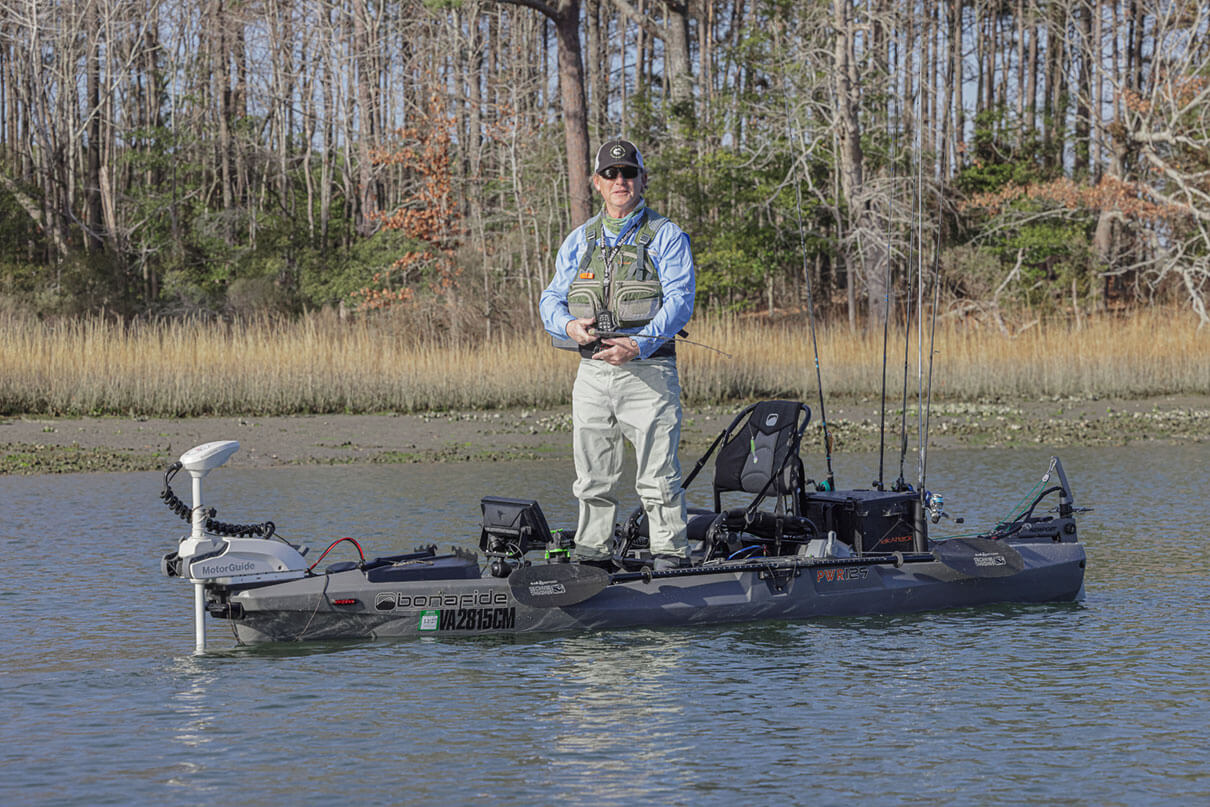
Even the seat is optimized for motorization. Bonafide is famous for its super comfortable frame seat, and I appreciate the support and versatility during a long day on the water. Moving the seat from the high to low position is simple, just fold down the front seat legs to lower the seat bottom two inches. Best of all, space beneath the seat is perfect for storing the battery for my electronics.
Motors

To build the ultimate motorized fishing kayak, I needed an electric outboard and a trolling motor. Just like a bass boat or an inshore skiff, I use the outboard to travel to the fishing grounds and then switch to the trolling motor to maneuver the boat while I’m fishing.
For the electric outboard, I installed a Newport NK300 in the stern. The installation was simple, using the Newport bracket and online installation videos. The Newport system comes with a smart throttle that displays important battery and motor data.
A length of paracord runs from the motor to the right side of my seat to tilt the motor out of the water. To engage the reverse lockout bracket, a length of paracord stretches from the motor to the left side of the seat. I used YakAttack Tie-Down Eyelets installed on the gear track on either side of the stern well to guide the lines and Vertical Tie-Downs in gear tracks on either side of the cockpit to cleat the paracord.
For a trolling motor, I installed a MotorGuide Xi3 with a 36-inch shaft and 55 pounds of thrust. I use the handheld remote to control direction, speed and functions like autopilot and anchor lock.
Installing the trolling motor on the bow required me to purchase a mounting plate from Bonafide. The thick plastic plate uses existing bolts and inserts, so installation only requires a few minutes.
I ran the power cable through a YakAttack GridLoc through-hull plug I installed in the bow hatch to a 60-amp fuse bolted to the underside of the hatch lid. From there the cables run to a 12-volt lithium battery stored in the PWR’s large bow hatch.
Electronics
To complete the package, I added a 10-inch Humminbird Helix G4N with Mega Side Imaging and Mega Live Imaging transducers.
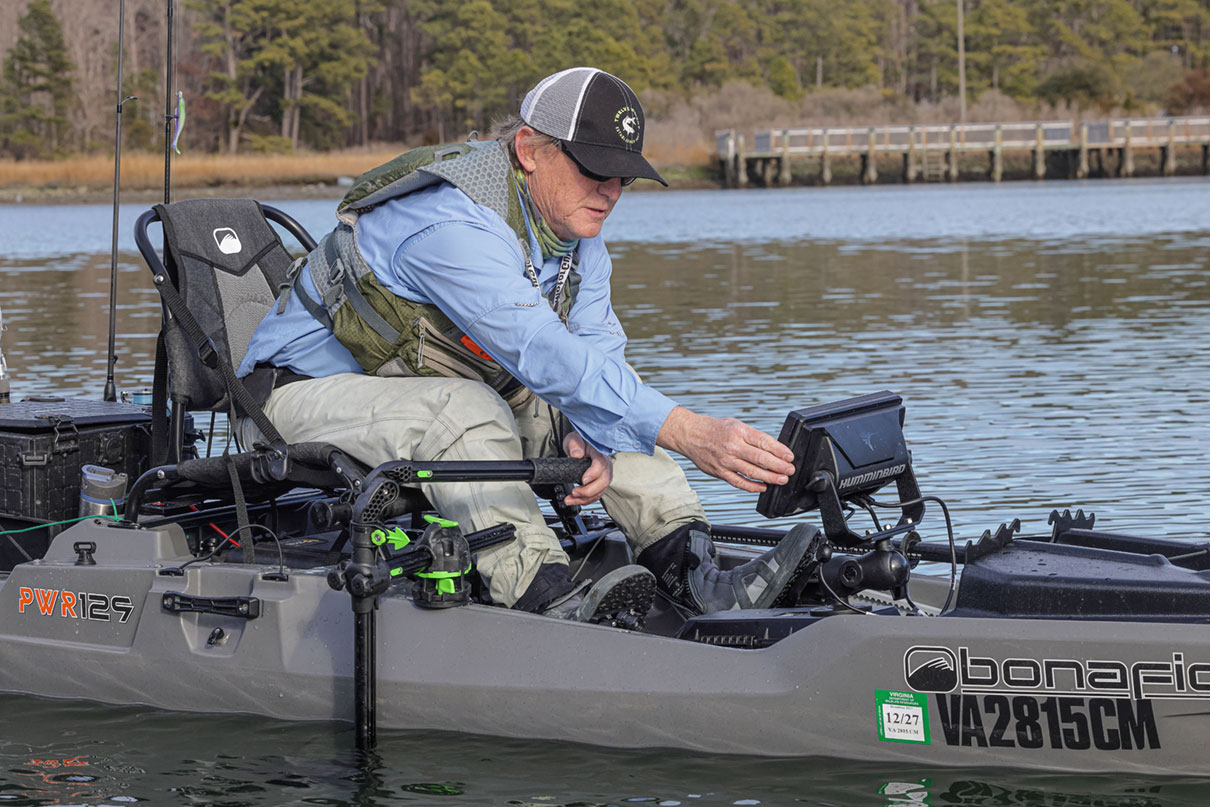
I mounted the multi-function display on the PWR’s removable transducer pod with a drill-down Ram Mount with 2.25-inch ball. The Helix transducer is bolted to the underside of the removable electronics pod with a YakHobby transducer mount. To lower the side view transducer below the hull, I attached the transducer to the factory transducer bracket and then modified the YakHobby mount to accept the Humminbird bracket.
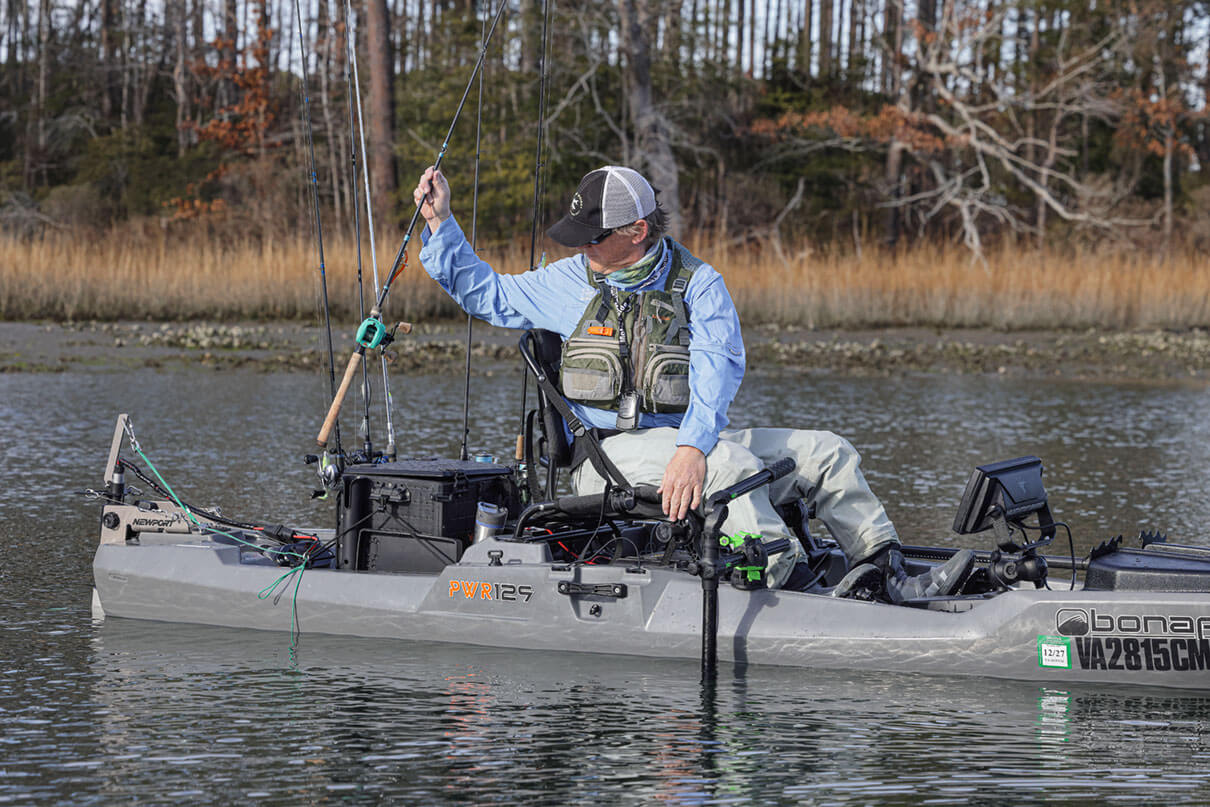
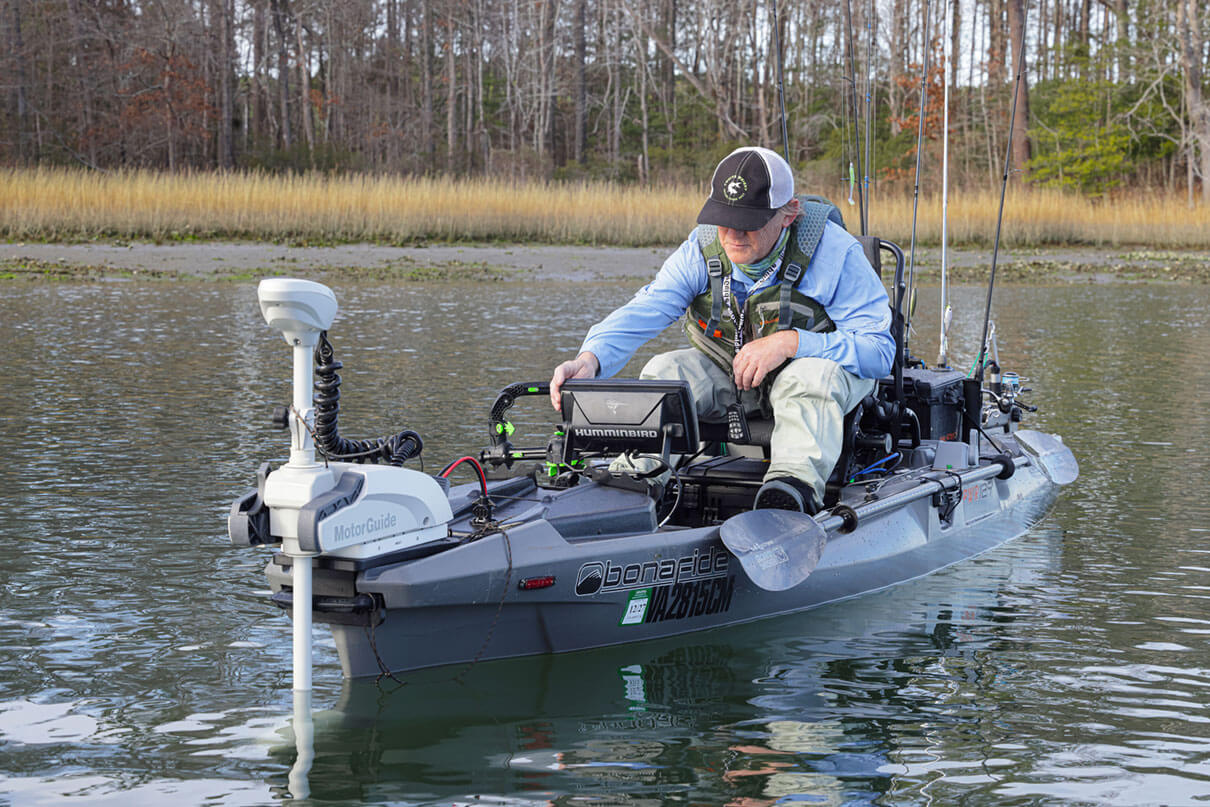
I used a YakAttack GridLoc port to route the transducer cable into the transducer pod. I coiled the excess cable inside the pod and then passed the plug end out through the same GridLoc port. Between fishing trips, I could remove the display, pod and transducer in seconds.
To install the Mega Live transducer, I used a Railblaza Live Pole attached to the starboard cockpit gear track. I replaced the quick-release knobs with bolts to secure the mount to the kayak.
Batteries
The heart of the system is the batteries. Advances in lithium ion batteries mean they are lighter, tougher and last longer than lead acid batteries, making it possible to power the electronics and motors.
To power the trolling motor, I use a 12-volt, 100-amp-hour lithium ion (Li-ion) battery stored in the large bow hatch. For the Newport NK300, I installed a 36-volt, 30-amp-hour Li-ion in the space behind the seat.
Powering my lights, fish finder display and forward-facing sonar transducer, I use a Power Pak Pro by Yak-Ease battery system. This package includes a Dakota Lithium 12-volt, 54-amp-hour battery inside a Pelican case with toggle switches to control power to my accessories. I store the Connect-Ease system under the seat.
On The Water
After wrestling with the build for two months, I was satisfied that the motors and electronics were functional. Dialing in the kayak required three sea trials without fishing rods.
Once the kayak, motors and electronics were working, it was time to go fishing. On my first trip, I braved freezing conditions to target mid-winter speckled trout and redfish on the Elizabeth River.
Once on the water, the system comes together. I lower the Newport NK300 into the water, throttle forward and steer with the foot pedals. Using the foot pedals, I steer wide turns and easily make micro-adjustments to stay on course.
The NK300 is surprisingly powerful. At full throttle, the motor pushes the kayak at over seven miles per hour. To save battery power, I drop the throttle to 50 percent and travel at a comfortable five miles per hour.
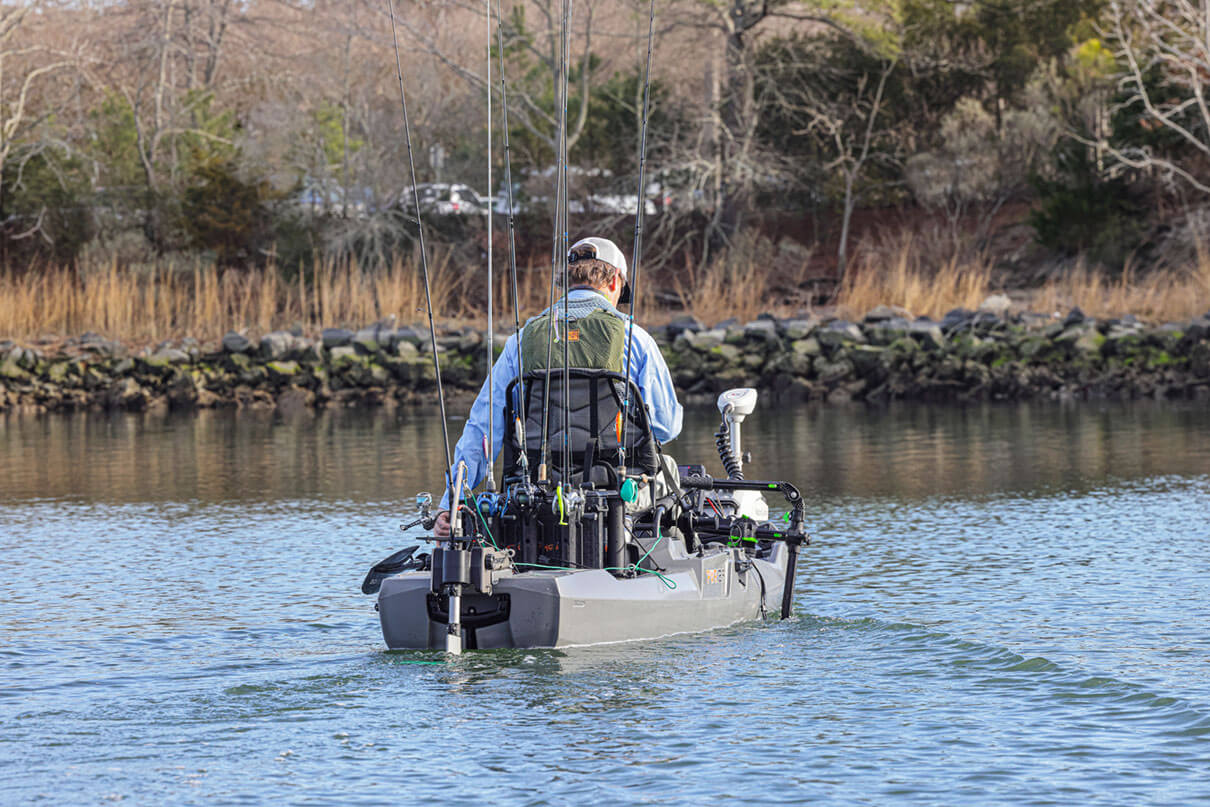
I haven’t tested the extent of the NK300’s range, but using the Newport smartphone app, I monitor draw, remaining power, temperature and other data. After about an hour of run time, I’ve used about 40 percent of the charge. Dropping the throttle to 40 percent only sacrifices a few tenths off the speed but increases the range, so I can go farther if I go a little slower.
Once I arrive at the fishing area, I power off the Newport and drop the MotorGuide Xi3 trolling motor. I’ve seen YouTube videos of anglers attaching a cord to the foot pedal and another cord to the motor head so they can lower and raise the motor from the seat. Trying to cut down on clutter and rigging, I crawl on my hands and knees to the bow and drop the motor without much trouble.
The Xi3 is incredible. It’s reliable, powerful and easy to operate. Pushing buttons on the remote control allows me to control direction and speed. Most importantly, the Xi3 has a satellite connection for autopilot and anchor lock. I point the Xi3 at my destination, hit autopilot and the boat keeps me on course. Then, when I want to fish, I hit anchor lock and the trolling motor holds the kayak in position.
Running the trolling motor from the Amped Outdoors 12-volt, 100-amp-hour battery provides ample power. After a couple hours fishing, the battery only loses about 10 percent of its charge. Maneuvering the boat with the trolling motor is key to using the Humminbird Helix 7 Chirp Mega GPS G4N and Mega Live sonar.
Many anglers install two displays to monitor charts, side-view and forward-facing sonar at the same time. I chose to install a single display to cut down on clutter in the cockpit and reduce the time required to rig the boat. Mounting the display, side-view transducer and storing the transducer cable in the removable sonar pod makes it easy to transport the fish finder.
Of course the system’s success rides on the PWR’s hull performance. Bonafide is known for high quality kayaks that deliver promises. Build quality, materials and components are the highest quality. The boat is overbuilt to handle the weight and forces of motor power. A modified catamaran hull keeps the PWR129 stable and improves tracking. The hull shape also balances stability at rest with a solid ride at speed. Even with a motor on the bow and stern and three batteries, the kayak sits level in the water. I think moving the bow battery back to the seat will further improve the ride in a head sea. Best of all, I can paddle the PWR129 even when the boat is loaded to the gills.
On the topside of the PWR129, there is a lot going on. Two motors, controls, batteries, a 10-inch fish finder display and 16-by-16-inch gear crate and more. The cockpit design provides space for everything and leaves plenty of room to fish. The wide flat padded deck is only interrupted by the Dry Pod. Even with the battery tucked behind the seat, the YakAttack crate is in easy reach. The PWR129’s bungees include clips to hold the crate in place. Ample gear tracks provide options for installing rod holders and other accessories, but I kept the rigging simple to reduce clutter and confusion.
So, is my PWR129 build more trouble than it is worth? Building the boat wasn’t easy, or cheap. The grand total for kayak, motors, electronics and parts is over $10,000. Loading and unloading the boat and dragging it around with the trailer is cumbersome and time-consuming. Managing all the connections and controls is like fishing out of the Space Shuttle. Maybe I should have bought a used skiff and saved the trouble.
Not so fast. The PWR129 adds a valuable tool to my fishing arsenal. Fitting between my 20-foot center console motorboat and my paddle kayak, the PWR129 provides a convenient and quick way to go fishing, like my paddle kayak. It also offers range and speed beyond my paddle kayak without the expense and maintenance of the motorboat. I can roll the kayak on my trailer and it fits in a corner of my yard.
So, the PWR129 makes practical sense, but mostly the little boat is a lot of fun. Everything works and, the more I use it, the more comfortable I am operating the boat. I can jump in this kayak after work and spend a couple hours fishing. With the forward-facing sonar and GPS-connected trolling motor, the PWR129 is a more effective fishing platform than my big boat or my paddle kayak. I use the PWR129 more often than I use any of my other boats. Offering the fishability of the bass boat with the ownability of a kayak, the Bonafide PWR129 is a perfect fit in my fishing arsenal.


It wasn’t easy, or cheap, but this boat is fun. | Feature photo: Patrick Hayes