Pedaling miles across open water. Carrying a full arsenal of tackle and gear. Spending hours on the water. Standing and fishing with confidence. If I didn’t tell you the price of my fishing kayak, you’d never believe I was fishing in a bargain boat. The design and features of 3 Waters Kayaks’ Big Fish 120 PDL are on par with a premium pedal kayak, but the price is about $1,000 less.
3 Waters Kayaks Big Fish 120 PDL Specs
Length: 12’
Width: 35.4”
Weight: 110 lbs
Capacity: 400 lbs
MSRP: $1,599
feelfreeus.com
Fishing Kayak Review: 3 Waters Big Fish 120 PDL
Fishy Features
The Big Fish 120 PDL is 3 Waters’ new flagship performance fishing kayak. 3 Waters’ engineers added pedals and rudder to the Big Fish 120 V2 paddle kayak to produce a boat that performs under either power option. The 12-foot waterline and 35-inch beam lead to a narrow bow and stern for a hull that moves easily through the water.
I use my pedal drive to travel to the fishing grounds. Then, I switch over to paddle power to maneuver the boat for fishing. I also use the paddle to propel the kayak while I stand and fish. So, I need a kayak I can operate with pedals or a paddle.
3 Waters’ famous cathedral hull adds stability to the equation without sacrificing straight line tracking. The hull features two outer pontoons transitioning into a flared bow. The design allows the boat to cut through waves while the pontoons work to keep it paddling straight without increasing drag.
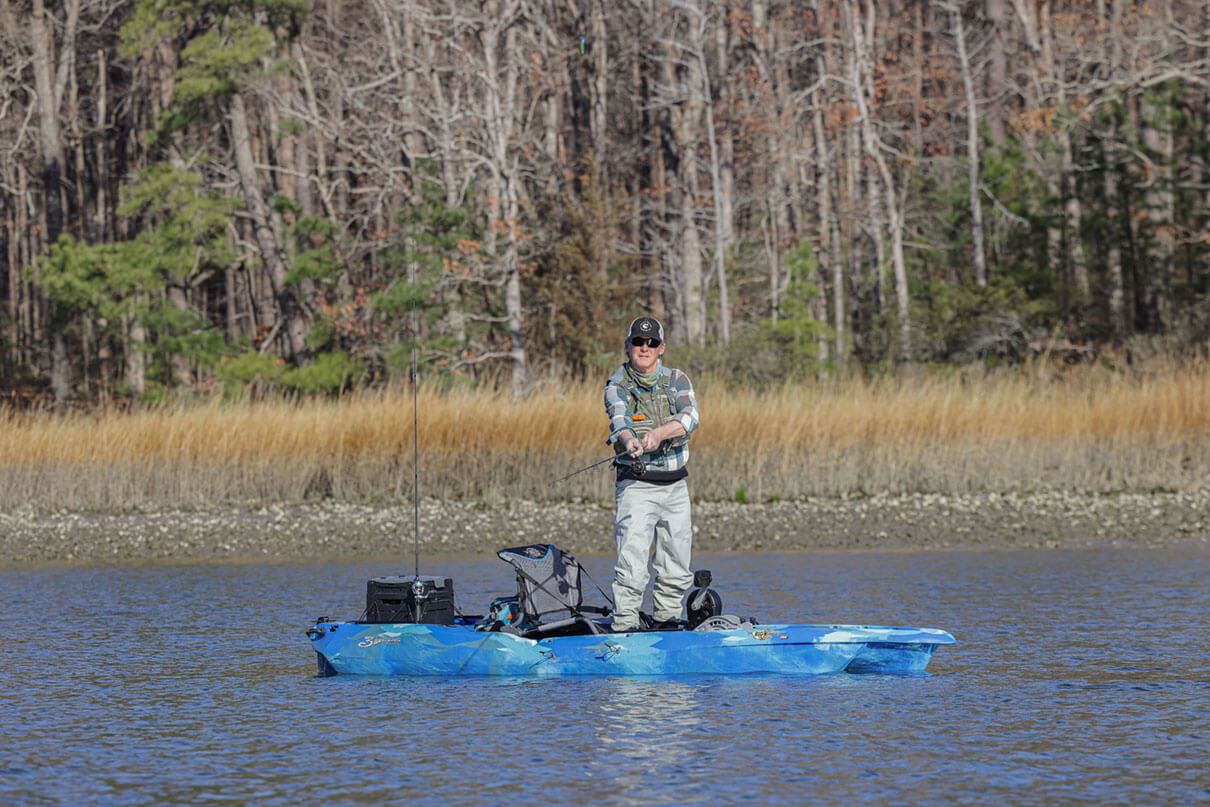
The Big Fish makes good use of the space above the waterline. The boat’s cockpit is wide and open with a reinforced and padded deck for stand up fishing. A large open space in the bow presents useable storage for my landing net or gear bags.The tankwell behind the seat fits a 13-inch-by-13-inch crate secured with the standard bungees.
To accommodate anglers of all size, the EZ Rider seat is extra wide with an ample backrest. The quick dry mesh keeps the seat light while still providing support for long days on the water. The seat sits in a metal bracket and molded inserts. The set-up keeps the seat secure while making it easy to adjust the position forward and back.
Pedal System
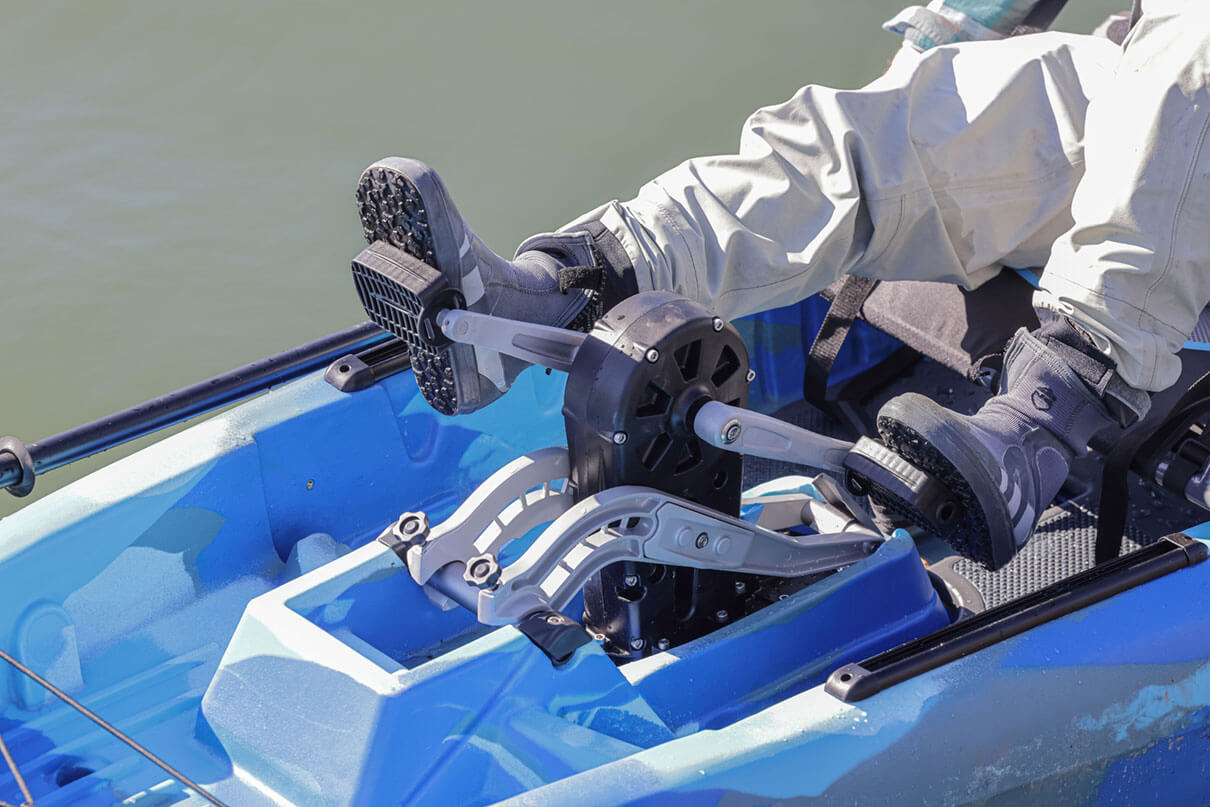
The star of the show is the Pro Fish Pedal Drive System. 3 Waters uses the same pedal system on the Big Fish 103 and 105 and the same drive and prop as Feelfree’s Rapid Pedal Drive in their Moken PDL and Lure PDL kayaks, so the drive is well tested and reliable.
The drive drops into the Big Fish pedal well and attaches to the forward brace with two knobs and in the rear with a metal latch. For shallow water clearance, releasing the latch allows the lower unit to pop up.
The new EZ Steer System is low profile so it stays out of the way while I’m fishing. The control knob includes cables to turn the rudder and a third cable to retract the rudder. Not only is the EZ Steer a big improvement on the previous knob controller on other 3 Waters boats, but the rudder lift mechanism makes the EZ Steer one of the best controllers I’ve tested.
Combining the EZ Steer with 3 Waters’ Beaver Tail rudder makes boat control easy. The huge rudder is ample for turning a big heavy kayak at speed. Most important, the simple system is easy to install with quality components including high tensile strength lines and stainless steel hardware.
When it comes to pedal kayaks, the quality and performance of the steering system is just as important as the speed and durability of the drive. If one part of the system goes down, I’m dead in the water.
Rigging
The true test of a full-feature pedal kayak is rigging the boat for any type of fishing. Bass fishermen, inshore anglers, flats fishermen and offshore anglers should be able to add accessories for their specific needs.
The Big Fish has the prerequisite gear tracks along the cockpit for rod holders, cup holders and fish finder base. Gear tracks along the tank well provide a secure connection for tie downs to add a gear crate, more rod holders, a navigation light or camera boom.
Unfortunately, the Big Fish doesn’t have accommodations for a fish finder transducer. With some creativity, I could attach the transducer to the transom and run the wire to the cockpit. I’d like to see more gear track options for mounting the fish finder display, but there is plenty of space in the bow well to mount an adjustable base.
Pre-installed inserts in the stern are spaced for standard motor mounts or Power-Pole remote anchor system. To tie the Big Fish’s EZ Steer controller to the motor, I could re-route the control cables to the guides on the topside of the stern deck.
I love the large molded handles in the bow and stern. The large bow handle is easy to grab with two hands. In the stern, the Big Fish has a handle on either side of the rudder to lift the heavy boat. I did miss the mid-ship handles as I wrestled the boat around my yard, but the seat and seat bracket offer a sturdy grab handle on the side of the boat.
Performance
The proof is in the pudding, as they say, and the Big Fish needed to prove itself on the water. I received the Big Fish in January, during the coldest weather of the year, limiting my fishing options. But winter is a great opportunity to explore new water, and take a fishing rod for a few casts.
At over 100 pounds hull weight, the Big Fish requires a trailer or a pick-up truck to transport to the boat ramp and a full-size cart to move the boat into the water.
3 Waters engineers spent years refining the cathedral hull design to perform in the worst sea conditions. The sturdy Pro Fish Pedal Drive returns a solid feel as I push the pedals to top speed and the large rudder and low-profile steering mechanism work in unison for intuitive boat control.
The Big Fish really shines when it’s time for fishing. I can stand and move around the cockpit with confidence and turn in the seat to reach my gear crate or sit sideways to dangle my feet in the water. I like the flush mount rod holders behind the seat to secure my fishing rod while I’m unhooking a fish or changing my lure. The features and design come together to make the Big Fish 120 PDL a capable fishing machine.

Who is the Big Fish Angler?
While the Big Fish doesn’t have the rigging capacity for full electronics and motors to make it “tournament ready”, the boat is ready for serious fishing. An angler looking to confidently and comfortably travel to distant fishing spots will appreciate the speed and seaworthiness. When it comes time for fishing, the hull’s stability and the open cockpit make casting and retrieving second nature. For an angler with space for a full size kayak, including a trailer or pick-up truck to transport the boat, who doesn’t have room in their budget for a high-dollar premium pedal kayak, the Big Fish 120 PDL is a perfect fit.

Doesn’t look like a bargain boat. | Feature photo: Patrick Hayes